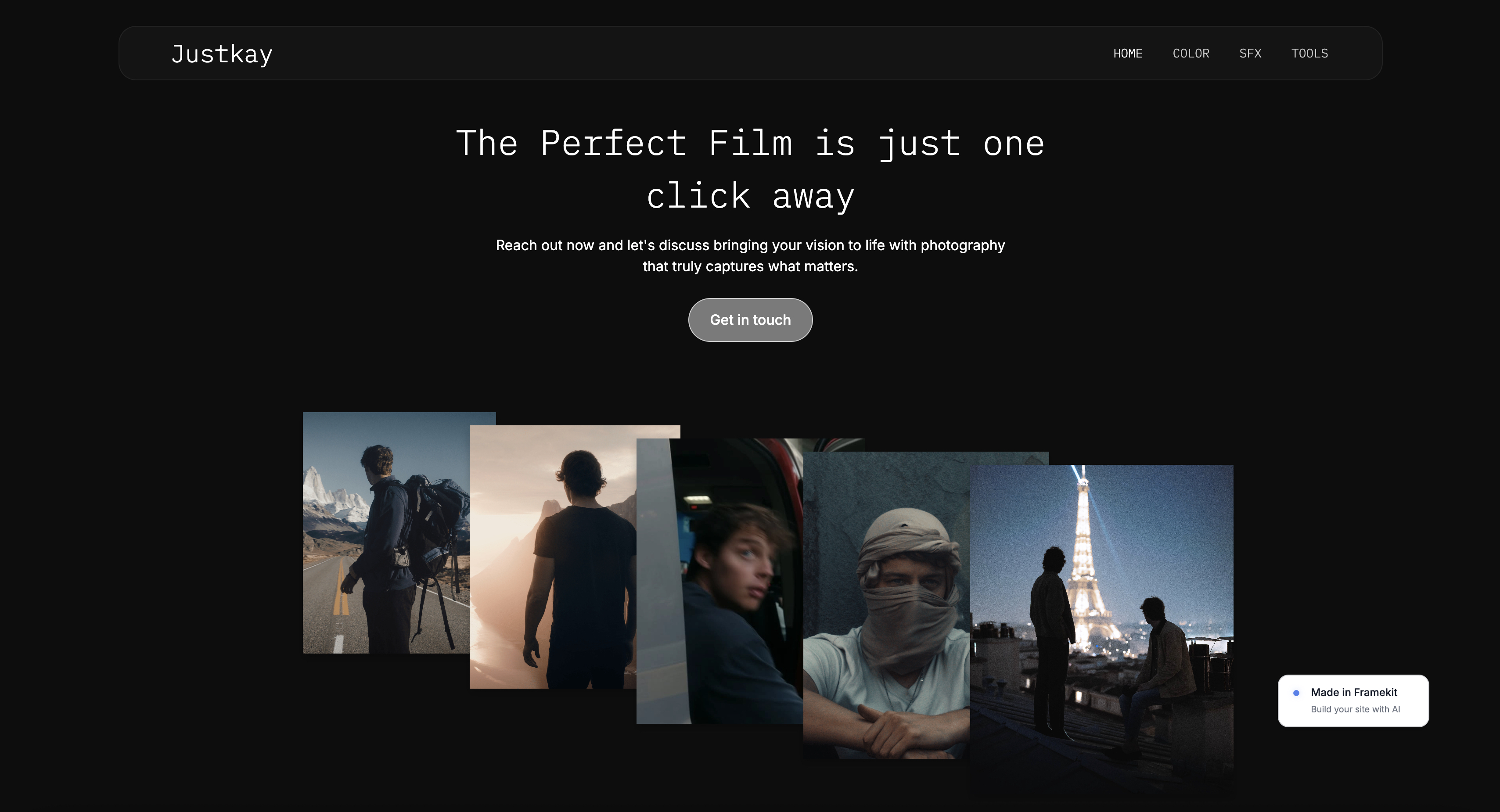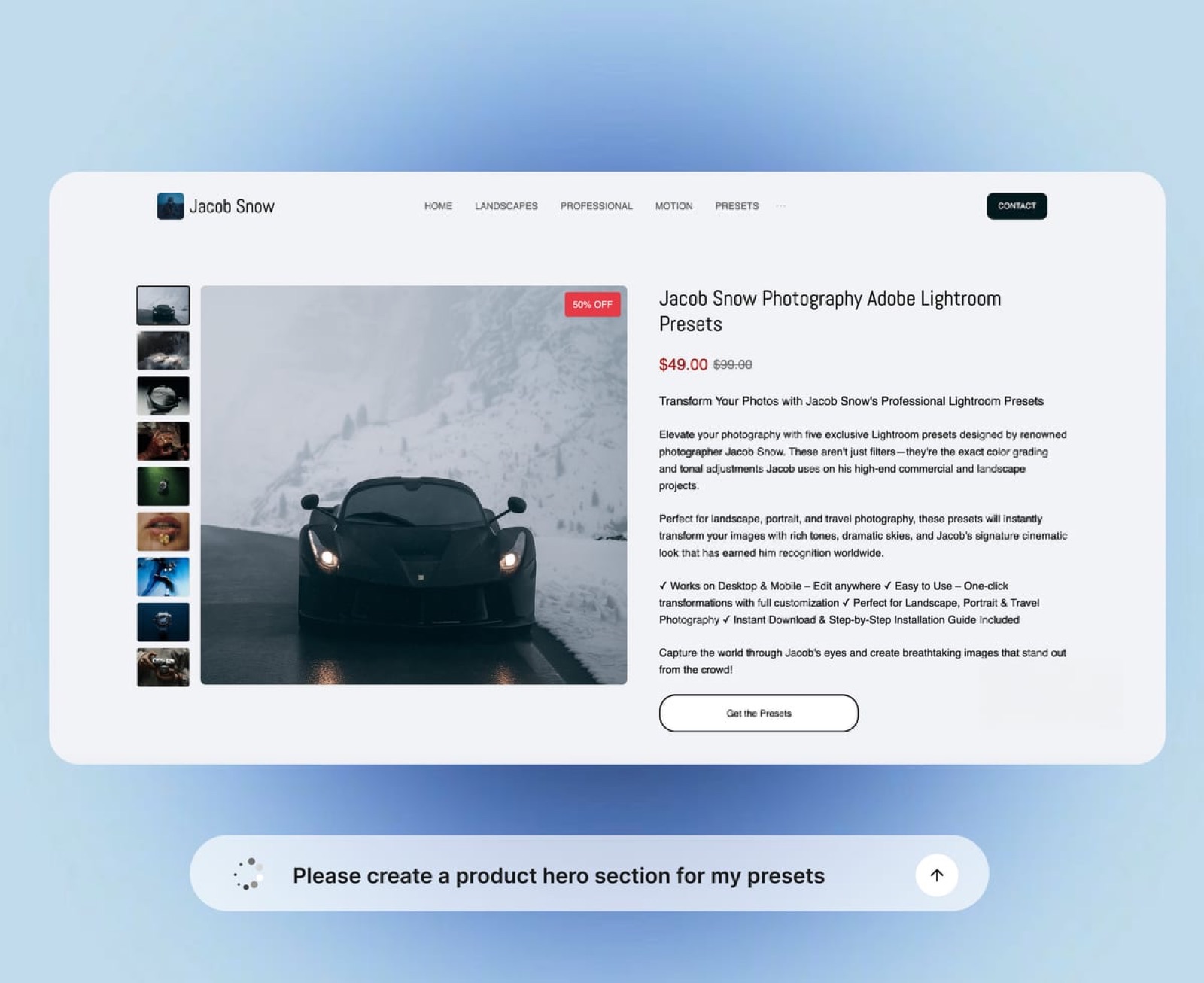
Framekit templates
Start from a designer-made template
 Use template
 Use template
 Use template
 Use template
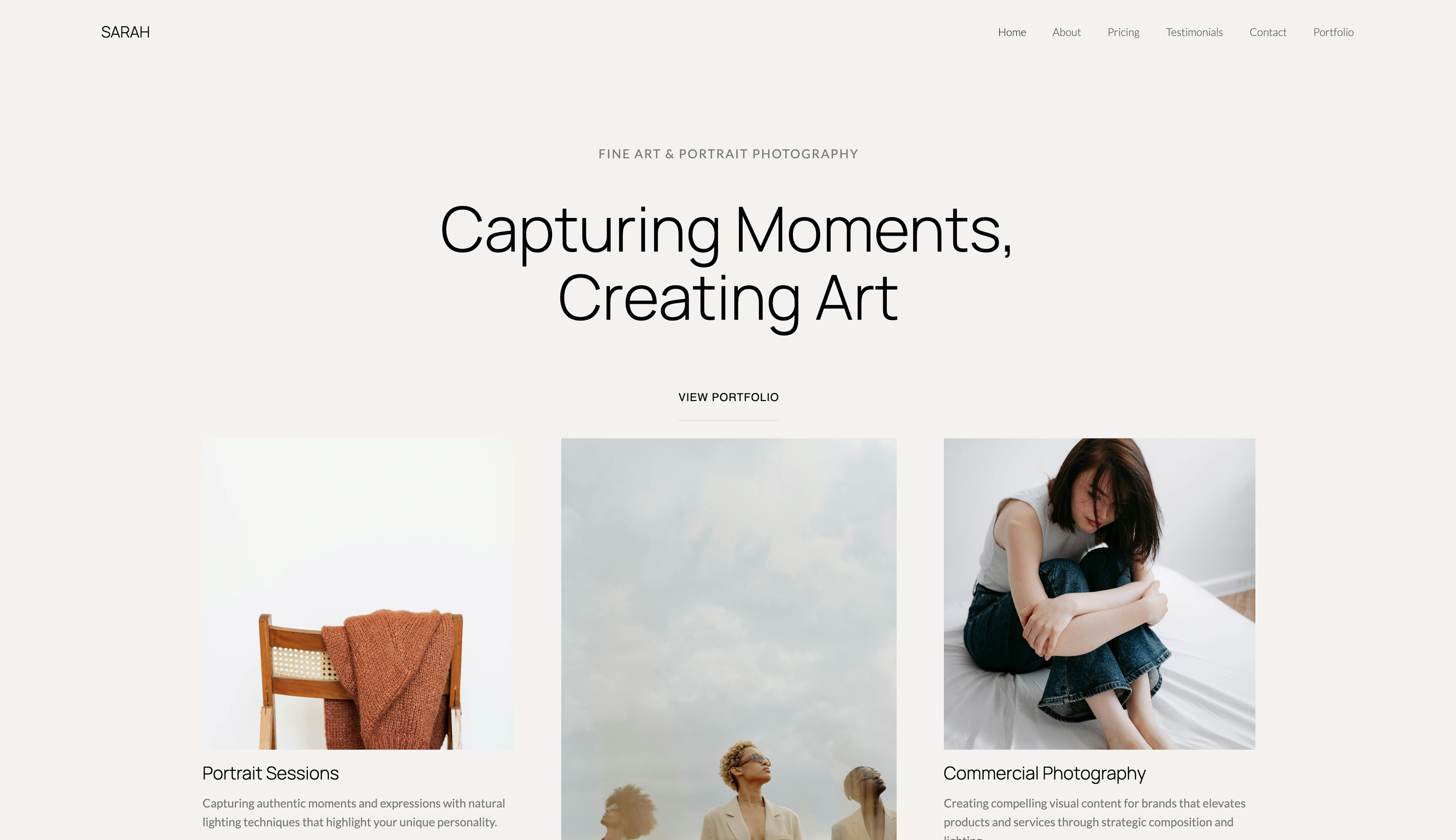 Use template
 Use template
 Use template
 Use template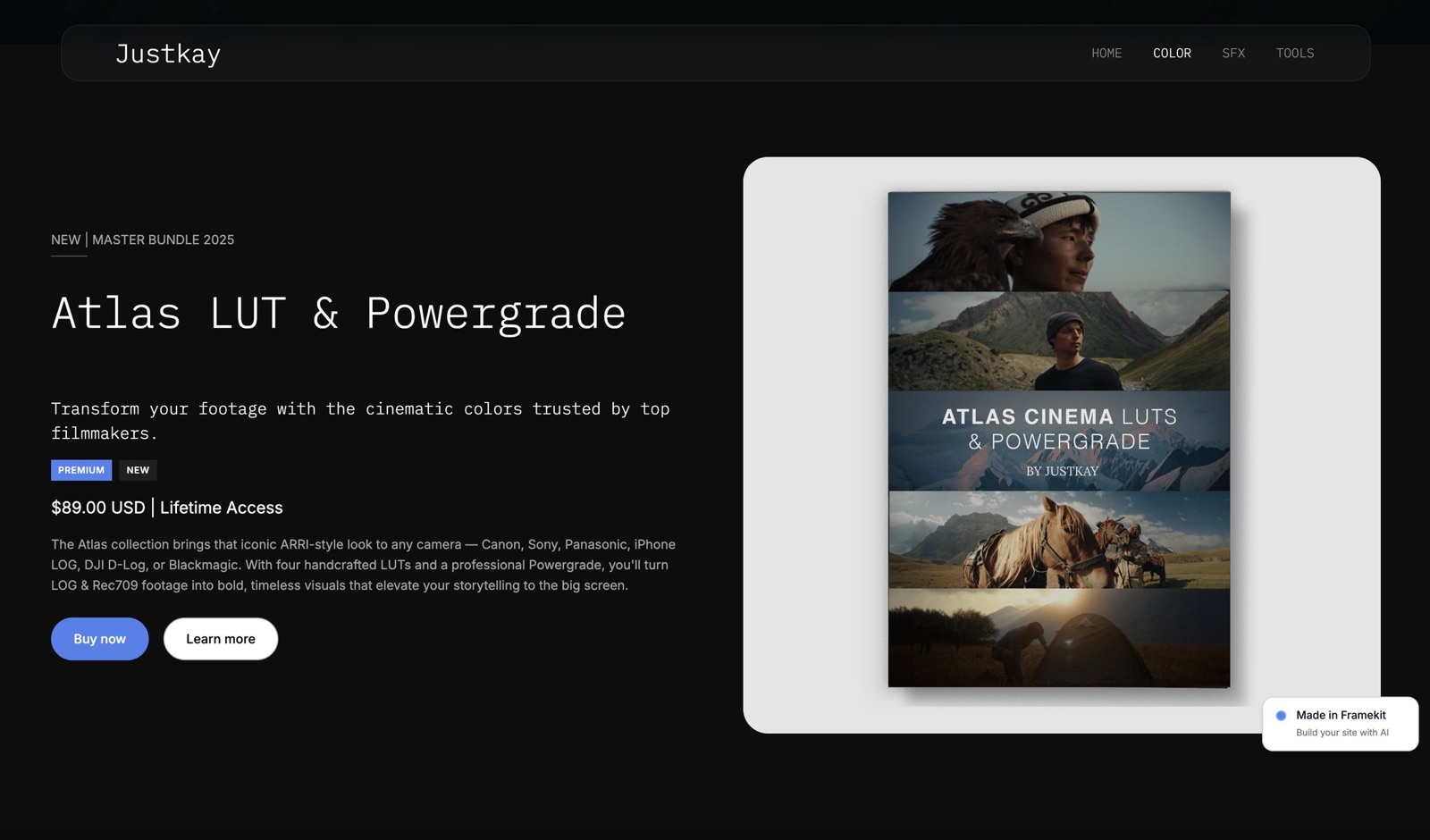
You already know how to write a sales page for a digital product in the abstract: headline, benefits, price, button.
Then you open your own page and find a paragraph about your colour philosophy, a bulleted list of twelve LUT names, and not one frame of footage with the grade applied.
The product is a look. The page shows a list. A buyer who cannot see the look has no way to decide, so they do the thing people do when they cannot decide, which is leave and not come back. Nothing on that page is wrong. It just never showed the thing being sold.
A sales page for a digital product is a single page whose only job is to move a visitor from "what is this" to "I can see what I get" to "bought", using proof of the output rather than description of the contents.
Lead with the output, not the feature list: for a LUT pack, a preset set, a template or a sound library, the first screen should be the result applied to real work, with the price and the button visible without scrolling.
Then answer four objections in the order buyers raise them - will it work with my footage, is it worth this much, what exactly do I receive, what if it does not work - and stop.
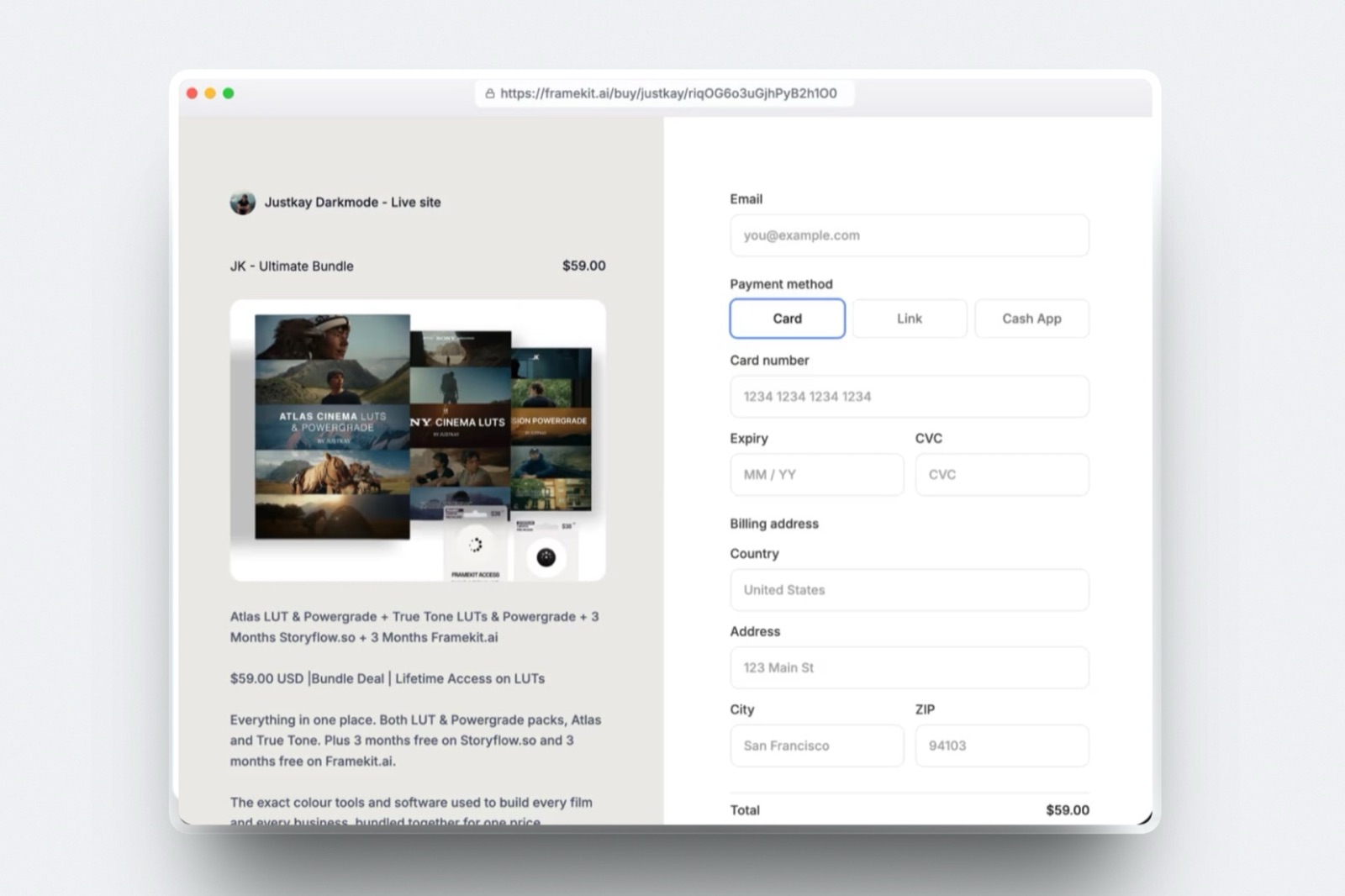
Framekit is a good home for this page because the store and the site are one thing, so the buy button sits on the page a visitor already trusts.
Gumroad is faster to launch and charges 10% plus 50 cents on direct sales, and Lemon Squeezy at 5% plus 50 cents is the pick if you want somebody else to be merchant of record.
Full disclosure: Framekit is our product, so treat the Framekit sections here as a vendor describing its own tool. Every third-party figure below was read on the vendor's own pricing page or documentation in September 2026 and is linked where it is used. Framekit's store has no affiliate program, no upsells or order bumps, no funnels and no email sending, so a seller who wants a page wrapped in all of that should build it somewhere that does those things.
How this guide was put together
This is a procedure, not a product review, and the evidence behind it splits three ways so you can tell which parts are documented facts, which are arithmetic you can redo, and which are editorial calls you are free to disagree with.
Read at the source. Every platform fee, legal rule and search requirement quoted below was read on the owner's own page in September 2026 and linked where it is used: Gumroad's pricing page, Lemon Squeezy's pricing page, Stripe's refund documentation, Google's merchant listing structured data reference and the European Commission's Your Europe page on returns and the right of withdrawal.
Calculated. The carried example is a twelve-LUT colour pack for Sony S-Log3 called Atlas, sold at $49. Every net figure in this guide is that $49 minus a stated fee, so you can swap in your own price and rerun the same sum.
Editorial, and flagged as such. The block order, the objection order and the wording of the refund line are opinions formed from how these pages fail, not measurements.
There is no conversion benchmark in this guide, because no primary source publishes a trustworthy one for creator digital products and the sites that quote figures like that will not open for inspection.
Instead of a borrowed number you get arithmetic on your own traffic, which is the only version that is true for you.
Sales page facts worth knowing before you write one
These five figures decide what the page has to do, what it may promise, and what it costs you to be wrong, and each comes from the source named beside it, not from received wisdom.
- 79 percent scan, 16 percent read word by word: Jakob Nielsen's reading study from September 1997, still the clearest statement of the problem. It is an old study and the web has changed, but nothing since has argued that buyers read more.
- 58 percent, 47 percent and 27 percent: the usability gains the same study measured for concise text, scannable layout and objective language, and 124 percent for all three together.
- First lines get more gazes than later lines: Nielsen Norman Group's F-shaped pattern research, first published in 2017 and last reviewed in August 2026, which is the eye-tracking reason the price belongs high on the page and not at the bottom.
- Name, image, offers, price and priceCurrency: the properties Google lists as required for a merchant listing, with price in three-letter ISO 4217 format and greater than zero.
- $43.60 from a $49 pack on Gumroad's direct rate: $49 minus 10 percent minus 50 cents, before the payment processor takes its share. The same pack on Framekit's free plan at 5 percent nets $46.55 before processing.

The nine blocks of a digital product sales page
A sales page that works has nine blocks in a fixed order, and the order matters more than the wording of any single one of them, because each block exists to remove the specific doubt the block above it created.
Write them as nine separate documents before you write a page. Block one gets rewritten forty times and blocks six to nine never get written at all, which is why a product page ends up as a beautiful headline followed by nothing.
| # | Block | What it has to do | The failure you see most |
|---|---|---|---|
| 1 | The result line | Name the outcome in the buyer's words, not the format | A poetic title with no noun in it |
| 2 | The proof image | Show the output applied to real work | A box mockup of a file that has no box |
| 3 | The price and button | One price, one currency, one action | Price hidden below four screens of story |
| 4 | What you actually receive | Files, formats, counts, sizes, versions | "Everything you need to get started" |
| 5 | Compatibility | Software, versions, cameras, systems | Assumed, then answered in emails forever |
| 6 | Before and after | The same frame, ungraded and graded | Ten graded stills with no reference |
| 7 | Who it is for and not for | Two short lists, honest about both | Only the flattering list |
| 8 | The refund line | What you will and will not do | Silence, which reads as "no refunds" |
| 9 | The second button | The same offer, at the end, unchanged | A different price or a new upsell |
Nothing here is decoration. Blocks four and five are the ones that quietly earn the money, because they are the two questions a buyer will not email you to ask.
In one lineNine blocks in this order turn a page from a description of a product into a sequence that answers each doubt at the moment it forms, which is why a plain page in the right order beats a beautiful page in the wrong one.
Step 1. Write the result line before you write anything else
Open a blank document and write the sentence a happy buyer would say to a friend about your product, because that sentence contains the outcome in their language and your headline is a compressed version of it.
Do this before you touch layout, because layout is where good copy goes to be decorated instead of written.
For the Atlas pack the buyer sentence is "my S-Log3 footage looks like the stuff I save on Vimeo without me spending an hour per clip".
Compress it and you get a result line: "Twelve looks for Sony S-Log3, graded in one click." It names the camera format, the count and the effort saved.
What goes wrongthe result line becomes a mood. "Atlas: a study in warmth and restraint" tells a buyer nothing they can act on. If your headline would work equally well on a candle, it is not a result line.
A quick test. Cover every other element on the page and read only the headline. If a stranger cannot say what they would receive and what it does, rewrite it.
Pricing follows the same discipline, and if you have not set the number yet, do that first with our guide to pricing digital products, because a page written before the price is a page you will rewrite.
In one lineThe result line is the buyer's own sentence with the adjectives removed, and writing it first stops the rest of the page drifting into a description of how the product was made instead of what it does.
Step 2. Put the output above the fold, then the price beside it
The first screen carries the proof image, the result line, the price and the button, and nothing else, because eye-tracking says first lines take the most gazes and every scroll you require is a decision you are asking a stranger to make on faith.
On a phone that first screen is roughly one image, one line and one button.
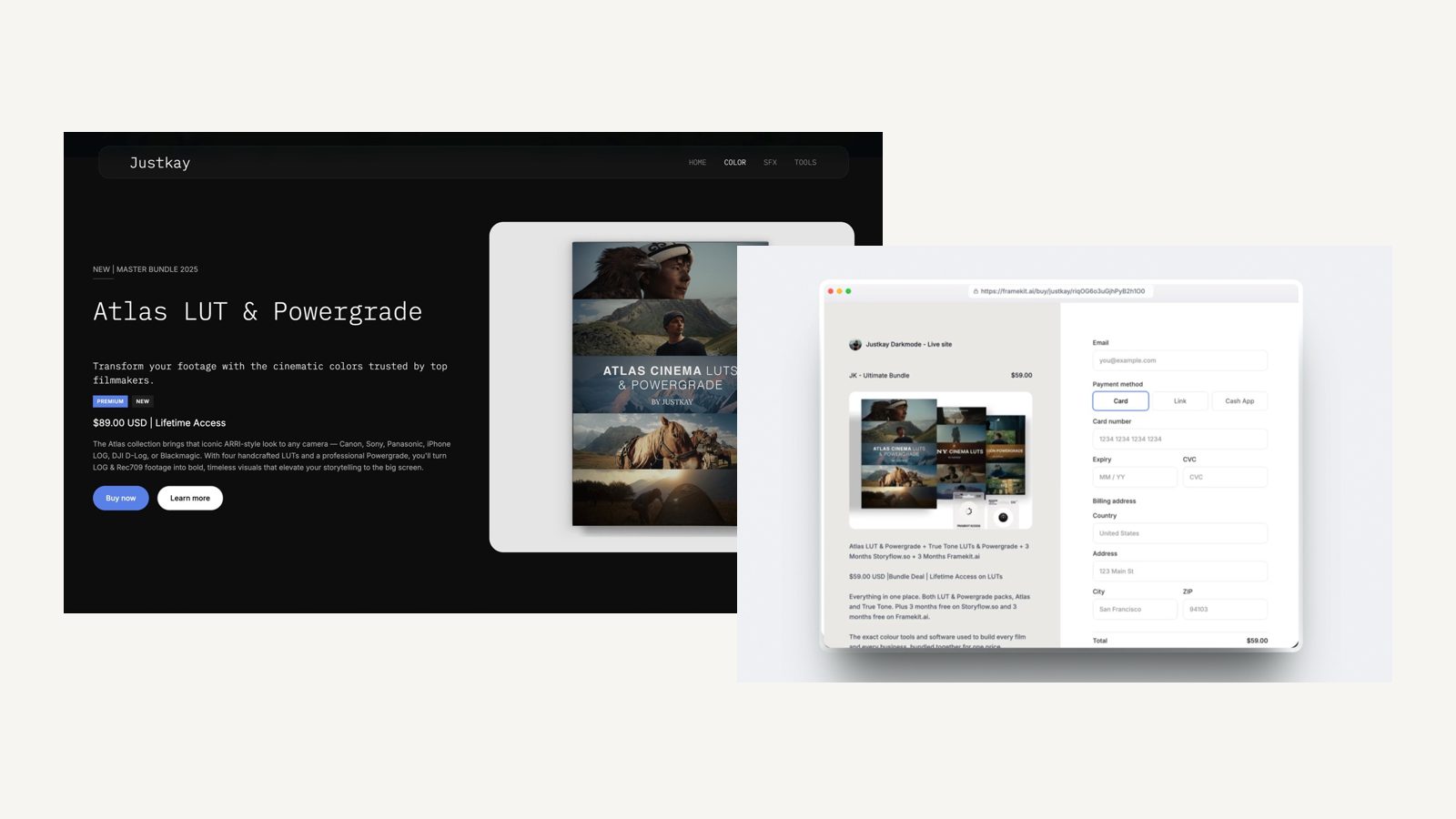
For a LUT or preset pack the proof image is one frame from real footage with the look applied, at full width, with no interface chrome around it. For a template pack it is the template in use. For a sound library it is a waveform you can press play on, not a list of filenames.
What goes wrongthe box mockup. Digital products have no box, and a 3D render of a case labelled "Atlas LUT Pack" proves nothing about the grade. It is a stock design habit borrowed from software in 2009 and it costs you the one screen where proof mattered.
The gotcha in week threethe page looks right on your 27 inch monitor and puts the price below the fold on every phone. Load your own page on your phone before you share it, and if the button is not visible without scrolling, cut a block, not the image.
Framekit is an AI website builder for photographers and filmmakers whose store and website are the same project, which matters here for one reason: the proof image and the buy button live in one editor, so the hero section and the checkout cannot drift apart the way they do when the page is on your site and the checkout is on somebody else's.
In one lineGive the first screen to the proof, the result line, the price and the button, and judge that screen on a phone and not on the monitor where you built it, because the phone version is the one most buyers will be deciding from.
Step 3. Draft the page with AI, then delete the adjectives it added
Write the first pass fast, because a blank page produces stalling and a bad first draft produces edits, and edits are the part of this job you are actually good at.
Whatever tool you draft in, the useful prompt names the product, the buyer, the camera or software, the price and the one result, and asks for the nine blocks in order.
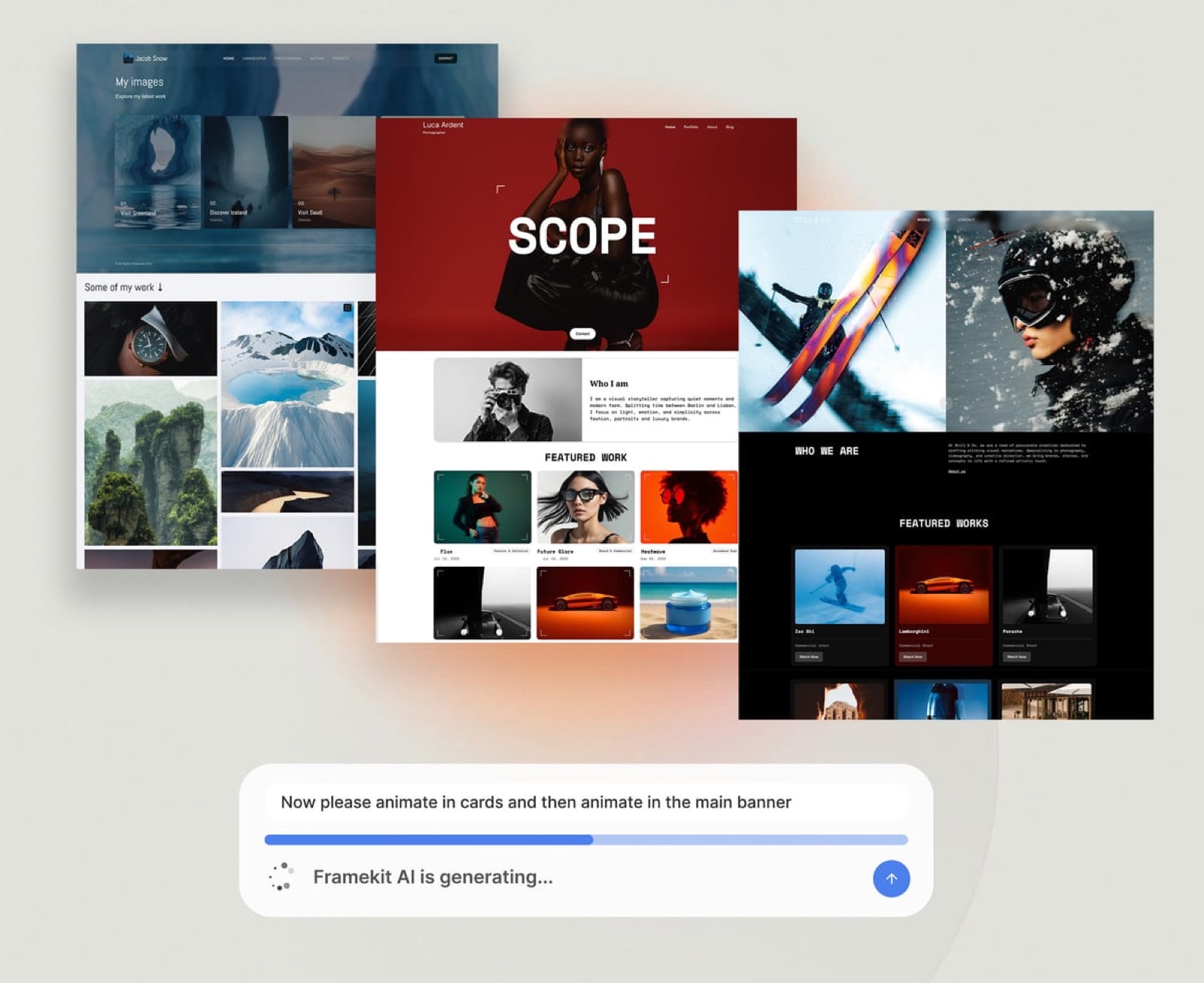
In Framekit you describe the section you want and the AI builds it in the fonts and colours the rest of your site already uses, so the product page does not arrive looking like a different website.
The AI slide and section writing runs on Framekit's own model tiers, Cadence for the best output and Score when you want something fast and cheap, with an Auto mode that picks per step.
What goes wrongyou keep the draft. Generated sales copy defaults to abstraction, so the first pass hands you "elevate your workflow" and "professional results" and you feel oddly reluctant to cut them because they sound like sales pages.
The rule is simple: every sentence that would still be true if you swapped in a different product comes out.
The detail nobody writes downrun the finished page through the concise, scannable and objective test from the reading study above. Concise means half the words. Scannable means a heading every screen. Objective means a number where an adjective was.
In one lineUse AI to get past the blank page and then spend the saved time deleting, because the value you add is subtraction and specificity, both of which a first draft is structurally bad at.
Step 4. Show before and after, not adjectives
Put the same frame twice, ungraded and graded, side by side or in a slider, because that single comparison does the job of six paragraphs about colour science and it is the only proof a colourist actually trusts.
For presets, use the RAW next to the edit. For templates, the empty layout next to the finished page. For a Notion or Canva pack, a real filled-in board next to the blank one.
Use three comparisons, not twelve. Pick the hardest one first: the skin tone, the mixed lighting, the underexposed interior. A pack that handles a lit studio portrait proves nothing, because everything handles a lit studio portrait.
The number to put under itname the source footage. "Sony FX3, S-Log3, S-Gamut3.Cine, no other correction applied" is a sentence that turns a picture into evidence, because it tells a buyer the grade was not rescued by a secondary pass they cannot see.
What goes wrongthe before image is quietly worse than a real ungraded frame. Crushing the before, or grading the after with a second layer you do not mention, is the fastest way to earn a refund request and a comment thread.
If you correct exposure before applying the LUT, say so on the page, because the buyer will find out in the first ten minutes.
For a pack specifically, the mechanics of file structure and delivery change what you can promise on this page, and our guide to selling LUTs online covers the formats and the install notes that belong in block four.
The same applies to preset packs, where selling Lightroom presets from your own website covers the version-compatibility trap in more detail than fits here.
In one lineOne honest before and after with the source footage named is worth more than every adjective on the page, and three comparisons that include your hardest case will out-sell twelve that all show good light.
Step 5. Answer the four objections in the order buyers raise them
There are four objections and they arrive in a fixed order, so answer them in that order instead of scattering the answers through the page, because an unanswered objection stops the reader at the point it occurs and nothing below it gets read.
| Order | The objection | Where it belongs | What answers it |
|---|---|---|---|
| 1 | "Will this work with my footage?" | Directly under the proof image | Exact camera, profile, software and version list |
| 2 | "Is it worth $49?" | Beside the price | What the alternative costs in hours or money |
| 3 | "What exactly do I get?" | Middle of the page | File count, formats, sizes, what is not included |
| 4 | "What if it does not work?" | Just above the second button | The refund line, written plainly |
Objection one is technical and it is where most creative products lose the sale in silence. A buyer on a Canon R5 looking at an S-Log3 pack needs a yes or no, and if your page does not give one they assume no.
Objection two is not answered with a discount. It is answered with a comparison the buyer can check: an hour of your grading time, a stock look that costs more, the afternoon they will not spend matching shots by eye. Say the comparison out loud on the page.
Objection three is where honesty pays cash. "Twelve .cube files, 33 point, plus a 3-page PDF install guide, 48MB zipped" converts better than "everything you need", because a specific list is checkable and a vague one is a risk.
Objection four is the refund line, and it gets its own step below because it is the one people write badly and then regret.
In one lineHandle compatibility, value, contents and risk in that sequence and in those positions, because each objection blocks the reader where it occurs and no amount of good copy below an unanswered question ever gets read.
Step 6. Show the price, in one currency, with the fee arithmetic already done
Put a single number on the page and put it next to the button, because a visitor who has to hunt for a price reads the hunt as a signal that the price is bad news. One currency, one number, no "from", no strike-through unless the higher price was genuinely charged.
The fee is not the buyer's problem, but it is yours, and it changes what a given price is worth to you.
Here is the same $49 pack across the checkouts a solo creator actually chooses between, using each vendor's published rate read in September 2026, before the payment processor takes its own cut.
| Where you sell | Platform fee | You keep on a $49 pack | The thing it costs you |
|---|---|---|---|
| Framekit, Free plan | 5% | $46.55 | Framekit badge, no custom domain |
| Framekit, Business plan | 0% on a $39 per month plan | $49.00 | The $39, which only pays back above $780 a month in sales |
| Gumroad, direct link | 10% + $0.50 | $43.60 | The page is a Gumroad page, not yours |
| Gumroad, via Discover | 30% | $34.30 | A third of the sale, in exchange for their traffic |
| Lemon Squeezy | 5% + $0.50 | $46.05 | Nothing on tax: they are merchant of record |

Read the right-hand column, not the middle one. The gap between $46.55 and $43.60 is $2.95 a sale, which is a rounding error until you sell a hundred of them, at which point it is $295.
The gap that actually matters is whether the page carrying your proof is yours or somebody else's.
Gumroad's rate comes straight from its pricing page, which states 10% plus 50 cents on direct sales and 30% on sales that come through its Discover marketplace, with no monthly fee at all.
That 30% tier is worth understanding before you opt in, and our breakdown of Gumroad's fees walks through when the extra traffic is worth the extra 20 points.
The gotcha in week threeyou list a price in dollars, a European buyer pays in euros, and the conversion happens somewhere you did not choose. Pick one currency and keep it, because the priceCurrency in your structured data has to match the number printed on the page and Google requires both.
If you want the rich result in Google, the price on the page needs matching structured data.
Google's merchant listing documentation requires the product name, an image and an offer carrying price and priceCurrency in three-letter ISO format, and notes that merchant listing experiences require a price greater than zero.
A free product does not qualify.
In one lineOne visible number beside the button, in one currency, backed by structured data that matches it, removes the single most common reason a warm visitor leaves a digital product page without buying or asking.
Step 7. Write a refund line you can actually honour
Write the refund policy in one or two sentences on the page, above the final button, in the same voice as the rest of the copy, because silence about refunds reads as "no refunds" and a wall of legal text reads as "we have had trouble".
Then check that the mechanics behind your promise are real, because refunds cost more than the amount refunded.
Three facts change what you should promise. Stripe's own documentation states plainly that its processing fees from the original transaction are not returned when you refund.
Stripe puts the credit on the buyer's statement 5 to 10 business days later depending on the bank, so a same-day refund is not a same-day experience.
And if the refund fails, for example because the card was closed, the money can take up to 30 days to find its way back to your balance.
Framekit keeps its platform fee when you refund a sale, which is worth knowing before you promise no-questions-asked returns on a low-margin product.
On a $49 pack refunded in full on the free plan you are out the $2.45 platform fee plus whatever the processor kept, and you have returned $49.
The legal wrinkle if you sell into the EUthe 14-day right of withdrawal exists, but the European Commission's own guidance says it does not apply to online digital content that the buyer started downloading after expressly agreeing to lose that right by starting the download.
That consent has to be collected, acknowledged and confirmed, which is a checkout design question and not a copy question, but the sentence you write on the page should not contradict it.
Three refund lines that work, in ascending order of nerve:
- "Files are delivered instantly, so I do not offer refunds once the download has started. Email me before you download if you are unsure and I will answer any compatibility question."
- "If the pack does not work with your footage, email within 14 days with a frame and I will refund you in full."
- "Thirty days, any reason, no questions. I would rather you have the money than the resentment."
Pick the one you will still mean in six months.
The refund mechanics deserve their own reading before you choose, and our guide to digital product refunds and chargebacks covers what a dispute costs compared with a refund you issue yourself.
In one lineSay what you will do about refunds in plain sentences above the last button, and choose the promise by what the mechanics behind it cost you, not by which one sounds most generous on a page.
Step 8. Cut the page to what a phone shows, then publish it
Cut the draft by a third before you publish, because the version you have written is the version that answers every question you have ever been asked, and most of those questions came from people who were never going to buy.
Long pages are not the problem. Long pages that defer the proof are.
The cut list, in order: the origin story, the second testimonial, any paragraph about your process, every sentence that starts with "whether you are", and the FAQ entries nobody has actually asked.
Keep the compatibility list even when it is ugly, because ugly and specific beats elegant and vague on the one block that decides the sale.
The last check before you publish. Open the live page on a phone, in daylight, on mobile data. Can you see the result and the price without scrolling? Does the file arrive?
Buy your own product with a real card if your checkout allows it, then refund yourself, because a page that sells a file which never arrives is worse than no page at all.
A product page on your own domain inherits whatever trust your portfolio has already earned, which is the argument for running a portfolio site with a shop attached.
In one linePublishing is a cut followed by a real purchase on a real phone, and the two failures you are looking for are a price you cannot see and a file that does not arrive, both of which are invisible from the editor.
The worked example: a complete page for a LUT pack
Here is the Atlas pack written out block by block so you can see how short a finished page is when every block does its own job and none of them repeats another, which is the usual reason a sales page ends up three times this length.
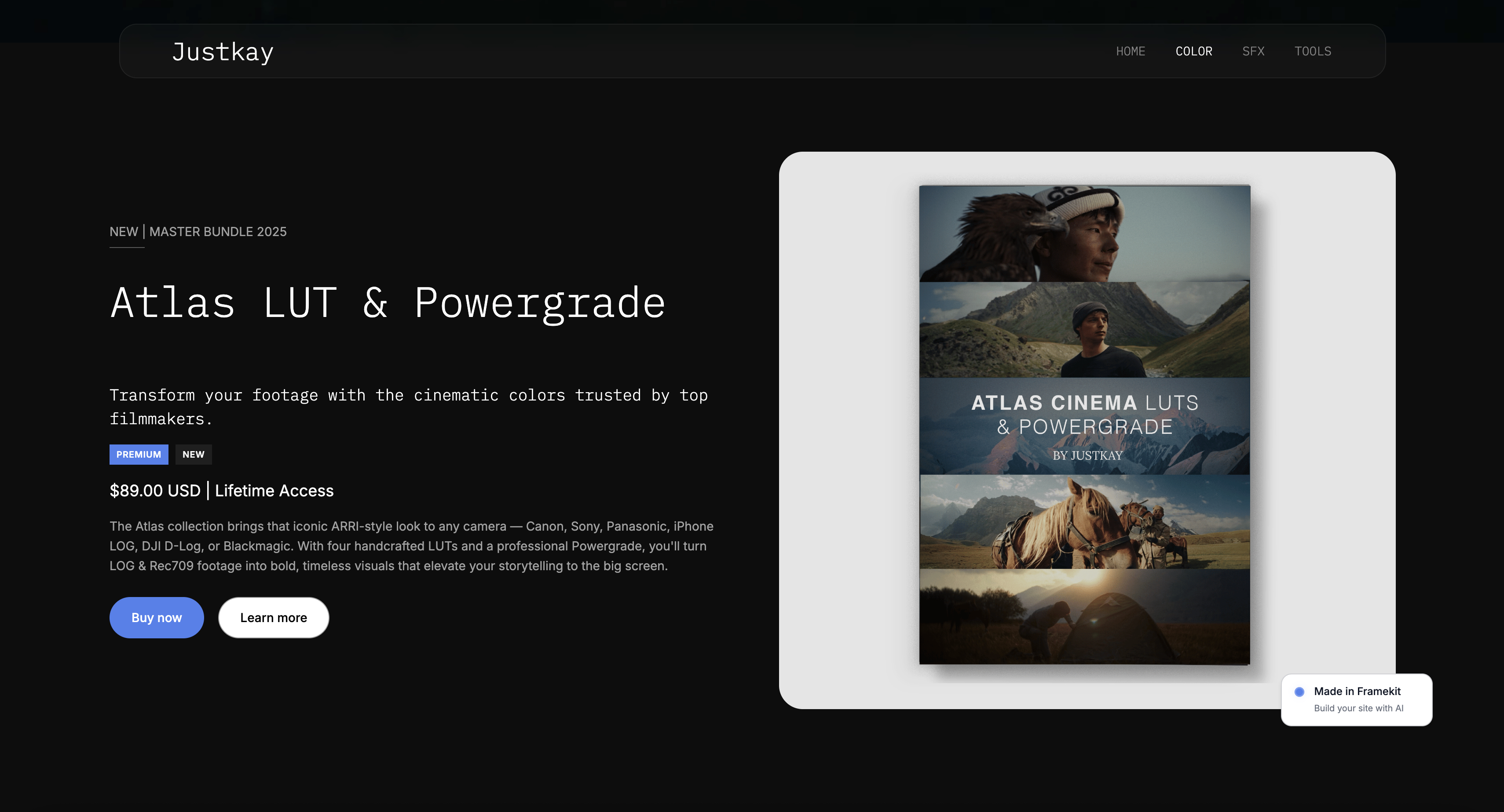
Block 1, the result line. Atlas: twelve looks for Sony S-Log3, graded in one click.
Block 2, the proof image. One full-width frame, FX3 interior at dusk, graded with Atlas 04. Caption: Sony FX3, S-Log3, S-Gamut3.Cine. Exposure corrected, no other grading applied.
Block 3, the price and button. $49. One button: Buy Atlas.
Block 4, what you receive. Twelve .cube files at 33 points. One Powergrade for DaVinci Resolve. A 3-page PDF with install steps for Resolve, Premiere and Final Cut. 48MB zipped. Free updates for as long as the pack is on sale.
Block 5, compatibility. Built on Sony S-Log3 and S-Gamut3.Cine footage. Works in DaVinci Resolve 18 and up, Premiere Pro 2023 and up, Final Cut Pro 10.6 and up. Not built for Canon C-Log3, Panasonic V-Log or iPhone Log, and I would not sell it to you for those.
Block 6, before and after. Three comparisons: mixed tungsten and daylight interior, underexposed night exterior, a skin tone on a dark background. RAW frame on the left, Atlas applied on the right, no other correction.
Block 7, who it is for. For Sony shooters who grade their own commercial and documentary work and want a starting point, not a finished look. Not for anyone expecting a one-click fix on mixed camera formats, and not for stills.
Block 8, the refund line. If Atlas does not work with your footage, email within 14 days with a frame and I will refund you in full.
Block 9, the second button. $49. Buy Atlas. Same price, same button, no surprise.
That is under 250 words of copy and four images. If your draft is 1,400 words, the extra 1,150 are almost certainly blocks one and seven repeated in different costumes.
In one lineThe Atlas page above is 216 words of copy and four images, and the reliable way to find the fat in your own draft is to label every paragraph with its block number and delete the paragraphs that carry a number already used.
What this page cannot do, and what to use instead
A sales page converts the visitors you already have, and it has no opinion at all about where they come from, which is why a page that answers every objection can still sell nothing in a month where nobody visited it. Know which problem you have before you rewrite the copy again.
Run the arithmetic on your own numbers, not on a borrowed benchmark. Take last month's visits to the page, divide the sales by the visits, and hold that fraction.
If 40 people visited and none bought, you do not have a page problem yet, you have an audience problem, and rewriting the headline a fifth time will not change a number that small.
The rule of thumb that survives contact with reality: below roughly 300 visits a month, spend the time on distribution instead of copy, because you cannot read a signal out of numbers that small.
Above it, changes to blocks one, two and five move the number more than anything else on the page.
Framekit's site analytics give you the denominator in that sum. What Framekit will not do is email the people who did not buy, run an affiliate program, add an order bump at checkout or build a funnel around the page, so the follow-up half of this lives in a dedicated email tool.
In one lineBefore rewriting copy again, divide last month's sales by last month's visits to the page, because under about 300 visits a month the number is noise and the honest answer is a distribution problem and not a page problem.
Which block carries which product
The nine blocks stay the same for every digital product, but which one does the selling changes, and picking the wrong emphasis is how a carefully written page for a template pack ends up converting nobody at all.
| Product | The block that carries it | The block people skip and regret |
|---|---|---|
| LUTs and presets | Before and after with named source footage | Compatibility: camera profile and app version |
| Templates for design tools | The template in use on a real project | What you receive: editable layers, fonts included or not |
| Ebooks and guides | The table of contents, in full | Page count, format, whether it is printable |
| Sound and sample packs | An audio preview you can play | Licence terms for commercial use |
| Notion and spreadsheet systems | A filled-in example, not the blank | Whether updates are included and for how long |
In one lineEvery product type has one block that sells it and one boring technical block that prevents refunds, and the reliable mistake is writing the first one beautifully while leaving the second to be answered by email forever.
Where to build the page: a branching guide
Work down these questions in order and stop at the first yes, because the right home for a sales page depends on what you already own and how much of the tax and traffic problem you want to hand to somebody else.
Do you already have a portfolio site that gets traffic? If yes, put the product page on it, on your own domain, and use a checkout that attaches to that page instead of replacing it. The trust is already paid for. If no, go to the next question.
Do you want someone else to be responsible for VAT and sales tax? If yes, Lemon Squeezy is the honest answer: it charges 5 percent plus 50 cents and states on its own pricing page that it is your merchant of record and takes on tax collection and calculation liability.
On the $49 pack that service costs $2.95 against the $2.45 Framekit's free plan takes, so 50 cents a sale moves VAT registration, filing and liability off your desk. If no, go on.
Do you need the sale to happen today, with no site at all? If yes, Gumroad at 10 percent plus 50 cents gets you a working page in an afternoon, and you can move later. Every hour you spend choosing is an hour not spent selling. If no, go on.
Do you sell more than $780 a month? If yes, a flat plan beats a percentage: on Framekit, 5 percent of sales equals the $39 Business plan at $780 a month, and above that the percentage keeps climbing while the flat fee does not.
Between the two paid tiers, Pro at $19 and 3 percent and Business at $39 and 0 percent cost the same at about $667 a month of sales on monthly billing, because the $20 gap divided by 3 points is $666.67.
If no, stay on the free plan and revisit the sum in three months.
For a full side-by-side of the checkouts themselves and not the pages they sit behind, our comparison of checkout tools for digital products does the fee tables in more depth than fits here.
In one lineChoose the home for your sales page by answering four questions in order about traffic, tax, urgency and monthly volume, because each one eliminates options and only the last one is about money.
Frequently Asked Questions
How long should a sales page for a digital product be?
A sales page for a digital product runs 250 to 600 words plus three or four images, not the 2,000-word format borrowed from information products.
The length is set by the number of real objections, and for a LUT pack, preset set or template there are four. Write the nine blocks, answer each objection once, and stop.
If your draft runs past 1,000 words, the extra is almost always the result line and the "who it is for" section restated in different words, not new information a buyer needed.
What should go above the fold on a digital product sales page?
Above the fold you need four things: the result line, one image of the output applied to real work, the price, and the button. Nothing else.
Nielsen Norman Group's eye-tracking work finds that first lines of text receive more gazes than later lines, which is the practical reason the price belongs on the first screen and not after the story.
Check this on a phone and not on a desktop monitor, because the phone version is where most visitors will make the decision.
Do I need a long story about how I made the product?
No. An origin story is one of the first things to cut from a digital product sales page, because it answers a question the buyer did not ask and delays the proof they came for.
There is one exception: if the story contains a credential that answers objection one, such as grading 40 commercials on the exact camera profile the pack is built for, then keep that one sentence and delete the rest of the narrative around it.
How do I write the refund policy for a digital download?
Write it in one or two plain sentences above the final button and make it a promise you can afford.
Refunds cost more than the amount returned: Stripe's documentation states its processing fees from the original transaction are not returned, and Framekit keeps its platform fee on a refunded sale, so a refunded $49 pack costs you the $49 plus roughly $2.45 in platform fee on the free plan plus the processing.
Decide whether you want a download-starts-no-refunds line, a 14-day compatibility guarantee or a 30-day open policy, and say which in the copy.
Can I promise a refund on a file the buyer has already downloaded?
You can, but the file is gone whatever you decide, so price that promise as a cost rather than a risk.
In the EU the 14-day right of withdrawal does not apply to digital content the buyer started downloading after expressly agreeing to lose that right, according to the European Commission's own consumer guidance, and that agreement has to be collected and confirmed at checkout.
If your checkout does not collect it, assume the withdrawal right applies and price accordingly.
Should I show the price or ask people to email me?
Show the price. Hiding it on a digital product page costs you the buyers who would have paid and gains you emails from the ones who will not.
Hidden pricing makes sense for custom work where every job is quoted, and makes no sense for a fixed file at a fixed price.
If you are genuinely unsure what to charge, set a number, publish it, and change it after 30 sales instead of leaving the page priceless while you decide.
Where should the sales page live: my own site or Gumroad?
Put it on your own site if you already have traffic, and on Gumroad if you need to be selling this week.
Gumroad charges 10 percent plus 50 cents on direct sales with no monthly fee, which is a fair price for not building anything, but the page is a Gumroad page, so the visitor sees a marketplace and not your work.
The switching cost later is real but survivable: you move the file, the copy and the link, and you lose the old URL's history.
How many images does a digital product page need?
Four: the hero showing the output applied to real work, and the three before-and-after comparisons that answer the compatibility question.
If you add a fifth, make it the file structure or the install guide, so block four stops being a list of promises. More than six and the page becomes a gallery that buries the button.
Fewer than three and the compatibility question goes unanswered, which is the objection that silently ends the most sales on creative products.
Does structured data help a digital product page rank?
Structured data does not make a page rank higher on its own, but it is what makes a price and a product appear as a rich result.
Google's merchant listing documentation lists name, image and offers as required on the product, with price and priceCurrency required on the offer, price expressed in three-letter ISO 4217 format and greater than zero.
A free product is not eligible for merchant listing experiences, so a free lead magnet will not carry a price in search.
Is Framekit a good place to build a digital product sales page?
Framekit works well for this when your portfolio and your store should be the same site, because the product page is built in the same editor and inherits the fonts, colours and domain your work already uses, and the free plan sells with a 5 percent fee and unlimited products.
It is a poor fit if you need memberships, subscriptions, courses, an affiliate program, order bumps or email sequences, because the store sells digital files only and does none of those things.
Final Verdict
A sales page for a digital product is not persuasion, it is evidence arranged in the order doubts arrive: the result line, the proof, the price, the contents, the compatibility, the comparison, the honest audience, the refund promise, the button.
Write those nine blocks, put the first four on the first screen, and cut everything that would still read as true if you swapped in a different product.
Verdict: Build the page where your work already lives, show the output before the feature list, and answer compatibility before value. Framekit suits the seller who wants that page on their own domain with the checkout attached to it, at 5 percent on the free plan and 0 percent on the $39 Business plan above $780 a month in sales.
Where Framekit loses: it does not run the marketing machinery around a page.
There is no affiliate program, no order bump, no upsell, no funnel and no email sending, and it is not the merchant of record, so the VAT and sales tax are yours to handle.
If you want tax handled for you, Lemon Squeezy is the better fit at 5 percent plus 50 cents. If you want to be selling by Friday with no site at all, Gumroad is the better fit and the 10 percent is the price of that speed.
And if your page gets 40 visits a month, no version of this guide will fix that, because the problem is not the page.
Related readingwork out the number before you write the page with how to price digital products, see the whole path from idea to first sale in how to start selling digital products, compare the storefronts themselves in the best platforms to sell LUTs, and make sure the file actually arrives with the best digital product delivery tools.
If you have no page yet, how to sell a digital product from one link gets money moving first, and when you are ready to make an event of it, how to launch a digital product works backwards from the open date.