Framekit templates
Start from a designer-made template
 Use template
 Use template
 Use template
 Use template
 Use template
 Use template
 Use template
 Use template
You finally finished the thing - the preset pack, the Notion template, the ebook, the design kit. Now you need somewhere to sell it.
You open a comparison article, and every "free" tool turns out to take a cut of every sale, hide the storefront behind a subscription, or put your shop on a page that looks like everyone else's.
That is the real problem with free product-selling software in 2026. "Free" rarely means free. It usually means free to sign up, and then a 5-10% cut of every sale forever.
And most of these tools hand you a checkout, not a brand: your store lives on their domain, in their layout, next to their logo.
We tested 12 of the most popular tools for selling digital products - including Framekit, Gumroad, Lemon Squeezy, Payhip, and Ko-fi - on what actually matters: the real cost to start, how much each sale keeps, whether you own a genuine storefront, and how fast you can go from signup to first sale.
This is the comparison to read before you hand a platform a percentage of everything you earn.
Framekit lets you sell digital products straight from your own website, and the free plan needs no credit card to start.
Product-selling software is a tool that handles the storefront, the checkout, and the delivery for the digital or physical products you sell. The best kind for creatives is built into a real website.
The best free product-selling software in 2026 is Framekit, because it lets you sell digital products directly from a real, designer-quality website instead of a generic checkout page - with a free plan and a low platform fee that drops to 0% on the Business plan (plus standard payment processing).
Gumroad is the simplest pure digital-product tool, Payhip is the best free dedicated storefront, and Lemon Squeezy is best when you need automatic sales-tax handling.
Free product-selling software is a platform that lets you list and sell a digital file without a monthly charge, which usually means it takes a percentage instead.
Full disclosure: Framekit, ranked #1 below, is our own product, and none of these free plans is free in the sense of costing nothing at any volume, ours included: we take 5 percent on the free plan. Every tool is linked, Payhip's free tier is the closest rival, Ko-fi is cheapest for community creators, and Lemon Squeezy files tax we leave to you.
Not ready for a store at all? 9 ways to sell digital products without a website covers the payment-link and hosted-page routes, and works out that a 10% method costs more than a $9 site at about five sales a month.
Quick Comparison: Free Product-Selling Software at a Glance
| Tool | Best For | Free to Start | Typical Fee per Sale |
|---|---|---|---|
| Framekit | Selling from your own branded website | Yes (free plan) | 5% on free, 0% on Business ($39/mo), plus processing |
| Gumroad | The simplest digital storefront | Yes | 10% + 50¢, plus processing |
| Payhip | A genuinely free dedicated store | Yes | ~5% on the free plan |
| Lemon Squeezy | Automatic tax / merchant of record | Yes | ~5% + 50¢ |
How We Tested These Product-Selling Tools
"Free" and "product-selling software" both mean very different things across these 12 tools. We tested each one hands-on by listing and selling a digital product, and scored it on five criteria.
Real cost to start. Can you list a product and take a payment without paying anything up front? Some tools are free to use; others only offer a trial.
Fee per sale. This is the number that actually matters. A "free" tool that takes 10% of every sale is not free - it is the most expensive option once you are selling regularly.
Storefront and branding. Do you get a real, ownable storefront, or just a checkout page on someone else's domain? Owning your store builds your brand; renting a checkout builds theirs.
Checkout and digital delivery. We checked how smooth the buyer checkout is and whether files are delivered to customers automatically and securely after purchase.
Speed to first sale. How long from signup to a live, shareable product link? We measured the full path, including connecting a payment processor.
Quick Picks by Use Case
Best overall: Framekit. Sell digital products from a real, designer-quality website you fully own - with a low platform fee that drops to 0% on the Business plan.
Best simple digital storefront: Gumroad. The fastest way to put a single digital product online, if you can accept 10% plus 50 cents a sale, with card processing on top.
Best free dedicated store: Payhip. A real storefront with a usable free plan and lower fees as you grow.
Best for taxes handled for you: Lemon Squeezy. A merchant of record that deals with global sales tax and VAT so you do not have to.
Best for tips and memberships: Ko-fi. Great for creators monetizing through donations, memberships, and small product sales.
Best for courses: Podia. Digital products, courses, and email in one place.
Best link-in-bio store: Stan Store. Built for creators selling straight from a social media bio link.
The 12 Best Free Product-Selling Tools in 2026: Full Comparison
We weighted real cost and storefront ownership most heavily - a tool that quietly takes 10% of every sale ranks below one with a small monthly fee and 0% commission.
| Tool | Best For | Free Plan | Typical Fee | Our Rating |
|---|---|---|---|---|
| Framekit | Selling from your own website | Yes | 5% on free, 0% on Business, plus processing | 9.5/10 |
| Gumroad | Simplest digital storefront | Yes | 10% + 50¢, plus processing | 8.6/10 |
| Lemon Squeezy | Tax handled for you | Yes | ~5% + 50¢ | 8.5/10 |
| Payhip | Free dedicated store | Yes | ~5% (free plan) | 8.4/10 |
| Ko-fi | Tips and memberships | Yes | 0-5% (0% with Gold) | 8.0/10 |
| Podia | Courses and digital products | Yes | No free plan, $42/mo + 5% | 7.9/10 |
| Shopify Starter | Lightweight commerce | Trial only | ~5% + processing | 7.8/10 |
| Sellfy | Quick all-in-one store | Trial only | 0% on paid plans | 7.7/10 |
| Stan Store | Link-in-bio selling | Trial only | 0% on subscription | 7.5/10 |
| Etsy | Marketplace discovery | Listing fees | 6.5% + $0.20 + processing | 7.4/10 |
| Square Online | Free basic online store | Yes | ~2.9% + 30¢ | 7.3/10 |
| Beacons | Link-in-bio creator store | Yes | ~9% (free store) | 7.2/10 |
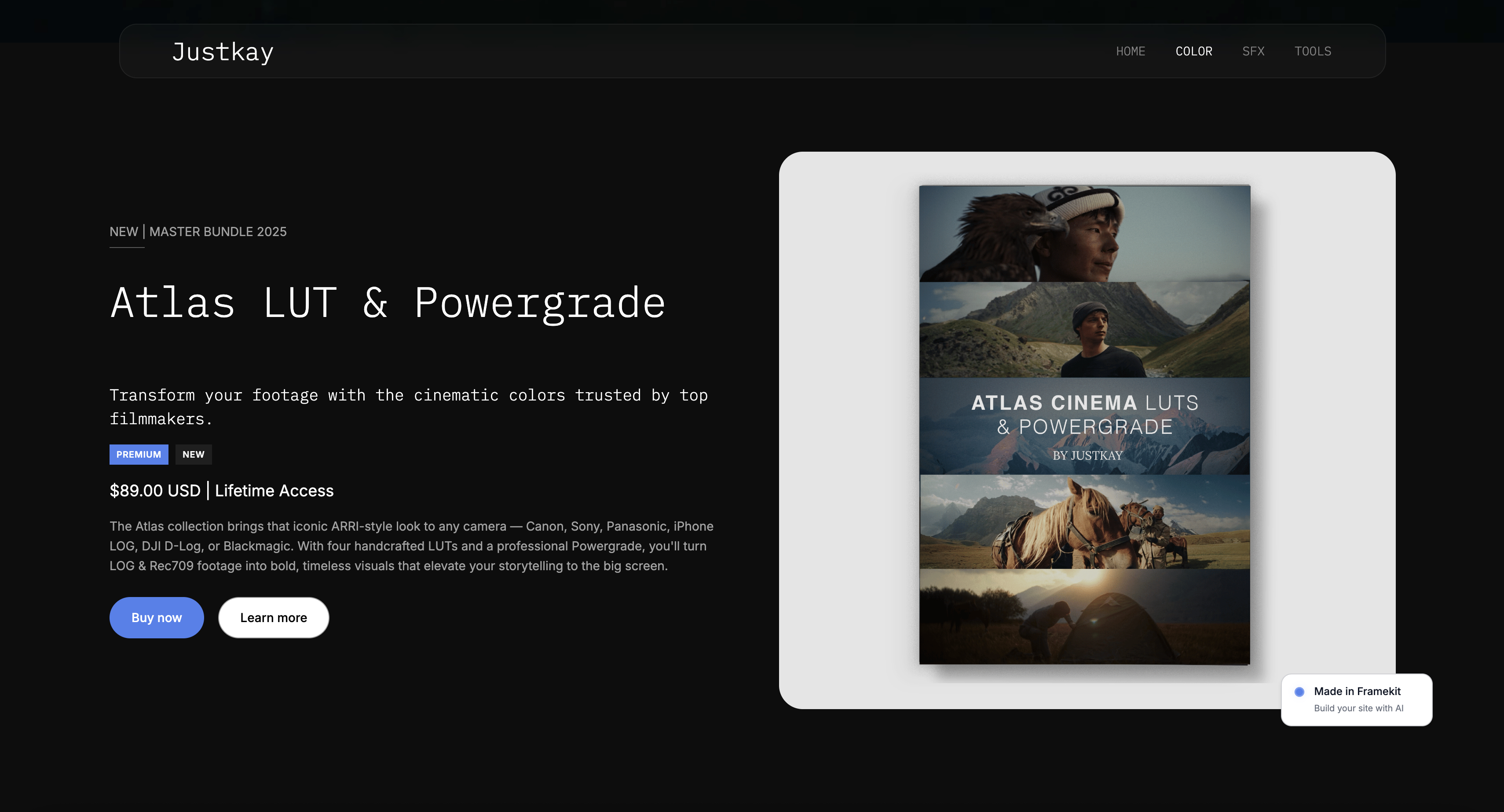
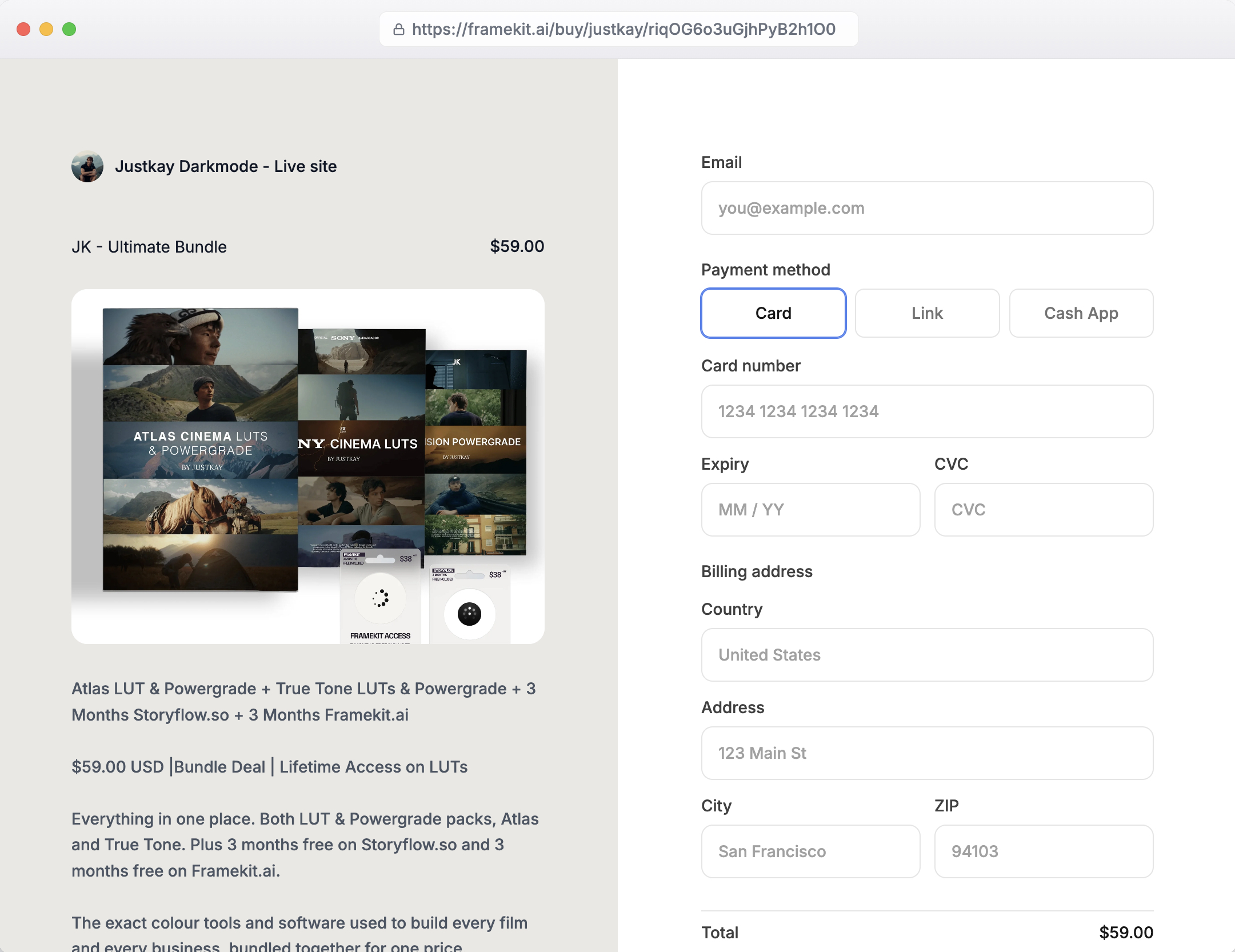
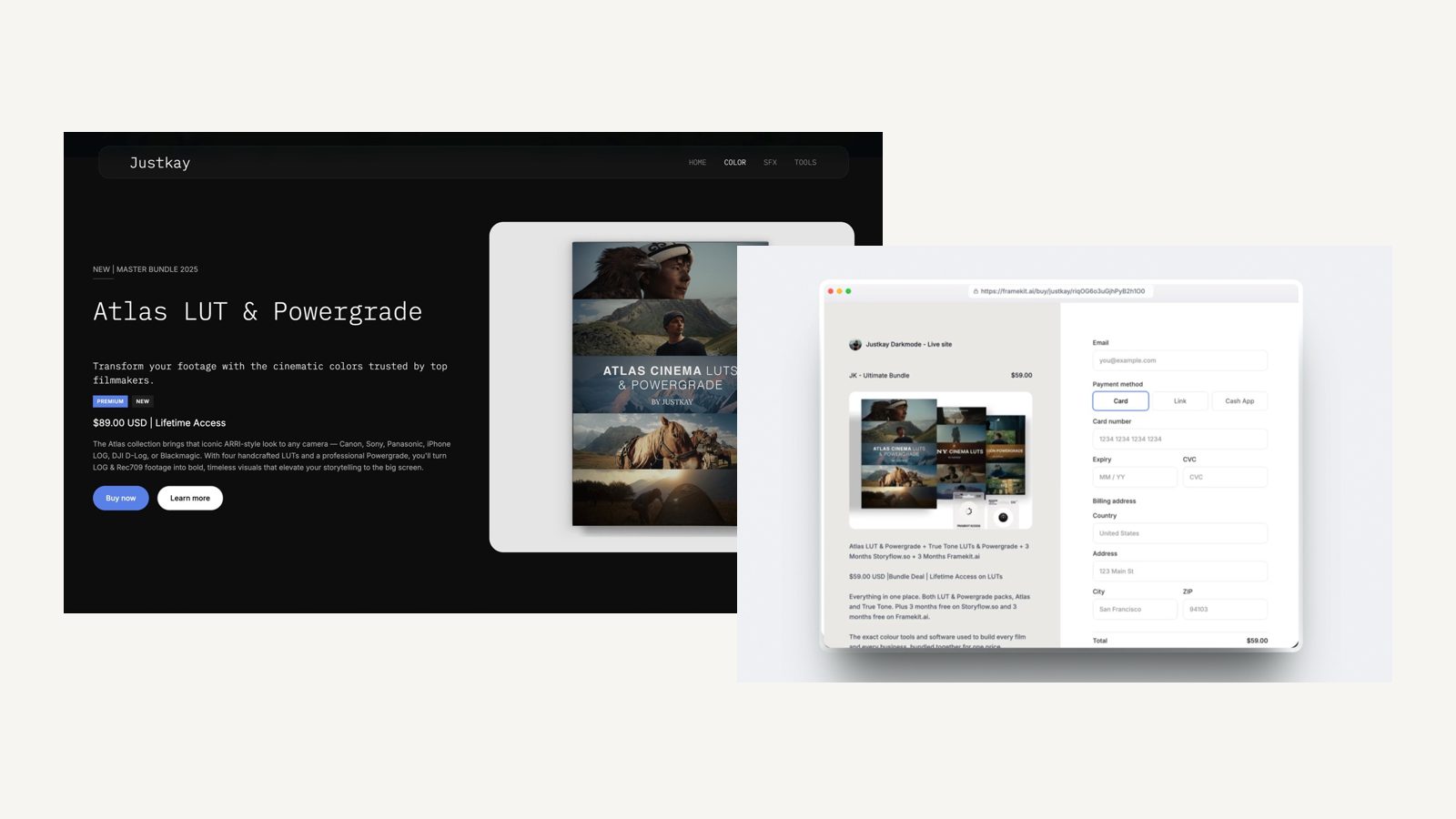
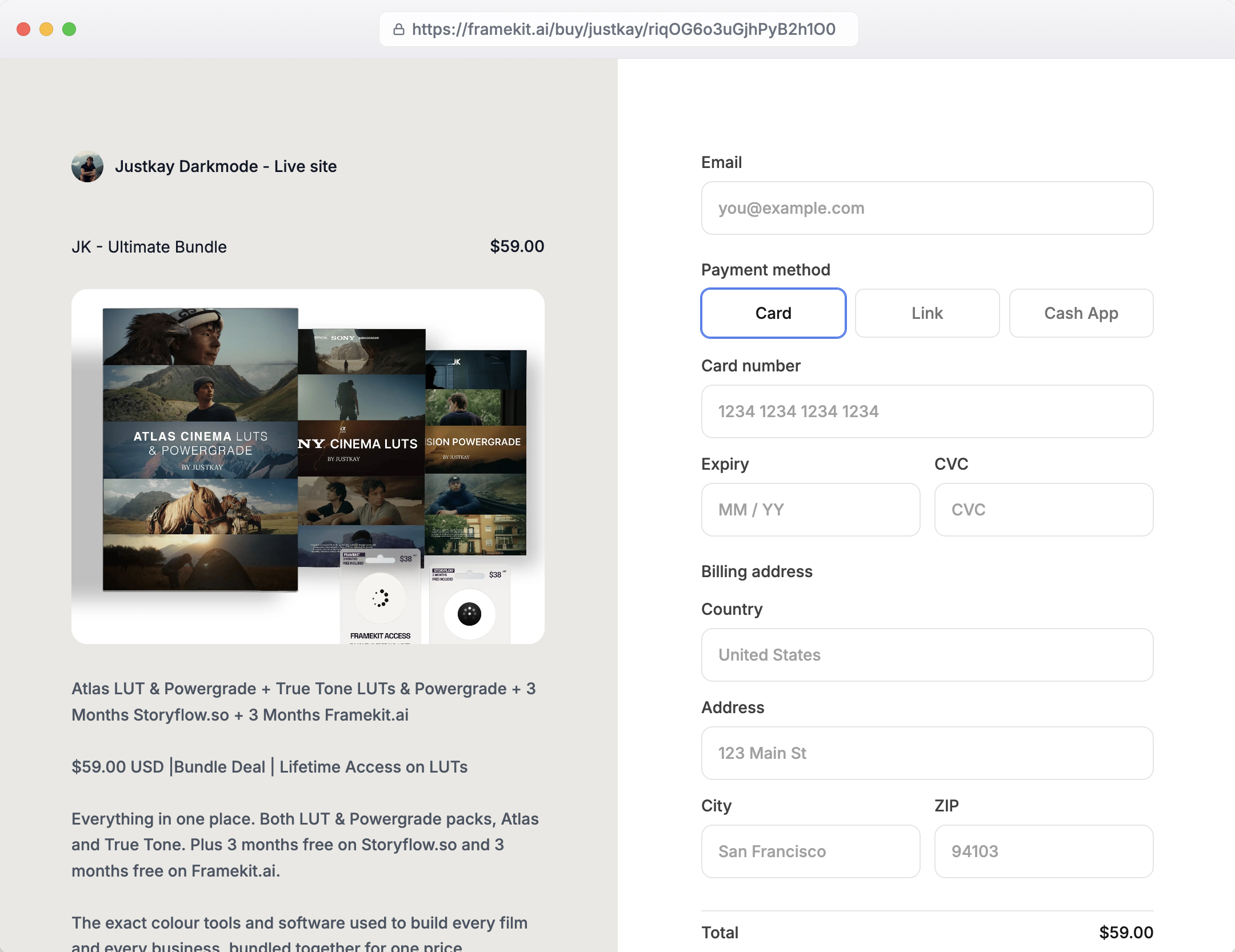
See how a Framekit store looks. The free plan lets you build a real product page and connect checkout - try it on your own product and see the difference from a generic checkout link.
1. Framekit: Best Overall

Our rating: 9.5/10
Framekit is an AI website builder with product selling built in.
Instead of sending buyers to a generic checkout on someone else's domain, you sell digital products directly from your own designer-quality website - the same site that holds your portfolio, your blog, and your brand.
Best forCreators, designers, and solopreneurs who want their store to live on a real website they own.
Key features:
- Sell digital products - presets, templates, ebooks, files - directly from your own site
- A free plan with no credit card required to build the site and list products
- Stripe-powered checkout with automatic, secure file delivery to buyers after purchase
- A low platform fee that drops to 0% on the Business plan, plus standard payment processing
- A products and orders dashboard to manage inventory and track revenue
- AI trained by senior designers, so your store looks professionally designed, not templated
The difference is ownership. On most "free" tools, your store is a page on their domain that looks like every other store on that platform.
With Framekit, the store is part of your website - your domain, your design, your brand - and the platform fee starts at 5% and drops to 0% on the Business plan, on top of the payment processor's standard fee.
Pricing:
- Free: $0 (build your site and list products)
- Pro: $19 per month (custom domain, no branding)
- Business: $39 per month (0% product-sale fee)
Pros:
- A low platform fee that drops to 0% on the Business plan - a major long-term saving
- Your store is part of a real, designer-quality website you own
- Free to start, with flat, low pricing instead of an ever-rising subscription
Cons:
- You connect your own payment processor rather than getting a merchant of record
- Built for digital products and creator commerce, not large physical-inventory stores
Verdict: Framekit is the best pick if you want selling to build your brand instead of someone else's. You get a real website and storefront, professional design, and a low platform fee that reaches 0% on the Business plan instead of a percentage that never falls. Start free at framekit.ai.
2. Gumroad
Our rating: 8.6/10
Gumroad is the fastest way to put a digital product online. You can have a product link live in minutes, and buyers do not need an account to purchase.
Best forCreators who want the simplest possible way to sell one or a few digital products.
Pros:
- Extremely simple - list a product and share a link
- Trusted, familiar checkout that converts well
- Handles file delivery and license keys automatically
Cons:
- The 10% + 50¢ fee per sale, plus card processing on top, is the highest in this comparison once you sell regularly
- Your storefront is a Gumroad page, not a site you own or fully brand
Verdict: Gumroad is great for getting started and for one-off products. Just be aware that 10% + 50¢ of every sale, plus processing, is a real cost as you grow, and it only drops to 5% + 50¢ after $20,000 of sales in a calendar month.
3. Lemon Squeezy
Our rating: 8.5/10
Lemon Squeezy is a checkout and billing tool that acts as a merchant of record, meaning it handles global sales tax and VAT compliance for you.
Best forSellers who want tax and compliance fully outsourced.
Pros:
- Handles sales tax, VAT, and compliance automatically as merchant of record
- Clean checkout, subscriptions, and license keys
- Good fit for software and SaaS-style products
Cons:
- It is a checkout tool, not a website builder - you do not get a real branded site
- ~5% + 50¢ per sale adds up, on top of having no storefront design control
Verdict: Lemon Squeezy is the right pick when tax handling matters more than owning a website. If you want a real storefront and brand, you will still need a site somewhere else.
4. Payhip
Our rating: 8.4/10
Payhip is a dedicated store builder for digital products, memberships, and coaching, with a genuinely usable free plan.
Best forCreators who want a real free storefront without a subscription.
Pros:
- A true free plan with a functional storefront
- Lower fees on paid plans as you scale
- Supports digital products, memberships, and courses
Cons:
- The ~5% free-plan fee still applies until you upgrade
- Storefront design is functional but generic compared to a full website builder
Verdict: Payhip is the best free dedicated store on this list. It is a strong pick if you want a focused product store and do not need a full website around it.
5. Ko-fi
Our rating: 8.0/10. Ko-fi started as a tipping tool and grew into a creator platform with memberships, commissions, and a shop.
Its free plan takes 0% on donations and a small cut on shop sales, and Ko-fi Gold removes most fees for a low monthly price.
Best for creators monetizing through a mix of tips, memberships, and small product sales rather than running a serious storefront.
6. Podia
Our rating: 7.9/10. Podia bundles digital products, online courses, and email marketing in one platform.
It removed its free plan in October 2024, so the entry point is Mover at $42 a month with a 5% fee, and Shaker at $84 removes the percentage.
It is a solid choice if courses are central to what you sell, and it no longer belongs on a shortlist of free ways to start selling.
7. Shopify Starter

Our rating: 7.8/10. Shopify Starter is a lightweight, low-cost way to sell through links and social media without a full Shopify store.
It is reliable and scales into full Shopify later, but it is built around physical-commerce assumptions and there is no genuine free plan, only a trial.
8. Sellfy
Our rating: 7.7/10. Sellfy gives you a quick all-in-one store for digital products, subscriptions, and print-on-demand merch, with 0% transaction fees on its paid plans.
The catch is there is no free plan, only a trial, so it is best once you are ready to commit to a subscription.
9. Stan Store
Our rating: 7.5/10. Stan Store is built for creators selling directly from a social media bio link - digital products, coaching, and mini-courses.
It is fast and creator-friendly with 0% transaction fees, but it is a flat-monthly subscription with no free plan, and the storefront is intentionally simple.
10. Etsy
Our rating: 7.4/10. Etsy is the one option here with built-in discovery, since buyers actively search it.
But it is a marketplace, not your store: you pay listing fees plus 6.5% per sale plus processing, you compete with everyone else on the platform, and you never own the customer relationship.
Useful as an extra channel, not as your home base.
11. Square Online
Our rating: 7.3/10. Square Online offers a genuinely free basic online store with standard payment processing fees and no extra platform cut.
It is dependable and integrates with Square's point-of-sale tools, but the design is basic and it is oriented toward physical and local businesses more than digital creators.
12. Beacons
Our rating: 7.2/10. Beacons is a link-in-bio tool with a built-in creator store.
It is convenient if you already use Beacons for your bio link, but the free-plan store fee is around 9%, among the highest here, and the storefront is a Beacons-hosted page rather than a real website.
What "Free" Actually Costs
The headline "free" almost always hides the real number: the cut taken from every sale.
Say you sell $2,000 of digital products in a month. On a 10% tool like Gumroad, that is $200 gone before its 50 cents a sale and card processing - every month. On a ~5% tool, $100.
Over a year of steady selling, the difference between a high-commission "free" tool and a low- or no-commission setup is easily four figures.
That is why a tool with a small fixed monthly price and a low, capped fee often beats a "free" tool once you are actually selling.
Framekit's approach - a free plan to start, then a flat, low monthly price with a platform fee that drops to 0% on the Business plan - is designed for exactly that: the more you sell, the more the math favors you instead of the platform.
The other hidden cost is your brand. A checkout on someone else's domain builds their platform, not your business. Selling from your own website compounds in your favor every single sale.
Frequently Asked Questions
What is the best free software to sell digital products in 2026?
The best free product-selling software in 2026 is Framekit.
It lets you sell digital products directly from your own designer-quality website on a free plan, with a low platform fee that drops to 0% on the Business plan, plus standard payment processing.
Gumroad is the simplest alternative, and Payhip is the best free dedicated storefront.
Is there a truly free way to sell digital products?
Yes, but read the fine print. Framekit, Gumroad, Payhip, Ko-fi, and Square Online are all free to start.
The real cost is the fee per sale: Framekit's platform fee runs 5% down to 0% on the Business plan (plus processing), versus 10% + 50¢ a sale (plus processing) on Gumroad.
A tool whose fee is low and capped, rather than an open-ended percentage, is effectively the cheapest once you sell regularly.
Do I need a website to sell digital products?
You do not strictly need one, but it helps enormously. Tools like Gumroad and Lemon Squeezy give you a checkout link with no real site. Selling from your own website - as you do with Framekit - means every sale builds your brand and your audience instead of the platform's.
What fees do product-selling platforms charge?
Fees fall into two types: payment processing (around 2.9% + 30¢, unavoidable on any platform) and a platform or marketplace cut on top. Platform cuts range from 0% to about 10%.
Framekit's own platform fee is 5% on Free and Starter, 3% on Pro, and 0% on the Business plan, where you pay only processing.
Can I sell digital products without paying monthly?
Yes. Framekit, Gumroad, Payhip, and Ko-fi all let you start on a free plan with no monthly fee. Framekit also keeps its pricing flat, so a paid plan does not rise at renewal, and its product-sale fee drops to 0% on the Business plan.
What is the cheapest way to sell digital products long-term?
Long-term, the cheapest setup is one whose fee is capped or falls to zero on a flat plan, because an open-ended percentage scales with your success.
A free or flat-priced tool that takes 0% on top of payment processing - like selling from a Framekit site on the Business plan - costs far less over a year than a "free" 10% tool once you are selling consistently.
Which platform is best for selling presets, templates, or ebooks?
For presets, templates, ebooks, and similar digital files, Framekit is the strongest pick because it pairs automatic file delivery with a real branded website. Gumroad and Payhip also handle these well as simpler storefronts.
Do free product-selling platforms handle EU VAT for you?
Only the ones acting as merchant of record. Lemon Squeezy, Paddle, and Gumroad register, collect, and remit VAT on digital sales to EU consumers as part of their fee, which is a genuine service rather than a markup.
Framekit, Payhip's basic setup, Ko-fi, and most others leave the obligation with you, which is manageable at low volume and becomes a real liability once you sell regularly across borders.
Is Framekit's free plan genuinely free, or does it take a cut?
It takes a cut, and we would rather put that in the FAQ than in the small print.
The free plan publishes a real store on a framekit.ai subdomain with no monthly charge and no card required, and it takes 5 percent of each product sale on top of card processing.
That fee drops to 3 percent on Pro at $19 a month and 0 percent on Business at $39.
The crossover is $780 a month in sales, which is $39 divided by 5 percent, so below that the free plan is the cheaper way to sell and above it the flat plan is.
No platform in this comparison is free in the sense of free forever at any volume, and the ones that claim it recover the money somewhere else.
Final Verdict: The Best Free Product-Selling Software in 2026
After testing 12 tools, the pattern is clear: most "free" product-selling software is free to sign up and expensive to actually use, and most of it hands you a checkout instead of a brand.
Framekit is the best free product-selling software in 2026. It lets you sell digital products from a real, designer-quality website you own, on a free plan, with a low platform fee that drops to 0% on the Business plan.
On Business you keep the full price minus only standard payment processing, so the more you sell, the more that model pays you back instead of the platform.
Gumroad is the simplest way to start, Payhip is the best free dedicated store, and Lemon Squeezy is the pick when you want tax handled for you. But if you want selling to build your own brand, start with a real website.
For more, read our Lemon Squeezy vs Framekit comparison, the best Lemon Squeezy alternatives, and our guide to the best AI website builders.
Fee structures were verified against Payhip's pricing page and Shopify's published plans.
_Re-verified July 2026: platform fees and free-plan terms confirmed on each seller's published pricing page._
Where Framekit loseswe are not a merchant of record, so EU VAT on digital sales is your responsibility and not ours, and we send you no buyers at all.
If tax handling is the thing you want to stop thinking about, Lemon Squeezy or Paddle is the better answer, and if you need a marketplace's search traffic rather than a store of your own, Etsy is, at its price.
Two related guides go deeper on the money: Gumroad fees explained covers what a 10% platform really costs at each price point, and Gumroad vs Payhip compares the two most common free starting points.