
Framekit templates
Start from a designer-made template
 Use template
 Use template
 Use template
 Use template
 Use template
 Use template
 Use template
 Use template
You graded a short film, dialed in a look you love, and packaged it as a LUT pack. Your color work is why people watch your channel, so selling the look should be easy - you already have the audience.
Then you list the pack on a marketplace, and two things go wrong: the platform takes a cut that stings on a $15 product, and your cinematic grade is presented as a thumbnail on a page full of competitors, with no room to show the before and after that actually sells a LUT.
That is the mismatch when you sell LUTs in 2026. LUTs sell on a look, so how the grade is presented matters as much as the fee, and LUTs are cheap, so a flat per-sale fee is a big share of the price.
Most selling platforms are built for generic downloads, not for a filmmaker showing a color transformation to an audience that already follows them. This guide ranks the platforms on how well they fit the way filmmakers actually sell.
Fees and terms were re-checked against each platform's pricing in July 2026.
An October 2026 correction removed our claim to have built a shop on all twelve and run test purchases, and fixed Podia's entry price after we re-verified its pricing page: Podia has had no free plan since 2024.
You sell the look, not the file - so show the look.
A platform to sell LUTs is the storefront, checkout, and delivery system a filmmaker or colorist uses to sell color-grading LUTs as downloads - and the best one lets you present the grade with before-and-after previews and sell to your own video audience, not just list a .cube file.
The best platform to sell LUTs in 2026 is Framekit, because you sell from a website you own where you can present the grade with before-and-after previews and sample footage, keep your video audience and email list, and pay a fee that drops to 0% on a flat plan - instead of a marketplace cut that never falls and a thumbnail that cannot show the look.
The honest trade-offs: if you have no audience, FilterGrade brings filmmakers already shopping for LUTs, and Gumroad or Lemon Squeezy handle tax as merchant of record.
Framekit lets you present and sell LUTs from your own website, and the free plan needs no credit card to start.
Full disclosure: Framekit, ranked #1 below, is our own product, so weigh the ranking against the concessions. We compared all 12 from their published pricing and help pages, without opening a shop on any of them, and we say plainly where each beats us: FilterGrade and Creative Market bring a built-in audience of filmmakers and creatives we cannot match, Gumroad and Lemon Squeezy handle sales tax as merchant of record and we do not, and Etsy has search traffic no owned store has. We verified every fee in July 2026. If you have no audience yet, a marketplace earns its cut in discovery.
How We Compared These LUT-Selling Platforms
We priced the same $15 LUT pack against every platform's published fees and features, and scored each on what matters when a filmmaker sells a look:
Fee per sale. LUTs are cheap, so the effective cut on a $15 pack, including any flat fee, matters more than the headline rate.
Preview presentation. Can you show the grade with before-and-after images or sample footage, so a buyer sees the look before buying?
File delivery. Whether the .cube files deliver automatically with an install guide for DaVinci Resolve, Premiere, or Final Cut.
Reaching your audience. Whether you sell to your own video following, or rent a marketplace's traffic.
Ownership. Whether you keep the customer and email list, or the platform does.
We carry one seller through the guide: a filmmaker or colorist selling a $15 LUT pack to their own YouTube and Instagram audience, around 200 sales a month.
We made no test purchases: fees were verified against each platform's pricing page in July 2026, and community sentiment is flagged as such.
What 12 LUT Platforms' Fee Pages Show
- On a $15 LUT pack, Gumroad's 10% + $0.50 works out to about 18% once processing is added, because the flat $0.50 is a big bite out of $15.
- A fee that drops to 0% keeps about $2 more per $15 sale than a 10%-plus-flat-fee marketplace - about $400 a month at 200 sales.
- LUTs sell on the before-and-after, and only a real website lets you present the grade properly rather than a marketplace thumbnail.
- Only the two full site builders here, Framekit and Shopify, give a grade a designed page of its own, and Shopify needs an app to deliver the files.
- Filmmakers usually have an audience already, so marketplace discovery matters less for LUTs than for a seller starting cold.
The 12 Best Platforms to Sell LUTs in 2026
How the ratings work: each platform is scored on fee per sale, preview presentation, file delivery, reaching your audience, and ownership, weighted toward how filmmakers actually sell - fee and ownership 45%, presentation 30%, delivery and reach 25%.
Presentation is weighted high because a LUT sells on the look, which a marketplace thumbnail cannot show.
| Platform | Best For | Present the Grade | Typical Fee on a $15 Pack | Our Rating |
|---|---|---|---|---|
| Framekit | Selling to your own video audience | Yes, full site | 5% free, 0% on Business | 9.4/10 |
| Payhip | A free dedicated store | Store page | ~5% + processing | 8.6/10 |
| Gumroad | The simplest first sale | Basic product page | ~18% (10% + $0.50 + processing) | 8.5/10 |
| Sellfy | A quick all-in-one store | Store page | 0% on paid plans | 8.3/10 |
| FilterGrade | Filmmaker-buyer discovery | Marketplace listing | Marketplace commission | 8.2/10 |
| Lemon Squeezy | Tax handled for you | Checkout only | ~5% + $0.50 | 8.2/10 |
| Ko-fi | Creators with a following | Ko-fi page | 0-5% | 8.0/10 |
| Podia | LUTs plus courses | Store page | No free plan, $42/mo + 5% | 7.8/10 |
| Shopify | A full store at scale | Product page | ~5% + processing | 7.6/10 |
| Stan Store | Selling from a bio link | Mobile bio page | 0% on subscription | 7.5/10 |
| Creative Market | Creative-buyer discovery | Marketplace listing | Marketplace commission | 7.4/10 |
| Etsy | Search traffic | Marketplace listing | 6.5% + $0.20 + ads | 7.2/10 |
Fees verified against each platform's pricing in July 2026. Processing of about 2.9% + $0.30 applies wherever you connect your own processor; marketplace commissions vary, so confirm current seller terms.
Fees and presentation on a $15 LUT pack
LUTs are cheap and sell on a look, so this is where flat fees and presentation separate the platforms.
| Platform | Fee structure | You keep on $15 | Show before-and-after |
|---|---|---|---|
| Framekit Business | 0% + processing | ~$14.26 | Yes, full site |
| Framekit free / Payhip | 5% + processing | ~$13.51 | Store page |
| Gumroad | 10% + $0.50 + processing | ~$12.26 | Basic page |
| FilterGrade | Marketplace commission | Varies, lower | Marketplace listing |
| Etsy | 6.5% + $0.20 + ads | ~$11 or less | Marketplace listing |
1. Framekit: Best Overall

Our rating: 9.4/10
Framekit is an AI website builder that fits how filmmakers actually sell LUTs: from a website they own, where the grade can be presented properly with before-and-after images and sample footage, to a video audience that already follows them.
A LUT sells on the transformation, and only a real site gives you the room to show it - a marketplace thumbnail cannot.
Best forFilmmakers and colorists with a YouTube or Instagram audience who want to present and sell LUTs from their own site.
Key features:
- Sell LUT packs as downloads from your own website, on your own domain from Starter
- Present the grade with before-and-after images, sample frames, and video on a designed page
- Automatic delivery of the .cube files with room for an install guide
- A platform fee that starts at 5% and drops to 0% on the Business plan
- Your own brand and email list, so the buyer stays your audience

The presentation is the difference.
On a marketplace your cinematic look is a small thumbnail beside competitors; on your own Framekit site it fills the screen with the before and after, the sample footage, and the story of the grade - which is what actually convinces a viewer to buy.
And on a $15 pack, the Business plan keeps about $14.26 after processing at 0% fee, versus about $12.26 on Gumroad, so you keep roughly $2 more per sale from an audience you built.
The real numberon the Business plan (0% fee), a $15 LUT pack nets about $14.26 after processing, versus about $12.26 on Gumroad - and even the free plan (5%) nets about $13.51, still ahead. The fee drops as you grow, and the look gets a full page instead of a thumbnail.
Pricing (transaction fee on sales in parentheses)Free $0 (5% fee), Starter $9 per month (5% fee, custom domain), Pro $19 per month (3% fee), Business $39 per month (0% fee).
Pros:
- Present the grade with before-and-after on a designed site, not a thumbnail
- A fee that drops to 0%, on a store you own with your video audience
- Automatic .cube delivery and your own brand and email list
Cons:
- You connect your own Stripe and handle your own sales tax, not a merchant of record
- No built-in marketplace traffic, so you sell to an audience you bring
- Built for filmmakers with a following, not for cold discovery
Skip it ifyou have no audience yet and need a marketplace's built-in filmmaker buyers - FilterGrade brings them - or you never want to touch tax, where Gumroad or Lemon Squeezy handle it.
Verdict: Framekit is the best platform to sell LUTs if you have a video audience and want to present the look and keep what you earn. You get a designed store you own and a fee that falls to 0%, in exchange for handling your own tax. Start free at framekit.ai, or see the sibling guide to the best platforms to sell presets.
2. Payhip: Best Free LUT Store
Our rating: 8.6/10
Payhip runs a genuine storefront on a free plan and delivers your .cube files automatically, charging only 5% - half of Gumroad's 10% - so a $15 LUT pack leaves you about $13.51 after the platform's share (Payhip's pricing).
For a colorist who wants a real product page rather than a bare checkout link, it gives the grade room for a description, a preview frame, and a price, and it settles EU VAT so an overseas buyer is charged correctly without you touching the paperwork.
The ceiling is design: every Payhip page is cut from one template, so your cinematic look sits inside a layout that reads as Payhip rather than as your own film brand.
Best forFilmmakers who want a free, low-fee store with a real product page and do not mind a shared template.
Key features:
- A working storefront on a free plan, no subscription to start
- Automatic delivery of .cube files after purchase
- A 5% fee, half of Gumroad's headline rate
- EU VAT collected and handled for overseas buyers
- A product page with room for a description and preview
The real numberat 5% and no flat per-sale charge, a $15 LUT pack nets about $13.51 on Payhip, roughly a dollar and a quarter more than the same pack sold through Gumroad's 10% plus fifty cents.
Pricinga free plan at 5%, with paid tiers that lower the fee; payment processing applies on top.
Pros:
- A real store on a free plan
- A 5% fee that undercuts most marketplaces
- EU VAT handled without extra setup
Cons:
- Every store shares the same template
- Cleaner than a marketplace but still not your own design
- No built-in audience to discover your LUTs
Skip it ifyou want the LUT page to carry your own film brand on a domain you own rather than a Payhip template.
Verdict: Payhip is the strongest free store for selling LUTs cheaply with a proper product page, and our best free product-selling software guide weighs it against the field. Visit Payhip
3. Gumroad: Fastest to Launch
Our rating: 8.5/10
Gumroad is the quickest way to get a LUT pack live: drop in the .cube files, set a price, share the link, and because it acts as merchant of record your global sales tax is handled from the first order.
The speed and the familiar checkout reassure buyers, which is why it is a fine place to prove a look sells this week.
The cost is what bites on a cheap product - Gumroad charges 10% + $0.50 plus processing, so on a $15 pack that flat fifty cents pushes the effective cut toward 18% (Gumroad's pricing) and you keep about $12.26, and a sale it tags through Discover is taken at 30%.
The product page is a link, not a canvas for a grade, so it launches a pack well and presents one poorly.
Best forFilmmakers who want the fastest possible launch with tax handled, and who accept a higher cut on a low price.
Key features:
- Drag-and-drop upload of .cube files with an instant buy link
- Merchant of record, so global sales tax is collected and remitted
- A familiar checkout that buyers recognize and trust
- Optional Discover placement for extra reach at a higher cut
- Simple analytics on views and sales
The real numberon a $15 LUT pack Gumroad's 10% plus a flat $0.50 works out near 18% once processing is added, leaving about $12.26, and any sale it surfaces through Discover is charged 30%.
Pricing10% + $0.50 per sale plus processing on standard sales; 30% on Discover-sourced sales; no monthly fee.
Pros:
- The fastest route from files to a live LUT link
- Tax handled as merchant of record
- A trusted, familiar checkout
Cons:
- The flat $0.50 makes the effective cut steep on cheap packs
- Discover sales are charged a heavy 30%
- The buyer meets Gumroad's brand, not yours
Skip it ifyou already drive your own traffic, because then you are paying marketplace-style rent on a film audience you built yourself.
Verdict: Gumroad is the best place to launch a LUT pack fast and a costly place to keep one, so graduate to a store you own once sales are steady - our best Gumroad alternatives guide marks that moment. Visit Gumroad
4. Sellfy: 0% Fees With Merch
Our rating: 8.3/10
Sellfy hands a filmmaker a tidy all-in-one store with 0% transaction fees on its paid plans, so once you subscribe at roughly $29 a month you keep the full price of every LUT pack minus only processing.
Setup is quick, and because it also runs print-on-demand merch, you can sell branded caps or tees beside your .cube files from the same store - useful for a creator turning a channel into a brand.
The catch is that there is no real free tier, only a trial, so you are paying from day one before you have proven the sales are there, which makes it a commitment rather than an experiment.
Best forFilmmakers ready to commit to a subscription for 0% fees who want LUTs and branded merch in one store.
Key features:
- 0% transaction fees on paid plans
- Print-on-demand merch alongside digital LUT downloads
- A quick, tidy store setup
- Automatic file delivery for .cube packs
- Email and upsell tools built in
The real numberat about $29 a month for 0% fees, Sellfy only clears its own cost once your LUT sales pass roughly $580 a month; below that, a plan charging 5% with nothing upfront keeps more.
Pricingpaid plans from about $29 a month at 0% transaction fees; a trial rather than a permanent free plan; processing applies.
Pros:
- A genuine 0% on paid plans
- Merch and LUTs sold from one store
- Fast to set up and run
Cons:
- No permanent free tier, only a trial
- You pay the subscription before proving sales
- The storefront is Sellfy's frame, not your own site
Skip it ifyou are still testing whether your LUTs sell, since paying $29 a month from day one is a poor bet before the demand is proven.
Verdict: Sellfy is the 0%-fee store for a committed filmmaker who wants LUTs and merch together and sells enough to clear the monthly cost. Visit Sellfy
5. FilterGrade: Best LUT Marketplace
Our rating: 8.2/10
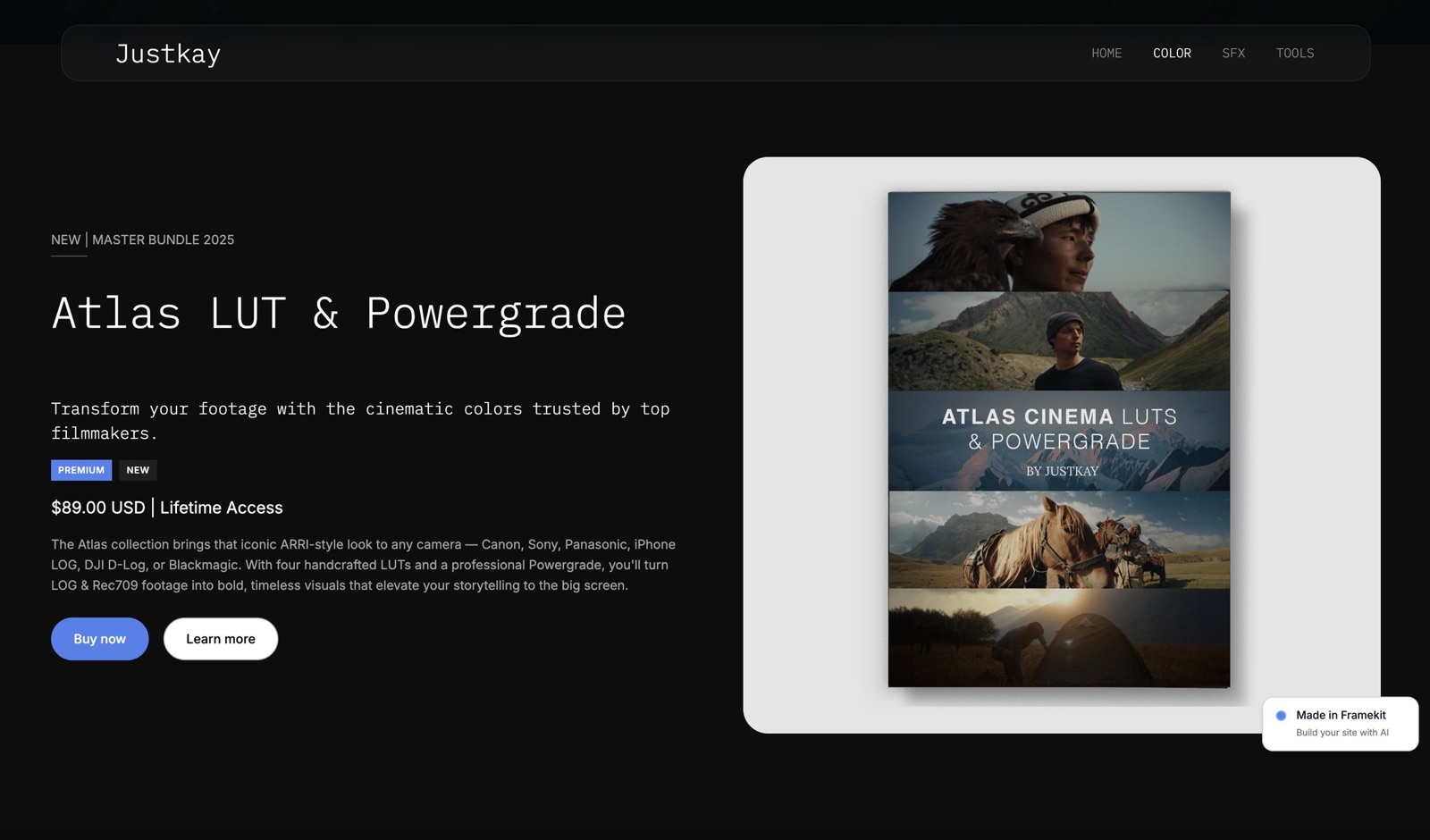
FilterGrade is the marketplace built for precisely this catalog - LUTs, presets, and video tools - with an audience of filmmakers and photographers who are already there to shop for looks (FilterGrade sell).
For a colorist without a following, that built-in buyer traffic is the whole point: FilterGrade runs the store and the delivery, and people who have never heard of you can still find your pack.
The trade is a marketplace commission larger than selling from your own site, and you do not own the customer - the buyer belongs to FilterGrade, so every sale grows its audience rather than your mailing list.
Treat it as a discovery channel, then move repeat buyers to a store you control.
Best forColorists without an audience who want a marketplace of filmmaker buyers already shopping for looks.
Key features:
- A marketplace focused on LUTs, presets, and video tools
- Built-in traffic of filmmakers and photographers
- Store hosting and file delivery handled for you
- Category placement that surfaces your pack to new buyers
- A curated home that signals quality to shoppers
The real numberFilterGrade's pull is buyer traffic you do not have to create, paid for with a marketplace commission higher than an owned store's fee and a customer you never get to keep.
Pricingfree to list, with a marketplace commission taken per sale - check current seller terms.
Pros:
- Built-in filmmaker and photographer buyers
- A niche home dedicated to looks and video tools
- No traffic of your own required to start
Cons:
- A commission larger than selling from your own site
- The buyer stays FilterGrade's, not yours
- Little brand presence beyond a marketplace listing
Skip it ifyou already have a film audience, because then you are handing a cut and the customer to a marketplace you no longer need for discovery.
Verdict: FilterGrade is the best marketplace for LUT discovery when you have no audience yet, best used as a feeder into a store you own. Visit FilterGrade
6. Lemon Squeezy: Tax Handled for You
Our rating: 8.2/10
Lemon Squeezy takes global tax entirely off your desk, acting as merchant of record to collect and remit VAT on every LUT sale at 5% + $0.50 (Lemon Squeezy's pricing), so a $15 pack nets about $13.50 with none of the compliance falling to you.
Its checkout is clean and it is genuinely strong if you sell a LUT membership or a recurring pack subscription.
The catches are small but real: that flat $0.50 stings on a cheap product the way it does on Gumroad, payouts arrive about twice a month rather than instantly, and the checkout is a single page rather than a site where the grade gets shown off.
Best forFilmmakers selling internationally who want tax handled and do not need a presentation-rich store.
Key features:
- Merchant of record collecting and remitting global VAT
- A 5% + $0.50 fee per sale
- A clean, modern checkout
- Strong support for subscriptions and memberships
- Automatic delivery of digital files
The real numberat 5% plus a flat $0.50, a $15 LUT pack nets about $13.50 on Lemon Squeezy, with global tax collected and remitted for you rather than left as a year-end problem.
Pricing5% + $0.50 per sale as merchant of record; payouts roughly twice a month; card processing folded into the fee.
Pros:
- Global tax fully handled as merchant of record
- A clean checkout that suits memberships
- Predictable per-sale pricing
Cons:
- The flat $0.50 bites on a cheap pack
- Payouts land about twice a month, not instantly
- A checkout page, not a site to present the grade
Skip it ifyou want a storefront that shows a look in full, since Lemon Squeezy is a checkout rather than a place a buyer browses your work.
Verdict: Lemon Squeezy is the tax-handled option for selling LUTs across borders, best when compliance matters more to you than presentation. Visit Lemon Squeezy
7. Ko-fi: Best for a Community
Our rating: 8.0/10
Ko-fi fits a filmmaker who sells LUTs beside tips and memberships from an existing community, taking 0% on donations even on the free plan and a low shop fee that Ko-fi Gold trims toward zero for about $12 a month.
It is friendly and quick to set up, and for a creator who already monetizes a following with a few packs it works nicely - the LUT becomes one more thing your supporters can buy without leaving the page they already visit.
The limit is presentation and brand: the storefront is a Ko-fi page, not your film identity, so it shows a cinematic look less fully than a designed site and reads as a creator-support hub rather than a color studio.
Best forFilmmakers monetizing a community who want LUTs alongside tips and memberships in one friendly hub.
Key features:
- 0% on donations, even on the free plan
- A low shop fee for selling digital files
- Ko-fi Gold at about $12 a month to reduce fees further
- Memberships and tips beside your LUT packs
- A quick, approachable setup
The real numberKo-fi's free plan takes nothing on donations and a small cut on shop sales, and about $12 a month for Ko-fi Gold pushes that shop fee toward zero - cheap for a creator already earning from a following.
Pricinga free plan with 0% on donations and a low shop fee; Ko-fi Gold about $12 a month to lower fees; processing applies.
Pros:
- 0% on donations and a low shop fee
- Tips, memberships, and LUTs in one place
- Inexpensive, even at the Gold tier
Cons:
- The storefront is a Ko-fi page, not your brand
- Limited room to present a grade in full
- Built around community support, not a designed store
Skip it ifyou want the LUT sold from a page that looks like your film studio rather than a shared creator-support platform.
Verdict: Ko-fi is the community-first pick for a filmmaker who already earns from a following and wants LUTs as one more offer beside tips and memberships. Visit Ko-fi
8. Podia: Best When You Also Teach
Our rating: 7.8/10
Podia suits a filmmaker who sells LUTs and teaches color grading in the same breath, bundling downloads, courses, and email so a pack can sit right beside the grading lesson that shows people how to use it.
Its free plan was withdrawn in October 2024, so entry is a 14-day trial and then Mover at $42 a month (billed yearly) plus 5%, and the whole tool is built to package education with products.
That makes it heavier than a pure LUT seller needs - you carry course machinery whether or not you teach - but it is a strong fit when the lesson and the look sell together, because the buyer who learns your grade is the buyer most likely to want it.
Best forFilmmakers who teach color grading and want LUTs bundled with courses and an email list.
Key features:
- Downloads, courses, and email in one platform
- LUT packs sold beside grading lessons
- A 14-day trial, then Shaker at $84 a month removes the 5% fee
- Built-in email marketing to your buyers
- Bundling of a product with the course that teaches it
The real numberPodia costs $504 a year for Mover plus 5% of each sale, with the percentage only disappearing at $1,008 a year on Shaker, so the math favors it only once combined LUT-and-course revenue justifies a four-figure annual bill.
Pricingno free plan; Mover at $42 a month billed yearly plus 5%, Shaker at $84 with no Podia fee; processing applies.
Pros:
- Courses, email, and LUT downloads together
- Paid plans remove the transaction fee
- Strong when teaching drives the sale
Cons:
- Heavier than a filmmaker who only sells LUTs needs
- Mover's 5% on top of $42 a month is steep on a cheap pack
- Course tooling goes unused if you do not teach
Skip it ifyou only sell LUTs and never teach, because you would be paying for course machinery that adds nothing to a simple download.
Verdict: Podia is the pick when LUTs sit alongside teaching color, pairing the look with the lesson and an email list in one place. Visit Podia
9. Shopify: Best for a Bigger Brand

Our rating: 7.6/10
Shopify is the full store for a filmmaker building a serious brand with many products, hosted on your own domain behind a checkout buyers trust the world over.
Selling a LUT download, though, means adding its Digital Downloads app to handle delivery, because the platform is built for physical commerce first and treats files as an add-on rather than a native product.
It presents products well on a real page and scales to a broad catalog, but for a single LUT pack the monthly plan plus the delivery app is more overhead than the job needs.
It earns its place when LUTs are one line in a wider product brand, not the whole store.
Best forFilmmakers building a broad product brand who want a full store on their own domain and can carry the overhead.
Key features:
- A full store on your own domain
- A checkout trusted by buyers everywhere
- The Digital Downloads app for file delivery
- Room for a large, mixed catalog
- A wide ecosystem of apps and themes
The real numberShopify's monthly plan plus the Digital Downloads app means the fixed cost sits above a lean LUT tool, so it pays off across a broad catalog rather than a single pack.
Pricingmonthly plans plus processing, with the Digital Downloads app needed to deliver files; costs rise with added apps.
Pros:
- A full store on a domain you own
- A checkout buyers recognize and trust
- Scales to a large, mixed product range
Cons:
- Digital delivery needs an added app
- Built for physical goods before files
- More overhead than a single LUT pack warrants
Skip it ifLUTs are your only product, since a full commerce platform plus a delivery app is more machinery than a lean download store requires.
Verdict: Shopify is the scaling option rather than the lean LUT store, right when your packs are one part of a broad brand you are building out. Visit Shopify
10. Stan Store: Best for Bio-Link Selling
Our rating: 7.5/10
Stan Store is built for selling straight from a social bio link, which fits a filmmaker whose audience taps through from a YouTube description or an Instagram profile, charging 0% transaction fees on a flat subscription of about $29 a month.
As a funnel it is cleaner than a bare link - a tidy mobile page that turns a tap into a purchase - but the storefront is simple and mobile-first, with little room to present a grade in the before-and-after depth a look really sells on.
And the flat cost with no free plan makes it pricey at low volume, so it only pays off once your video audience converts from that link consistently.
Best forFilmmakers with strong social traffic who sell from a bio link and can convert it consistently.
Key features:
- Selling straight from a social bio link
- 0% transaction fees on a flat subscription
- A clean, mobile-first checkout for followers
- A simple funnel from tap to purchase
- A focused store rather than a full site
The real numberat roughly $29 a month and no free tier, that 0% only overtakes a 5% plan once your LUT sales pass about $580 a month, a high bar for a link that sells cheap packs one tap at a time.
Pricinga flat subscription of about $29 a month at 0% transaction fees; no free plan; processing applies.
Pros:
- A genuine 0% on a flat subscription
- Built for bio-link selling to a social audience
- A clean, mobile-first checkout
Cons:
- No free plan, so the cost starts on day one
- Limited room to present a grade
- A focused bio-link store, not a full site you own
Skip it ifyour bio-link traffic does not yet convert steadily, because below that crossover a free percentage plan costs you less.
Verdict: Stan Store is the bio-link option for a filmmaker with social traffic that converts, turning a profile tap into a LUT sale. Visit Stan Store
11. Creative Market: Marketplace for Creatives
Our rating: 7.4/10
Creative Market is a broad marketplace for design and creative assets, LUTs and video tools among them, with a large audience of creatives who arrive ready to buy looks.
Like FilterGrade it brings built-in buyers and runs the store for you, in exchange for a marketplace commission larger than selling independently - check the current seller terms, as they set the cut.
The audience quality is high, which makes it a solid discovery channel for reaching buyers who have never seen your work, but the same marketplace logic applies: the customer is Creative Market's, so the smart play is to use it for first contact and move repeat buyers to a store of your own.
Best forFilmmakers who want reach into a large creative-buyer audience without building their own traffic.
Key features:
- A marketplace spanning design and creative assets
- LUTs and video tools among the categories
- A large, high-quality audience of creatives
- Store hosting and delivery handled for you
- Discovery for sellers without their own traffic
The real numberCreative Market's draw is a large creative audience you do not have to build, paid for with a commission above an owned store's fee and a buyer relationship the marketplace keeps.
Pricingfree to list, with a marketplace commission per sale - confirm current seller terms.
Pros:
- A large, high-quality creative audience
- Built-in discovery for new sellers
- The store and delivery run for you
Cons:
- A commission larger than an independent store
- The customer belongs to the marketplace
- Terms and cut can change with policy
Skip it ifyou already reach your own buyers, because the commission and the lost customer are only worth paying for discovery you still need.
Verdict: Creative Market suits a filmmaker who wants creative-buyer reach without building traffic, best treated as a discovery feeder into a store you own. Visit Creative Market
12. Etsy: Best for Search Traffic
Our rating: 7.2/10
Etsy brings its own search traffic - people really do search it for LUTs and video presets - which helps a seller who has no audience of their own to lean on.
The cost is a fee stack that adds up fast on a cheap product: $0.20 per listing, 6.5% of the sale, payment processing, and a possible 15% Offsite Ads charge that together can take about a quarter of a $15 pack, and Etsy keeps the customer as its own.
Its listing also frames a cinematic grade as a small thumbnail among crafts and printables, which undersells a film look badly.
Use Etsy as a discovery feeder and treat its fees as paid acquisition, then move repeat buyers to a store you own.
Best forSellers with no audience who want marketplace search traffic and will treat the fees as paid acquisition.
Key features:
- Built-in search traffic for LUTs and video presets
- A large general marketplace audience
- Listing and delivery handled by the platform
- Optional Offsite Ads for extra reach
- A familiar, trusted checkout for buyers
The real numberon a $15 LUT pack Etsy's $0.20 listing fee, 6.5% cut, processing, and a possible 15% Offsite Ads charge can stack to roughly a quarter of the sale, and the buyer stays Etsy's rather than becoming yours.
Pricing$0.20 per listing plus 6.5% plus processing, with a possible 15% Offsite Ads fee on some sales.
Pros:
- Real search traffic you do not have to build
- A large, trusting marketplace audience
- The platform handles listing and delivery
Cons:
- Fees stack toward a quarter of a cheap pack
- A thumbnail listing undersells a cinematic grade
- Etsy keeps the customer relationship
Skip it ifyou already have buyers of your own, since Etsy's stacked fees only make sense as payment for discovery you still lack.
Verdict: Etsy suits a seller who wants search traffic and treats it as paid acquisition, best used as a feeder into a store you eventually own. Visit Etsy
What Selling LUTs Actually Costs
In one lineLUTs are cheap, so the flat per-sale fee decides your margin as much as the percentage - a marketplace at 10% + $0.50 takes about 18% of a $15 pack, while a 0% plan keeps roughly $2 more per sale, about $400 a month at 200 sales.
The headline rate hides the real cut on a cheap product. Our filmmaker sells a $15 LUT pack, 200 a month, $3,000 in sales. On Gumroad, 10% + $0.50 plus processing keeps about $2.74 per sale - around $550 a month.
On Framekit's Business plan at 0%, the platform keeps nothing beyond processing for a flat $39, so the same sales keep about $360 a month more after the plan, from an audience you already own.
Because LUTs sell to a following you built, the marketplace cut is usually the hardest to justify - you are paying to reach people who already watch your channel.
Run the math on your own pack: subtract the platform's percentage, flat fee, and processing from your price, and multiply by your monthly sales.
On a $15 LUT, the gap between a marketplace and a store you own is larger than it looks, because the flat fee is a bigger share of a small price - the same trap we cover for the best platforms to sell presets.
Presentation Sells the Look
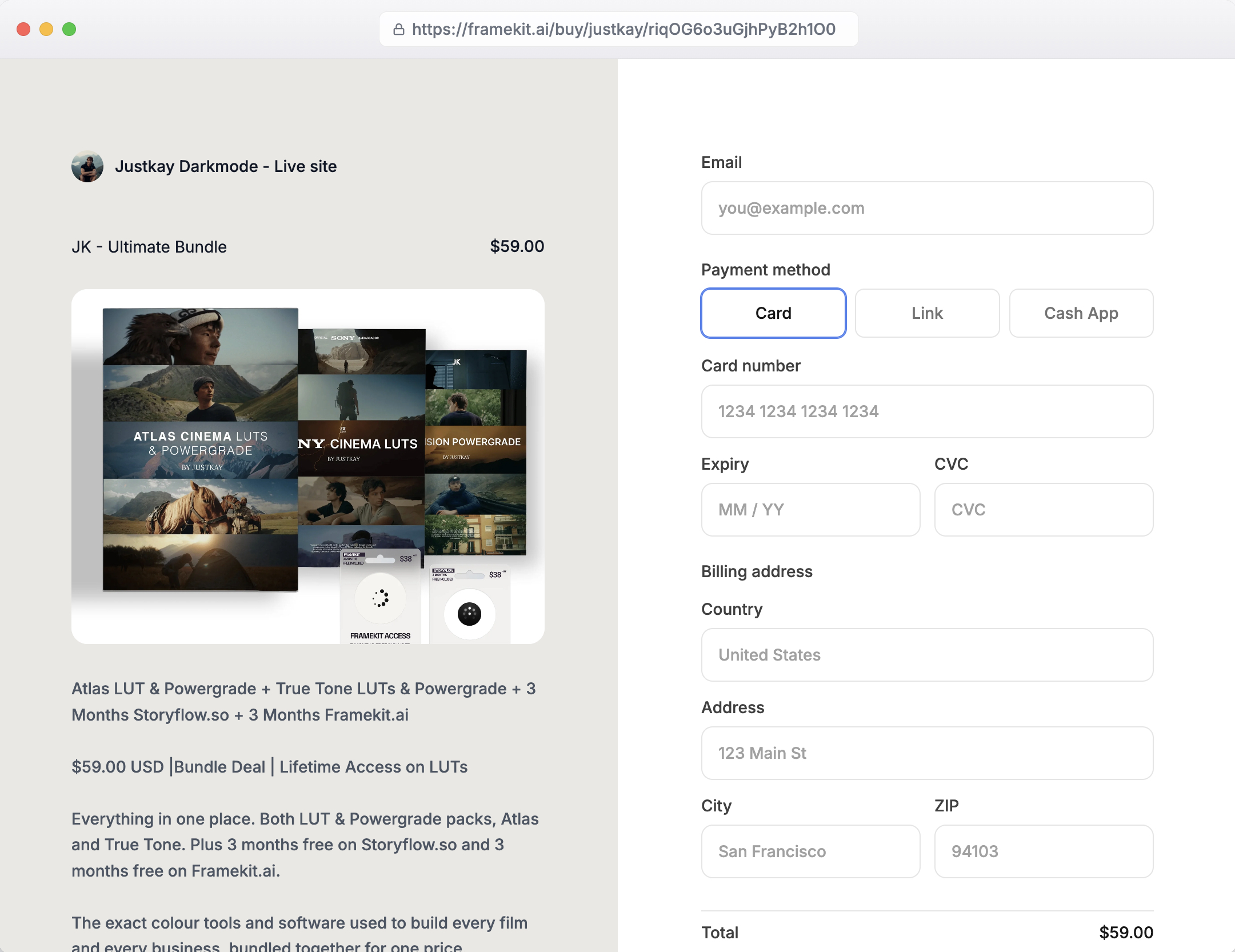
In one linea LUT is bought on the before-and-after, so the platform that lets you present the grade at full size with sample footage sells more than one that shows a thumbnail - which is why a site you design beats a marketplace listing for LUTs specifically.
LUTs are unusual among digital products because the product is invisible until applied - nobody buys a .cube file, they buy the transformation it makes. That means presentation is not a nicety; it is the sale.
A buyer needs to see the ungraded frame, the graded frame, and ideally moving footage, at a size that reads, before they believe the look is worth $15. A marketplace thumbnail cannot do that, and a bare checkout link barely tries.
A website you design can show the before and after full-width, embed sample clips, and tell the story of the grade - which is exactly what converts a viewer who already trusts your color work.
This is why, for LUTs more than most products, selling from your own site is not just about fees but about showing the look, a point our best website builders for filmmakers guide develops.
How to Choose a Platform to Sell LUTs: A Decision Tree
Start from your audience, and take the first branch that fits.
Do you already have a video audience that would buy your LUTs?
- Yes, a YouTube channel, Instagram, or client base. Sell from a store you own: Framekit to present the grade and keep the most, Payhip for a free dedicated store, or Sellfy for 0% fees on a paid plan.
- No, I need filmmakers to discover me. Go to the next question.
Do you want a marketplace's built-in LUT buyers?
- Yes, discovery matters most now. Choose FilterGrade for a filmmaker audience, or Creative Market for creatives - then move repeat buyers to your own store.
- No, I just want the fastest first sale. Choose Gumroad, and accept the fee while you prove the look sells.
Need tax handled or extra products?
- Global sales, no tax hassle: Lemon Squeezy or Gumroad, both merchant of record.
- LUTs plus a grading course: Podia. Selling from a bio link: Stan Store.
Frequently Asked Questions
What is the best platform to sell LUTs in 2026?
The best platform to sell LUTs in 2026 is Framekit, because you sell from a website you own where you can present the grade with before-and-after previews and sample footage, keep your video audience and email list, and pay a fee that drops to 0% on a flat plan.
The trade-offs are that you handle your own tax and bring your own audience - so if you have no following, FilterGrade brings filmmaker buyers, and Gumroad or Lemon Squeezy handle tax as merchant of record.
How much do platforms take when you sell LUTs?
It varies, and on a cheap LUT pack the flat fee matters as much as the percentage.
Gumroad takes 10% + $0.50 plus processing, about 18% of a $15 pack; Payhip and Framekit's free plan take 5%; Lemon Squeezy takes 5% + $0.50; Etsy takes 6.5% + $0.20 plus possible ads; and marketplaces like FilterGrade take a larger commission for discovery.
Framekit's fee drops to 0% on Business, keeping the most on a cheap pack.
Why does presentation matter more for LUTs than other products?
Because a LUT is invisible until applied - buyers do not buy the .cube file, they buy the color transformation, which they must see to believe.
Unlike an ebook or a template, a LUT needs a before-and-after and ideally sample footage at a readable size to convince a buyer, so the platform's ability to present the grade directly affects sales.
A marketplace thumbnail undersells a cinematic look; a website you design can show it full-width, which is why presentation is weighted heavily for LUTs.
Can I sell LUTs from my own website?
Yes, and it is the best option if you have a video audience.
With Framekit you sell LUTs from your own website (on your own domain from Starter, with a Framekit-hosted checkout), present the grade with before-and-after images and footage, keep the customer and email list, and pay a fee that drops to 0%.
Most marketplaces host your listing and keep the customer, and a bare checkout link cannot present the look, so selling from your own site is what lets you both show the grade properly and keep the most of each sale.
What file format should I deliver LUTs in?
Deliver LUTs as .cube files, the most widely supported format across DaVinci Resolve, Premiere Pro, Final Cut Pro, and most grading software, and consider including both standard and log-to-Rec709 variants if relevant.
Package them with a short install guide showing how to load the LUT in the main editors and note which color spaces the pack is built for, so buyers can actually apply them.
The best platforms - Framekit, Payhip, Gumroad - deliver the zip automatically, so include the guide inside it.
Do I need an audience to sell LUTs?
To sell from your own store, effectively yes - a store you own has no built-in traffic, so you need a following, channel, or client base to send buyers.
Most filmmakers selling LUTs already have that from their video work, which is why an owned store fits the niche so well.
If you have no audience, a marketplace like FilterGrade or Creative Market brings filmmaker buyers, which is worth their commission early on. The honest path is a marketplace for discovery, then your own store for your audience.
FilterGrade vs selling from my own site for LUTs?
FilterGrade is better when you have no audience, because it brings filmmakers already shopping for LUTs, in exchange for a marketplace commission and keeping the customer.
Selling from your own site with Framekit is better once you have a following, because you present the grade fully, keep the customer and email list, and pay a fee that drops to 0%.
Since most LUT sellers already have a video audience, an owned site usually keeps more; use FilterGrade to reach new buyers and your own store for repeat ones.
What is the cheapest way to sell LUTs?
Long-term, the cheapest way is a store you own with a fee that drops to 0%, like Framekit's Business plan, because a percentage scales with sales while a flat fee does not.
Below a modest volume, a 5% free plan like Framekit's or Payhip's is cheapest with no subscription.
Marketplaces are the most expensive per sale but the cheapest way to reach buyers you cannot find yourself, so the cheapest option depends on whether you have an audience.
Gumroad vs Framekit for selling LUTs: which keeps more?
Framekit keeps more of each LUT sale.
On a $15 pack, Gumroad's 10% + $0.50 plus processing leaves about $12.26, while Framekit's Business plan (0% fee) leaves about $14.26, and even the free plan (5%) leaves about $13.51 - all more than Gumroad.
Beyond the fee, Framekit lets you present the grade with before-and-after on a site you own, while Gumroad shows a basic page. Gumroad wins on speed and tax handling; Framekit wins on cost, presentation, and owning your audience.
Can I sell LUTs and presets on the same platform?
Yes. LUTs and Lightroom presets sell through the same platforms as digital downloads, and the same economics apply - both are cheap, so flat fees bite, and an owned store keeps the most for a creator with an audience.
A filmmaker who shoots stills and video can sell both a LUT pack and a preset pack from one Framekit store, presenting each with before-and-after.
Our best platforms to sell presets guide covers the photo side, and the platform choice is the same for both.
How do I present a LUT before someone buys it?
Show the before-and-after: an ungraded frame next to the graded frame, ideally several across different scenes and lighting, plus short sample footage with the LUT applied.
State what the pack is built for - camera profiles, log formats, and software - so buyers know it fits their footage.
A website you design lets you show these full-width with the story of the grade, which sells a look far better than a marketplace thumbnail, so present on a real page rather than a bare checkout link wherever you can.
Final Verdict: The Best Platform to Sell LUTs
LUTs sell on a look, to an audience you built with your video work, and they are cheap - which means the platform decides both how well you show the grade and how much of a small price you keep.
Most selling tools do neither well, presenting a cinematic look as a thumbnail and taking a fifth of a $15 pack.
Framekit is the best platform to sell LUTs in 2026 for a filmmaker with an audience.
You sell from a website you own where the grade gets a full page of before-and-after, keep your video following and email list, and pay a fee that drops to 0% - keeping about $2 more per sale than a marketplace while actually showing the look.
Where Framekit loses: colorists with no audience yet, who need a marketplace's filmmaker buyers - FilterGrade brings discovery Framekit does not - and anyone who never wants to touch tax, where Gumroad and Lemon Squeezy handle it as merchant of record.
Payhip is the best free store, Gumroad is the fastest first sale, and FilterGrade is the best LUT marketplace for discovery. But if you have a video audience, sell LUTs from a site you own where you can show the grade and keep what you earn.
For more, read our best platforms to sell presets, our best free product-selling software comparison, the best website builders for filmmakers, our best Gumroad alternatives, and if you license clips as well as looks, the best places to sell stock footage.
_LUT-platform fees and terms re-checked against each vendor's pricing, July 2026._