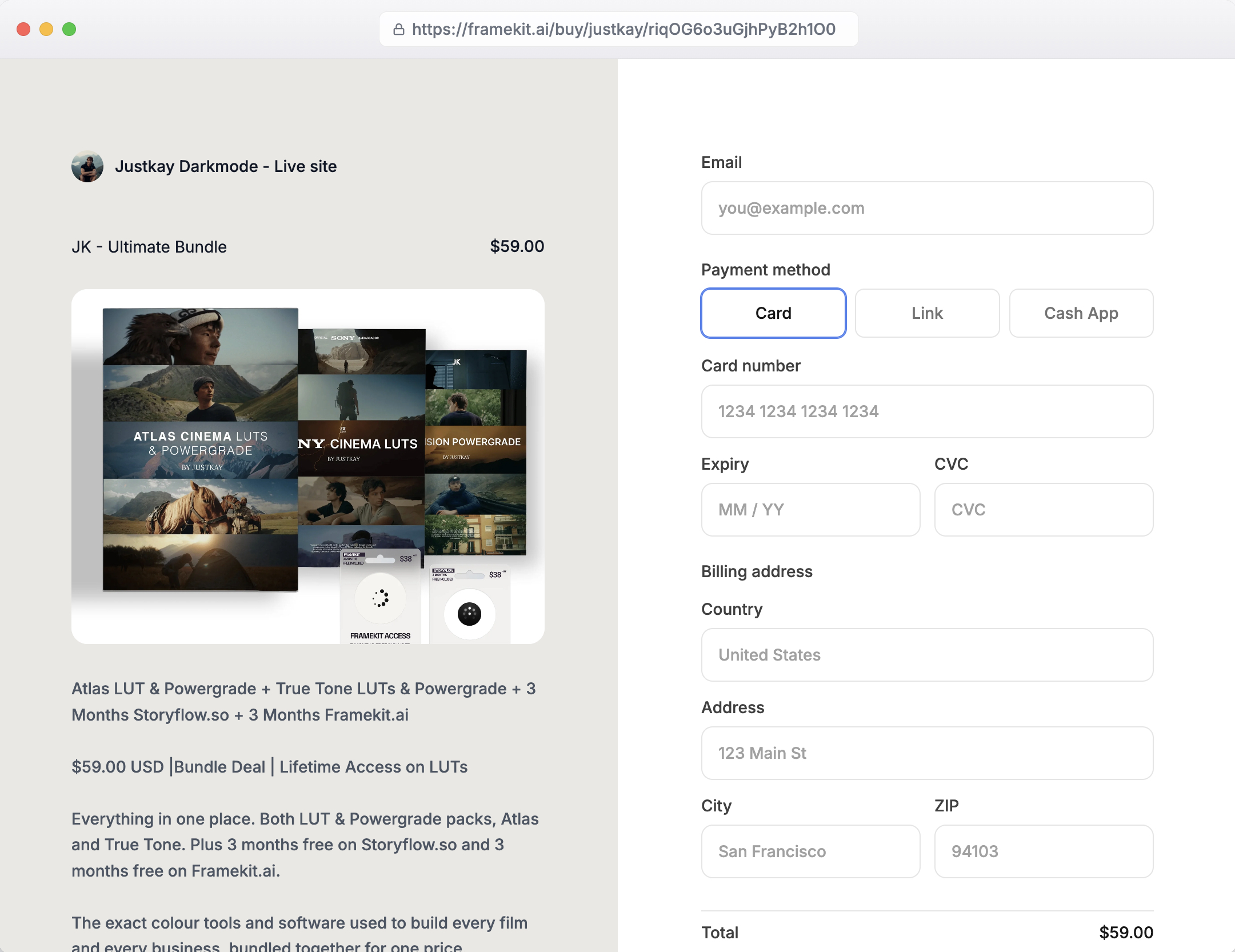
Framekit templates
Start from a designer-made template
 Use template
 Use template
 Use template
 Use template
 Use template
 Use template
 Use template
 Use template
Sellfy is a capable store with a pitch that holds up: no transaction fees, print-on-demand merch, PDF stamping, video streaming and email marketing in one place. The catch sits in two lines of its pricing page.
There is no free plan, only a 14-day trial, so a product you have not yet proven costs at least $22 a month billed yearly or $29 monthly.
And every plan has an annual sales ceiling, $10,000 on Starter, so a good year moves you up a tier whether or not you wanted the extra features.
That is why sellers look for a Sellfy alternative in 2026. Below about $440 a month in sales, a free plan that takes 5% costs less than Sellfy Starter.
Above about $833 a month, Starter's ceiling forces Business at $59 or $79 a month, and several alternatives reach 0% for less. In between, Sellfy Starter is honestly the cheapest store on this page.
A Sellfy alternative is a platform for selling digital products that a creator switches to when Sellfy's subscription before the first sale, its annual sales ceilings or its store-only format outweigh its 0% transaction fee and built-in marketing tools.
The best Sellfy alternative in 2026 is Framekit for creatives who sell downloads beside their portfolio, because it starts free, has no sales ceiling, and reaches a 0% fee on its $39 Business plan ($31 billed yearly), which is cheaper than every Sellfy plan once sales pass about $833 a month: $1,356 a year at $2,000 a month against $1,692 on Sellfy Business billed yearly.
Between about $440 and $833 a month, Sellfy Starter is cheaper than Framekit. Payhip is the best free store if you want PDF stamping and courses, Shopify is the pick for print-on-demand at scale, and Big Cartel and Stan Store reach 0% for less if you do not need a full site.
Full disclosure: Framekit is our product and ranks first on the weights we publish below. We did not build stores on these platforms or list a product on each; an earlier version of this page said we had, and that claim has been removed along with the "Tested" label. Every Sellfy figure was re-verified on its pricing page and help docs on 12 October 2026, when its prices were $29, $79 and $159 a month, or $22, $59 and $119 billed yearly.
How These Sellfy Alternatives Were Compared
This guide compares each alternative's published pricing and documentation against Sellfy's, prices one carried product at three sales volumes, and scores each tool on weighted criteria, and it reports no test purchases, store builds or timed setups.
Read at the source on 12 October 2026. Sellfy's pricing page, its features page and its subscription and billing doc; the pricing pages of Payhip, Stan Store, Big Cartel, Ecwid, Squarespace, Polar and Stripe; and Gumroad's, Lemon Squeezy's, Podia's, Shopify's and Etsy's terms from our 12 October checks.
Squarespace and Shopify served euro prices to our read; Ko-fi's and Etsy's pages refused it. Each is noted where it applies.
Read in the product. Framekit charges each sale on the seller's own connected Stripe account and takes its fee after any discount code.
Calculated. A $25 preset pack sold to US card buyers at $500, $2,000 and $5,000 a month, which is 20, 80 and 200 sales, with card processing at 2.9% plus 30 cents on every non-merchant platform, Sellfy included.
Each Sellfy figure uses the cheapest plan whose ceiling covers that year.
The weights. Cost to start and to run carries 45%, because the reason most people question Sellfy is paying before the first sale and paying for a tier after a good month.
The store and site you get carries 30%, because this blog writes for creatives who need a portfolio anyway. Selling features (merch, email, upsells, file protection, tax help) carries 25%.
How the weights change the answer. Framekit leads on the first two and scores near the bottom on the third.
Raise selling features to 40% and Payhip and Shopify both move above Framekit, and Sellfy itself would beat most of this list. Ignore the site and Big Cartel's $15 plan is the cheaper store.
Sellfy in Numbers
Seven figures from Sellfy's own pages decide whether leaving makes sense, and most of them are about when the subscription stops being a bargain rather than what the store can do.
- $22, $59 and $119 a month billed yearly for Starter, Business and Premium; $29, $79 and $159 monthly.
- $10,000, $50,000 and $200,000 are the annual sales ceilings on those plans.
- 2% is the overage fee Sellfy may charge on revenue above your ceiling if you do not upgrade.
- 14 days is the free trial, with no card needed; there is no free plan.
- 2.64% is Starter's effective rate when you fill its ceiling on yearly billing ($264 on $10,000).
- 5 download attempts per file per purchase, across devices.
- 30 days after a cancelled plan ends, Sellfy deletes the product files stored on its servers.
The 12 Alternatives at a Glance
The table sorts the twelve Sellfy alternatives by this guide's ranking and shows what each charges, whether it has a free plan, whether it caps your sales, and the one thing it does worse than Sellfy.
| Rank | Platform | Free plan | Fee model | Sales ceiling | Where Sellfy beats it |
|---|---|---|---|---|---|
| 1 | Framekit | Yes | 5% Free, 3% Pro, 0% Business ($39, $31 yearly) | None | No merch, email sending, upsells or PDF stamping |
| 2 | Payhip | Yes | 5% Free, 2% Plus ($29), 0% Pro ($99) | None | No built-in print-on-demand |
| 3 | Shopify | No, short trial | 0% with Shopify Payments; Basic $39, $29 yearly | None | Digital delivery needs an app |
| 4 | Big Cartel | Limited Gold plan | No transaction fee listed; Platinum $15, Diamond $30 | None listed | Fewer marketing tools |
| 5 | Stan Store | No, 14-day trial | 0%; $29 a month or $300 a year | None | A bio-link page, not a store |
| 6 | Gumroad | Yes | 10% + $0.50 + processing | None | Far more per sale |
| 7 | Lemon Squeezy | Yes | 5% + $0.50, processing included | None | No paid plan to cut the fee |
| 8 | Squarespace | No, 14-day trial | 2% on Basic, 0% from Core | None | Priced like Sellfy before the store |
| 9 | Ko-fi | Yes | 5% on shop sales; Gold about $12 for 0% | None | A support page, not a store |
| 10 | Podia | No, 14-day trial | 5% on Mover ($42 yearly), 0% on Shaker ($84) | Product caps | No merch |
| 11 | Ecwid | No | 0%; Venture $35, $29 yearly | 100 products on Venture | No built-in print-on-demand listed |
| 12 | Etsy | No monthly fee | $0.20 listing, 6.5% + processing | None | You do not own the buyer |
How the top five placed on each criterion
| Platform | Cost to start and run (45%) | The store and site (30%) | Selling features (25%) |
|---|---|---|---|
| Framekit | 5/5 | 5/5 | 1/5 |
| Payhip | 4/5 | 3/5 | 4/5 |
| Shopify | 3/5 | 4/5 | 5/5 |
| Big Cartel | 5/5 | 3/5 | 2/5 |
| Stan Store | 3/5 | 2/5 | 3/5 |
| Sellfy itself, for reference | 3/5 | 3/5 | 5/5 |
Framekit's features score is the lowest on the board, below Sellfy, and that row is the honest price of ranking it first.
What Sellfy and the Alternatives Cost Over a Year
At $2,000 a month in sales of a $25 product, Sellfy costs $1,692 a year on Business billed yearly, against $1,356 on Framekit Business, $1,284 on Stan Store Creator, $1,332 on Shopify Basic and $1,164 on Big Cartel Platinum, all billed yearly with processing included.
Every figure is the full annual cost to the seller: the plan, any platform percentage or fixed fee, and card processing. Squarespace is left out because its page served euro prices only.
| Platform, cheapest setup at each volume | $500 a month | $2,000 a month | $5,000 a month |
|---|---|---|---|
| Sellfy, yearly billing | $510 (Starter) | $1,692 (Business) | $3,888 (Premium) |
| Sellfy, monthly billing | $594 | $1,932 | $4,368 |
| Framekit (Free, then Business yearly) | $546 | $1,356 | $2,832 |
| Payhip (Free, Plus, then Pro) | $546 | $1,812 | $3,648 |
| Shopify Basic, yearly | $594 | $1,332 | $2,808 |
| Big Cartel Platinum, $15 a month | $426 | $1,164 | $2,640 |
| Stan Store Creator, yearly | $546 | $1,284 | $2,760 |
| Gumroad, direct sales | $966 | $3,864 | $9,660 |
| Lemon Squeezy | $420 | $1,680 | $4,200 |
| Ko-fi (Gold at about $12 a month) | $390 | $1,128 | $2,604 |
| Podia (Mover, then Shaker, yearly) | $1,050 | $1,992 | $3,468 |
| Ecwid Venture, yearly | $594 | $1,332 | $2,808 |
| Etsy, no Offsite Ads | $678 | $2,712 | $6,780 |
Three things the table says. First, at $500 a month Sellfy Starter billed yearly is cheaper than Framekit, Payhip, Stan and Shopify; it loses only to Lemon Squeezy, Ko-fi Gold and Big Cartel.
Second, at $2,000 and $5,000 a month Sellfy's ceilings push it to Business and Premium, and nearly every flat-fee alternative undercuts it.
Third, Big Cartel's figures assume no transaction fee, because its pricing page lists none; check before relying on them.
Where Framekit and Sellfy cross
| Monthly sales | Cheapest of the two | Why |
|---|---|---|
| Under about $440 | Framekit Free | 5% is less than Starter's $22 a month billed yearly ($580 on monthly billing) |
| About $440 to $833 | Sellfy Starter | Its flat $22 to $29 beats both 5% and Framekit Business's $31 to $39 |
| Above about $833 | Framekit Business | Starter's $10,000 ceiling is gone, and Sellfy Business costs $59 to $79 |
| Above $50,000 a year | Framekit Business, widening | Sellfy needs Premium at $119 to $159 |
Run it yourselftake your best month, not your average, and multiply by twelve. If the answer is under $10,000, Sellfy Starter billed yearly is hard to beat on price.
If it is over, compare your Sellfy tier's monthly cost with $31 (Framekit Business yearly), $25 (Stan Creator yearly), $29 (Shopify Basic yearly) or $15 (Big Cartel Platinum); processing is the same on all of them and drops out.
1. Framekit: Best Sellfy Alternative for Creatives With a Portfolio

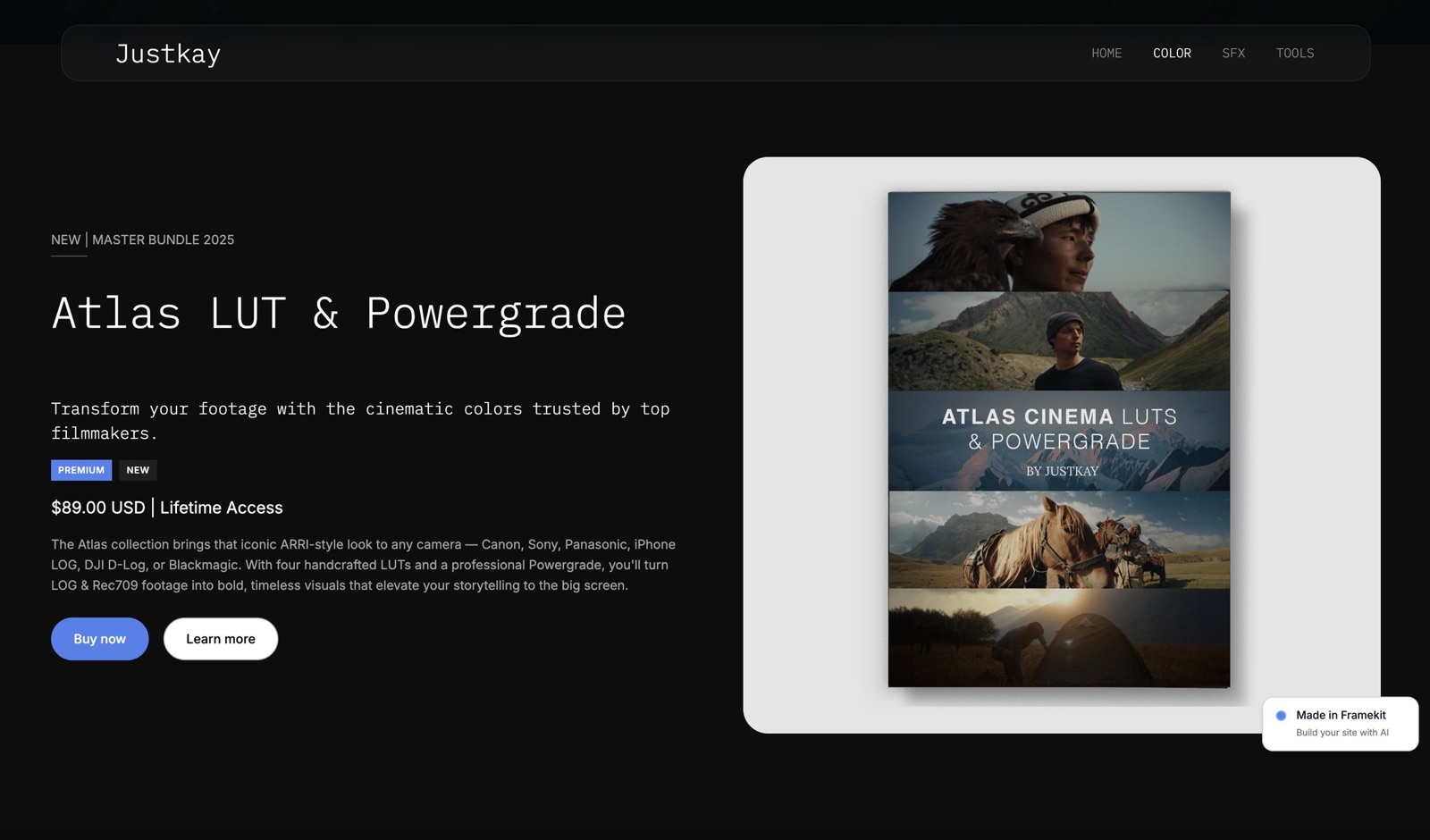
Framekit is an AI website builder with a digital-download store, client galleries, Frame.io-style video review and Slides decks in one account, and it ranks first for photographers, filmmakers and designers who want to stop paying before the first sale and stop watching a sales ceiling.
The texture. You add a product with a file, price and cover, and it appears as a section on any page of your portfolio site and as a direct buy link at framekit.ai/buy that sells with no site at all.
Buyers pay through your own Stripe account and download on the confirmation page. Products are unlimited on every plan, free products work as lead magnets, and there is no annual sales cap on any tier.
The number that matters$833 a month. Above it, Framekit Business at $31 a month billed yearly is cheaper than every Sellfy plan: $1,356 a year at $2,000 a month against $1,692 on Sellfy Business, and $2,832 at $5,000 a month against $3,888 on Sellfy Premium.
The standout detailthe fee is charged on the amount after a discount code, so a launch at 40% off pays 5% of $15 rather than $25 on Free, and nothing on Business.
The gotchaFramekit loses to Sellfy on features. It has no print-on-demand, no physical products, no subscriptions, no email sending, no upsells or abandoned-cart emails, no affiliates and no PDF stamping.
It is not a merchant of record and does not calculate VAT at all, where Sellfy at least calculates EU and UK VAT for you.
It keeps its fee on refunds, sends 7-day download links you can resend, does not push updated files to past buyers, and opens checkout at framekit.ai/buy with a "Powered by Framekit" line on every plan.
Skip it ifyou sell merch, subscriptions or courses, rely on Sellfy's email credits and upsells, or sell between about $440 and $833 a month, where Sellfy Starter is the cheaper store.

PricingFree $0 (5%), Starter $9 a month (5%, own domain), Pro $19 (3%, discount codes), Business $39 (0%); $7, $15 and $31 billed yearly.
Verdict: the best Sellfy alternative for a creative selling downloads beside client work, from the first sale up, with one honest exception: in the $440 to $833 a month band, stay on Sellfy Starter until your best month says otherwise.
2. Payhip: Best Free Store With Sellfy's File Protection
Payhip is the closest thing to a free version of Sellfy, because its free plan carries every feature its paid plans have, including PDF stamping, download limits, courses, memberships, coaching and affiliates, and it collects and remits EU and UK VAT, which Sellfy does not.
The real numberthe free plan takes 5% per sale, $546 a year at $500 a month. Plus at $29 a month and 2% is Payhip's cheapest plan from about $967 to $3,500 a month, and Pro at $99 removes the fee entirely, costing $3,648 a year at $5,000 a month against $3,888 on Sellfy Premium.
The standout detailPDF stamping with buyer details, three downloads per file by default and expiring links, which covers most of Sellfy's anti-piracy pitch.
The gotchano built-in print-on-demand, and the store is a Payhip storefront rather than a portfolio site.
Verdict: the right move for a Sellfy seller who uses its file protection and email tools but wants a free start and European VAT handled. The best Payhip alternatives covers the step up.
3. Shopify: Best for Print-on-Demand and Physical Products

Shopify is the Sellfy alternative for a seller whose merch is a real business line, because it is a full store on your own domain with no platform fee on Shopify Payments and the widest range of third-party print-on-demand and fulfilment apps of any tool here.
The real numberBasic costs $39 a month or $29 billed yearly in the US, with online card rates from 2.9% plus 30 cents, and a 2% fee if you use a third-party payment provider.
That is $1,332 a year at $2,000 a month billed yearly, $360 below Sellfy Business.
Shopify's page served euro prices to our October read, so the dollar figures come from our Shopify vs Gumroad check.
The gotchadownloads run through Shopify's free Digital Downloads app, capped at 50 files and 5GB per variant, and there is no free plan. Shopify calculates tax but you register and file.
Verdict: the best home for a merch-and-download brand that has outgrown Sellfy's built-in print-on-demand, and more machinery than a downloads-only seller needs. Squarespace vs Shopify compares the two site-first options.
4. Big Cartel: Cheapest Flat Plan for a Small Catalogue
Big Cartel is the cheapest flat-fee Sellfy alternative here for an artist with a small catalogue, because its pricing page lists Platinum at $15 a month after a 7-day trial and Diamond at $30, lists no transaction fee, and includes physical and digital products on Platinum.
The real numberat $15 a month, Platinum costs about $1,164 a year at $2,000 a month with processing, second only to Ko-fi Gold in this guide, assuming no Big Cartel transaction fee.
The standout detailDiamond adds abandoned-cart recovery and scheduled product drops, two of the marketing features Sellfy reserves for Business.
The gotchathe free Gold plan exists but its limits are not described on the pricing page, and Big Cartel's tools lean toward physical goods; its marketing is lighter than Sellfy's email credits.
Verdict: the cheapest way off Sellfy's tiers for an artist selling a handful of prints and downloads, and too lean for a large digital catalogue.
5. Stan Store: Cheapest 0% Plan for Selling From a Bio Link
Stan Store is a link-in-bio storefront that charges 0% on every sale, and its Creator plan at $300 a year works out at $25 a month, less than Sellfy Starter's monthly price and with no sales ceiling.
The real numberStan's own pricing article lists Creator at $29 a month or $300 a year and Creator Pro at $99 a month or $948 a year, both at 0%, with a 14-day trial. At $2,000 a month that is $1,284 a year billed yearly, $72 below Framekit Business and $408 below Sellfy Business.
The gotchadiscount codes, upsells, order bumps, email broadcasts and flows, affiliates and buy-now-pay-later all sit on Creator Pro at $99, so matching Sellfy Business's marketing costs more than Sellfy Business. The storefront is a mobile bio page, not a store or a site.
Verdict: the cheapest 0% option for a creator who sells from social and does not need a site. Stan Store pricing and the best Stan Store alternatives go further.
6. Gumroad: Best for Testing a Product With No Subscription
Gumroad is the opposite of Sellfy's pricing model, nothing a month and a large cut of each sale, which makes it the best place to test a product you have not proven, and it has been the merchant of record since 1 January 2025.
The real numbera $25 direct sale leaves $20.97 after 10% plus 50 cents and processing, so $2,000 a month costs $3,864 a year, more than double Sellfy Business. Sellfy beats Gumroad on a $25 product from about 7 sales a month on Starter billed yearly.
The standout detailGumroad files sales tax and VAT worldwide, returns its own fee when you refund, and can surface products on Discover, at 30% for sales it brings.
Verdict: the right test bed before Sellfy or any flat plan, and the wrong home once you sell every week. Sellfy vs Gumroad prices that pairing in detail.
7. Lemon Squeezy: Best for Tax Handled With No Subscription
Lemon Squeezy is a merchant of record that charges 5% plus 50 cents per order with card processing and global tax included, so it is the cheapest Sellfy alternative at $500 a month for a seller who wants VAT filed for them.
The real number$420 a year at $500 a month, against $510 on Sellfy Starter billed yearly, then $1,680 at $2,000 a month.
It has no paid plan, so the rate never falls: Sellfy Starter billed yearly is cheaper from about $760 to $833 a month, and Sellfy Business only overtakes it above about $2,030.
The gotchapayouts are paid twice a month after a 13-day hold with a $50 minimum, and its January 2026 update said the team's focus has moved to Stripe Managed Payments. The best Lemon Squeezy alternatives covers what that means.
Verdict: the tax-handled answer for small international sellers, with a planning horizon to keep in mind.

8. Squarespace: A Design-Led Site With a Store

Squarespace wraps the store in a polished general-purpose website, sells digital products on every plan, and charges no online-store transaction fee from its Core plan up, so it suits a seller who wants a design-led site and does not need Sellfy's merch.
Its pricing page served euro prices to our October read: Basic at €15 a month or €11 billed annually with a 2% store transaction fee, Core at €24 or €17 with 0%, and Advanced at €42 or €29 with 0%.
Courses and memberships carry a separate fee of 7%, 5% and 0% by plan. There is a 14-day free trial.
The real numberCore at €17 a month billed annually is a 0% store at roughly Sellfy Starter's price, with no sales ceiling.
The gotchano free plan, and Basic's 2% applies until you upgrade.
Verdict: a strong choice for a seller who wants a general website first and a store second. Website builders to sell digital products compares it with Framekit.
9. Ko-fi: Cheapest 0% Route for a Creator With a Following
Ko-fi suits a creator whose income is mostly tips and memberships with a few products on the side, because the free plan takes no Ko-fi fee on tips and 5% on shop sales, and Ko-fi Gold removes the shop fee for about $12 a month.
Ko-fi's page refused our automated read in October 2026, so the Gold price comes from its previously published terms.
The real numberabout $1,128 a year at $2,000 a month on Gold with processing, the lowest figure for any storefront in this guide.
The gotchathe page is built around support buttons, not a product catalogue, and nothing here files tax.
Verdict: the cheapest exit from Sellfy for a community-funded creator, and too thin as a primary store. Ko-fi alternatives covers the neighbours.
10. Podia: Best When Courses Matter More Than Merch
Podia is the Sellfy alternative for a creator whose downloads sit beside courses, memberships, coaching and an email list, because it bundles all of those, though it has no free plan and no print-on-demand.
Its pricing page lists Mover at $42 a month billed yearly with a 5% fee, Shaker at $84 with none, and Earthquaker at $150, with email to 100, 500 and 1,000 subscribers and a 14-day trial.
The real number$1,992 a year at $2,000 a month on Shaker, $300 above Sellfy Business, with the course player and email tool included.
Verdict: a better fit than Sellfy for teachers and a worse one for merch sellers. Framekit vs Podia compares the download side.
11. Ecwid: Best for Adding a Store to a Site You Already Have
Ecwid adds a store to a website you already run, charges no transaction fees on any plan, and handles digital goods from its Venture plan, but it no longer lists a free plan for new stores, so the old advice to start on Ecwid for free no longer applies.
Its pricing page lists Starter at $5 a month for up to 10 products, Venture at $35 a month or $29 billed annually for up to 100 products and digital goods, Business at $65 or $49 for 2,500 products, and Unlimited at $149 or $119, with digital files up to 25GB each from Venture up.
The real number$1,332 a year at $2,000 a month on Venture billed annually, $360 below Sellfy Business.
The gotchaStarter does not list digital goods, so a downloads seller starts at Venture, and the store is an embed rather than a destination.
Verdict: the right tool for a seller with a site they love who only needs a cart.
12. Etsy: Best for Buyers You Do Not Have Yet
Etsy is the only Sellfy alternative that brings its own shoppers, which makes it the best first channel for a seller with no audience, at the cost of fees that stack and a customer relationship Etsy keeps.
Etsy's pages block automated reads, so these figures come from our October Etsy vs Framekit check: $0.20 per listing, a 6.5% transaction fee, processing of 3% plus 25 cents, and Offsite Ads at 15%, or 12% for shops over $10,000 a year, where they become mandatory.
The real number$2,712 a year at $2,000 a month without ads, $1,020 more than Sellfy Business; a $25 sale through Offsite Ads at 15% leaves $18.42.
Verdict: use Etsy to find buyers and a store you own to keep them. The best Etsy alternatives for digital products covers the move.
Where Sellfy Still Wins
Sellfy remains the better choice for a seller who uses its built-in extras and sits inside one of its bands, because few alternatives combine print-on-demand, PDF stamping, video streaming, subscriptions, email credits and upsells in one store at $22 to $59 a month.
Built-in print-on-demand. T-shirts, hoodies, mugs and hats printed and shipped as orders arrive, beside your downloads, on every plan. Only Shopify matches it here, and through third-party apps.
PDF stamping and download limits. The buyer's email printed on every page of a PDF, plus five download attempts per file, which buyers can reset themselves by verifying their email.
Email credits included. 2,000 on Starter, 10,000 on Business and 50,000 on Premium.
Money on the day. Payments land in your own PayPal or Stripe account instantly, and Sellfy calculates EU and UK VAT at checkout and gives you a report for your return, though you register and file.
Cheapest in its first band. From about $440 to $833 a month, Sellfy Starter billed yearly is cheaper than any store on this page except Big Cartel, Ko-fi Gold and, below about $760, Lemon Squeezy.
The honest limits. No free plan, a ceiling to watch, and a 2% overage fee if you pass it without upgrading.
If you cancel, the store stays open to the end of the prepaid period and Sellfy deletes your stored product files 30 days after the plan ends, so download them first.

The Sellfy Features You Would Be Giving Up
Leaving Sellfy costs you nothing if you sell plain downloads, and real features if you sell merch or rely on its marketing tools, so this table shows which alternatives replace each of Sellfy's extras as their own pages describe them.
| Sellfy feature | Framekit | Payhip | Shopify | Stan Store | Gumroad | Podia |
|---|---|---|---|---|---|---|
| Print-on-demand merch | No | No | Through apps | No | No | No |
| Physical products | No | Yes | Yes | Not covered here | No | No |
| PDF stamping | No | Yes | Through apps | Not listed | Not listed | Not listed |
| Subscriptions or memberships | No | Memberships | Through apps | Not covered here | Memberships | Memberships |
| Email marketing | Collects signups, sends nothing | Listed as a feature | Through Shopify's tools and apps | Creator Pro | Posts and emails to buyers | 100 to 1,000 subscribers |
| Upsells | No | Cross-sell order bumps | Through apps | Creator Pro | Not covered here | Shaker and up |
| Affiliates | No | Yes | Through apps | Creator Pro | Yes | Shaker and up |
| Discount codes | Pro and Business | Coupons | Yes | Creator Pro | Yes | Yes |
| Free plan | Yes | Yes | No | No | Yes | No |
In one lineif your Sellfy store is downloads only and you never opened the email tab, every one of these tools replaces it; if you sell merch, only Shopify does without a second service.
Tax, Refunds and Payouts After You Leave
Sellfy, Framekit, Payhip, Shopify, Stan and Big Cartel all leave you as the merchant of record, while Gumroad and Lemon Squeezy file tax for you, so leaving Sellfy only changes your tax position if you move to one of those two.
| What happens | Sellfy | Framekit | Payhip | Gumroad |
|---|---|---|---|---|
| Who is the seller | You | You | You | Gumroad |
| EU and UK VAT | Calculated and charged; you register and file | Not calculated; comes out of your price | Collected and remitted for you | Collected and remitted for you |
| Refund a $25 sale | In PayPal or Stripe; Stripe keeps about $1.03 | In Stripe; Framekit keeps $1.25 on Free, $0 on Business; Stripe keeps about $1.03 | In your processor; fee return not documented | Gumroad returns its fee; you lose about $1.03 |
| A chargeback | In your processor; $15 on Stripe US, plus $15 to counter | In your Stripe account; $15 plus $15 to counter, returned if you win | In your processor | Gumroad contests it |
| When the money is yours | Instantly, in your PayPal or Stripe | Instantly, in your Stripe; first payout typically 7 to 14 days | Instantly, in your PayPal or Stripe | After a 7-day hold, $100 minimum |
The tax rules behind the table. A seller outside the EU owes VAT on digital sales to EU consumers from the first sale, a non-UK seller owes UK VAT from the first sale, EU-based sellers get a €10,000 cross-border threshold, and most US states only require registration past an economic nexus threshold, commonly $100,000 a year.
Sellfy's VAT calculation is a real help with the first of those; Framekit offers no equivalent. Our VAT on digital products guide covers registration.
Moving Off Sellfy: A Checklist
Moving from Sellfy is a re-upload, a store rebuild and a link swap, and the step with a deadline is downloading your files, because Sellfy deletes stored product files 30 days after a cancelled plan ends.
| Step | What to do | Why it matters |
|---|---|---|
| 1 | Size your year: best month times twelve | Tells you whether Sellfy Starter is still your cheapest option |
| 2 | Download every product file, cover and description | Sellfy deletes stored files 30 days after the plan ends |
| 3 | Export customers and email subscribers | Your list is the asset that does not rebuild itself |
| 4 | Decide where merch and subscriptions go | Framekit sells neither; Shopify or a print-on-demand service does |
| 5 | Connect payments on the new platform | On Framekit, Stripe's first payout typically takes 7 to 14 days |
| 6 | Recreate products and a free lead magnet | Unlimited products on every Framekit plan |
| 7 | Rebuild discount codes | On Framekit, Pro and Business only |
| 8 | Swap links in bios, video descriptions and emails | Old links keep selling on Sellfy until the plan ends |
| 9 | Cancel at the end of a billing cycle | The store stays open until the prepaid period ends |
How to Choose a Sellfy Alternative: A Decision Tree
Work through these questions in order and stop at the first yes, because the first two decide whether you should leave Sellfy at all, and only then does the choice between alternatives come down to price and format.
1. Do you sell print-on-demand merch or physical products as a real part of the business? If yes, stay on Sellfy, or move to Shopify for merch at scale. If not, go to question 2.
2. Is your best-month-times-twelve between about $5,300 and $10,000? That is roughly $440 to $833 a month, and Sellfy Starter billed yearly is the cheapest store on this page for you. Stay unless you need something it lacks. If not, go to question 3.
3. Are you still testing whether a product sells? If yes, start free on Framekit, Payhip or Gumroad and pay nothing until it does. If not, go to question 4.
4. Do you want PDF stamping, courses or EU VAT handled? If yes, Payhip. If you want worldwide tax handled, Lemon Squeezy or Gumroad. If not, go to question 5.
5. Do you also need a portfolio site, client galleries or review links? If yes, Framekit. If not, go to question 6.
6. Do you only need the cheapest 0% storefront? Big Cartel Platinum at $15 a month, Stan Store Creator at $300 a year, or Ko-fi Gold at about $12 a month if your income is mostly tips.
Frequently Asked Questions
What is the best Sellfy alternative in 2026?
The best Sellfy alternative in 2026 for creatives selling downloads beside their portfolio is Framekit, which starts free, has no sales ceiling and reaches 0% on its $39 Business plan, cheaper than every Sellfy plan above about $833 a month.
Payhip is the best free store with PDF stamping and EU VAT handled, and Shopify is the best choice for print-on-demand merch.
How much does Sellfy cost in 2026?
Sellfy costs $29 a month on Starter, $79 on Business and $159 on Premium, or $22, $59 and $119 a month billed yearly, according to its pricing page in October 2026.
Each plan has an annual sales ceiling of $10,000, $50,000 or $200,000, and Sellfy may charge a 2% overage fee on revenue above the ceiling if you do not upgrade. There is a 14-day free trial and no free plan.
Is Sellfy worth it?
Sellfy is worth it if your annual sales sit between about $5,300 and $10,000 and you bill yearly, or if you use its print-on-demand, PDF stamping, email credits and upsells.
Below about $440 a month a 5% free plan is cheaper, and above about $833 a month Starter's ceiling forces Business at $59 to $79, where Framekit Business, Stan Store, Shopify and Big Cartel all cost less.
What happens to my Sellfy store if I stop paying?
If you cancel Sellfy, your store stays open until the end of the billing period you have already paid for, and Sellfy deletes all product files stored on its servers 30 days after the plan ends, according to its billing help doc.
Download your files and export your customers before cancelling, because there is no free plan to fall back to.
Framekit vs Sellfy: which is cheaper?
Framekit is cheaper than Sellfy below about $440 a month in sales on its free plan and above about $833 a month on its Business plan; Sellfy Starter billed yearly is cheaper in between.
At $500 a month on a $25 product, Sellfy Starter costs $510 a year and Framekit $546; at $2,000 a month, Framekit Business costs $1,356 against $1,692 on Sellfy Business, both billed yearly.
Does Sellfy have a free plan?
No. Sellfy offers a 14-day free trial with no card needed and then requires a paid plan, the cheapest being Starter at $22 a month billed yearly or $29 monthly. Payhip, Framekit, Gumroad, Lemon Squeezy and Ko-fi all have free plans that take a percentage of each sale instead.
Which Sellfy alternative has PDF stamping?
Payhip is the Sellfy alternative with PDF stamping built in, on every plan including Free, along with download limits and expiring links. Framekit, Stan Store, Gumroad and Podia do not list it.
Framekit protects downloads with 7-day email links that the seller can resend, which deters casual sharing less than a stamped file.
Which Sellfy alternative sells print-on-demand merch?
Shopify is the main Sellfy alternative for print-on-demand, through third-party apps, because none of the other tools here has it built in.
Sellfy's own print-on-demand is included on every plan, so if merch is central, staying on Sellfy or moving to Shopify are the two realistic options.
What happens when I pass Sellfy's sales limit?
When you pass your plan's annual sales limit, Sellfy expects you to upgrade to the next plan, and if you do not, it may charge a 2% overage fee on revenue above the limit, according to its pricing page.
Its billing doc says those fees stop accumulating once you upgrade. Check your ceiling against your best month times twelve, not your average.
Is there a Sellfy alternative with no sales ceiling?
Yes. Framekit, Payhip, Shopify, Stan Store, Gumroad, Lemon Squeezy, Ko-fi and Squarespace publish no annual sales ceiling, so a strong launch month never moves you to a bigger plan. Podia caps products by plan and Ecwid caps products at 100 on Venture, but neither caps revenue.
Does Framekit handle VAT like Sellfy?
No. Sellfy calculates and charges EU and UK VAT at checkout and gives you a report for your return, though you still register and file. Framekit does not calculate or add VAT at all, so any VAT you owe comes out of your price.
Payhip goes further than both, collecting and remitting EU and UK VAT for you.
Can I move my Sellfy customers to a new platform?
Yes. Export your customer and subscriber lists from Sellfy, download every product file before the 30-day deletion window after your plan ends, and re-upload products on the new platform.
Past buyers who need files again will have to come to the new store, so tell them where it is if they agreed to hear from you.
Final Verdict
Framekit is the best Sellfy alternative for a creative who sells downloads beside client work, because it starts free, has no sales ceiling, puts the store inside a portfolio site with galleries and review on the same account, and costs less than every Sellfy plan once sales pass about $833 a month.
Where Framekit loses is the territory Sellfy was built for.
It does not sell merch, physical goods or subscriptions, does not send email, does not offer upsells or PDF stamping, and does not calculate VAT, so a seller who uses those tools is better off on Sellfy, Shopify or Payhip.
Between about $440 and $833 a month, Sellfy Starter billed yearly is simply the cheaper store, and Big Cartel, Stan Store and Ko-fi Gold all reach 0% for less than Framekit Business if you do not need the site.
The test that settles it is one line: your best month times twelve, set against Sellfy's ceilings.
Related readingSellfy vs Gumroad converts Sellfy's ceilings into effective rates, the best zero-commission selling platforms runs the same crossover across the field, and the best free product-selling tools covers the free-plan side.