Framekit templates
Start from a designer-made template
 Use template
 Use template
 Use template
 Use template
 Use template
 Use template
 Use template
 Use template
Gumroad made selling a digital product as easy as pasting a link, and that convenience is why so many creators start there.
Then the sales add up, and so does the math: on a $24 product, Gumroad keeps about $3.90 of every order once its 10% + $0.50 and card processing are counted.
Sell 200 a month and Gumroad's own share is around $580 a month - close to $7,000 a year - handed to a platform for hosting a file and a checkout page with its logo on it, not yours.
That is why creators look for a Gumroad alternative in 2026.
The fee only drops once you pass $20,000 of sales in a calendar month, the store lives on a gumroad.com page beside competitors, its Discover marketplace can charge 30% on sales you did not ask for, and the customer belongs to Gumroad, not you.
Once you drive your own traffic, you are paying marketplace rent on an audience you built. This guide ranks the alternatives that let you keep more of it.
The fees below reflect each platform's published pricing as of July 2026, and the page was recently updated, on 12 October 2026, to remove claims of store builds and test purchases we cannot document and to correct where Framekit's checkout runs.
The fee only falls past $20,000 of sales in a month, and the customer was never yours.
A Gumroad alternative is a platform for selling digital products - downloads, templates, presets, ebooks - that a creator switches to when Gumroad's 10%-plus-flat fee, its branded storefront, or its hold on the customer costs more than the convenience is worth.
The best Gumroad alternative in 2026 is Framekit, because you sell from a website you own, on your own domain from $9 a month, and pay a platform fee that starts at 5% and drops to 0% on a flat plan - instead of Gumroad's 10% + $0.50 plus processing - and the customer and email list stay yours.
The honest trade-offs: Gumroad and Lemon Squeezy handle sales tax as merchant of record and Framekit does not, so if you never want to touch tax, Lemon Squeezy is the closest swap; Payhip is the best free dedicated store, and Etsy is the only option that brings its own buyers.
Framekit lets you sell digital products from your own website, and the free plan needs no credit card to start.
Full disclosure: Framekit, ranked #1 below, is our own product, so weigh the ranking against the concessions. We compared all 13 on their published pricing and documentation rather than by building a store on each, and we say plainly where each beats us: Lemon Squeezy and Gumroad itself handle global sales tax as merchant of record and we do not, Etsy has search traffic no owned store can match, and Shopify has an app ecosystem we do not. We verified every fee against the platforms' pages in July 2026. If tax handling is your priority, a merchant of record beats us, and we say so.
How We Compared These Gumroad Alternatives
We priced the same $24 digital product on every platform from its published fees, and rated each from its documented features on what makes creators leave Gumroad:
Fee per sale. The number that decides everything once you sell regularly - Gumroad's 10% + $0.50 is what most people are trying to escape.
Payout speed. How fast the money reaches you, since Gumroad's weekly payout with a hold is slower than a direct Stripe connection.
Storefront ownership. Whether you get a store you own on your own domain, or a page on the platform.
Traffic. Whether the platform brings buyers, since Gumroad's Discover is a double-edged source of both.
Tax and delivery. Whether it handles VAT as merchant of record, and how cleanly it delivers files.
We carry one seller through the guide: a creator selling a $24 digital product, around 200 sales a month, driving their own traffic. We verified fees from each platform's pages in July 2026, ran no test purchases, and flag community sentiment as such.
What the 13 Gumroad Alternatives Have in Common
- On a $24 product, Gumroad keeps about $3.90 per sale (10% + $0.50 + processing), roughly 16% - and its Discover marketplace charges 30% on attributed sales.
- Moving to a platform fee that drops to 0% keeps about $2.90 more per $24 sale than Gumroad, around $580 a month at 200 sales.
- Payhip's free plan takes 5%, half of Gumroad's 10%, on a real dedicated storefront (Payhip's pricing).
- Framekit is the only one of the 13 that is a full portfolio website with the store built in; like most here, its payment step is still a hosted checkout page.
- Lemon Squeezy is the closest like-for-like swap if you want to keep Gumroad's merchant-of-record tax handling at a lower headline fee.
The 13 Best Gumroad Alternatives in 2026
How the ratings work: each platform gets our rating, from its published terms and features, on fee per sale, storefront ownership, payout speed, traffic, and tax and delivery, weighted toward what compounds - fee and ownership 50%, payout and delivery 30%, traffic 20%.
Ownership is weighted heavily because Gumroad's percentage on every sale, which only drops after $20,000 of sales in a month, is the cost that grows with your success.
| Platform | Best For | Sell From Your Own Site | Typical Fee | Our Rating |
|---|---|---|---|---|
| Framekit | Selling from your own website | Yes, your domain | 5% free, 0% on Business | 9.4/10 |
| Payhip | A free dedicated store | No, Payhip store | ~5% free, 0% top plan | 8.7/10 |
| Lemon Squeezy | Keeping tax handled for you | No, checkout only | ~5% + $0.50 | 8.5/10 |
| Sellfy | A quick all-in-one store | No, Sellfy store | 0% on paid plans | 8.3/10 |
| Ko-fi | Creators with a following | No, Ko-fi page | 0-5% | 8.1/10 |
| Podia | Products plus courses | No, Podia store | No free plan, $42/mo + 5% | 7.9/10 |
| Shopify | A full store at scale | Partly, Shopify-hosted | ~5% + processing | 7.7/10 |
| Stan Store | Link-in-bio selling | No, bio link | 0% on subscription | 7.5/10 |
| Etsy | Search traffic | No, marketplace | 6.5% + $0.20 + ads | 7.4/10 |
| Square Online | A free basic store | Partly, Square-hosted | ~2.9% + 30¢ | 7.3/10 |
| Beacons | Link-in-bio creators | No, Beacons page | ~9% free store | 7.1/10 |
| Big Cartel | A simple product store | No, Big Cartel store | Flat plan, no per-sale cut | 7.0/10 |
| SendOwl | Digital delivery engine | No, checkout only | Flat subscription | 6.8/10 |
Fees verified against each platform's pricing page in July 2026. Card processing (about 2.9% + $0.30) applies wherever you connect your own processor. Confirm current numbers before deciding.
What each platform keeps on a $24 product
The reason to leave Gumroad is the fee, so this is the cut on a single $24 sale.
| Platform | Fee structure | You keep on $24 | Effective cut |
|---|---|---|---|
| Framekit Business | 0% + processing | ~$23.00 | ~4% |
| Framekit free / Payhip | 5% + processing | ~$21.80 | ~9% |
| Lemon Squeezy | 5% + $0.50, tax handled | ~$22.30 | ~7% |
| Gumroad (direct) | 10% + $0.50 + processing | ~$20.10 | ~16% |
| Gumroad (Discover) | 30%, processing included | ~$16.80 | ~30% |
1. Framekit: Best Overall

Our rating: 9.4/10
Framekit is an AI website builder with digital-product selling built in, which makes it the strongest answer to Gumroad's core problem: your store is not yours.
Instead of a gumroad.com page with Gumroad's logo, you sell from your own website and domain, and the customer, the email, and the next sale stay with you rather than the platform.
Best forCreators who drive their own traffic and want the store, the customer, and the margin to be theirs.
Key features:
- Sell digital products from your own site, on your own domain
- A free plan with no credit card required to build the store and list products
- Automatic, secure file delivery after purchase
- A platform fee that starts at 5% and drops to 0% on the Business plan, instead of Gumroad's 10% + $0.50 plus processing
- Your own brand and email list, so you keep the customer Gumroad would have kept
The money math is the argument.
On a $24 product, Framekit's Business plan keeps about $23.00 after processing, where Gumroad leaves about $20.10 - roughly $2.90 more per sale, which at 200 sales a month is around $580 a month you keep, or about $540 after the $39 plan.
And because you sell from a site you own, the buyer joins your list and lands on your brand, rather than becoming a Gumroad customer you cannot reach again.
The real numberon the Business plan (0% fee), a $24 product nets about $23.00, versus about $20.10 on Gumroad and about $16.80 if Gumroad tags the sale as Discover at 30%. Even on Framekit's free plan (5%) you net about $21.80, still ahead of Gumroad.
Pricing (transaction fee on sales in parentheses)Free $0 (5% fee), Starter $9 per month (5% fee, custom domain), Pro $19 per month (3% fee), Business $39 per month (0% fee).
Pros:
- The fee drops to 0% on a flat plan, instead of Gumroad's 10% + $0.50 until $20,000 of sales in a month
- You sell from a real website you own and keep the customer and email list
- No Discover-style surprise 30% cut on sales you did not choose
Cons:
- You connect your own Stripe and handle your own sales tax, where Gumroad is merchant of record
- No built-in marketplace traffic, so you bring your own audience
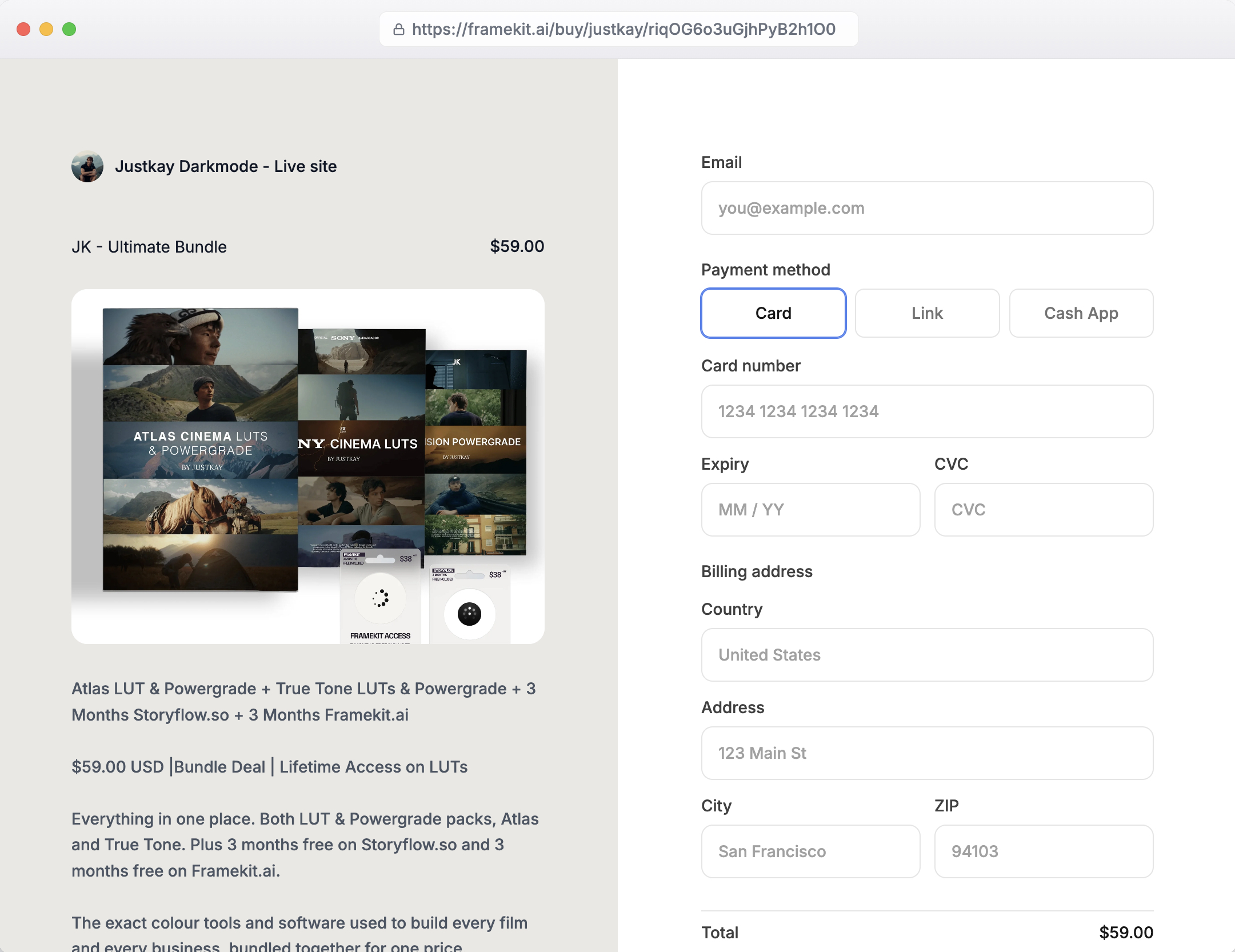
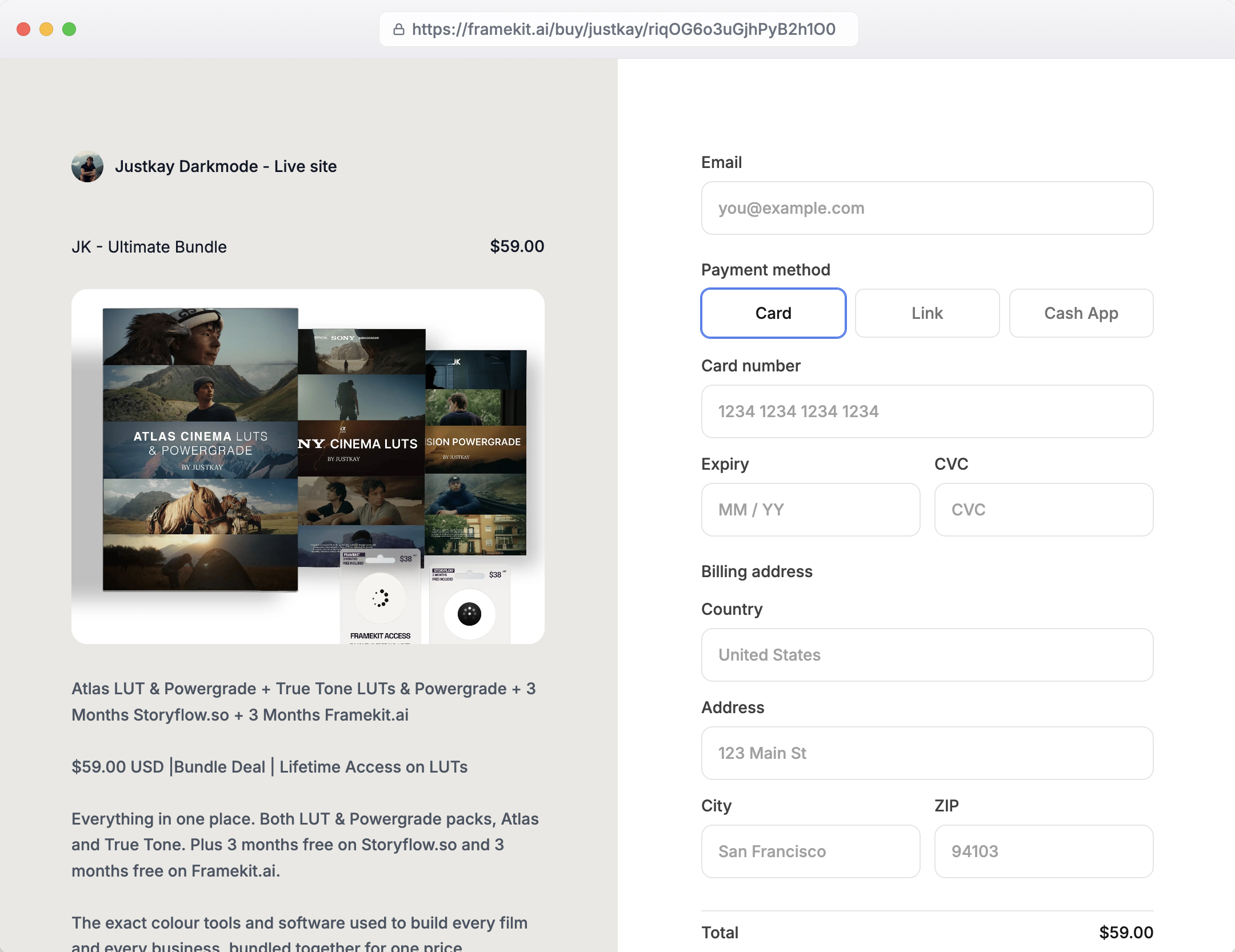
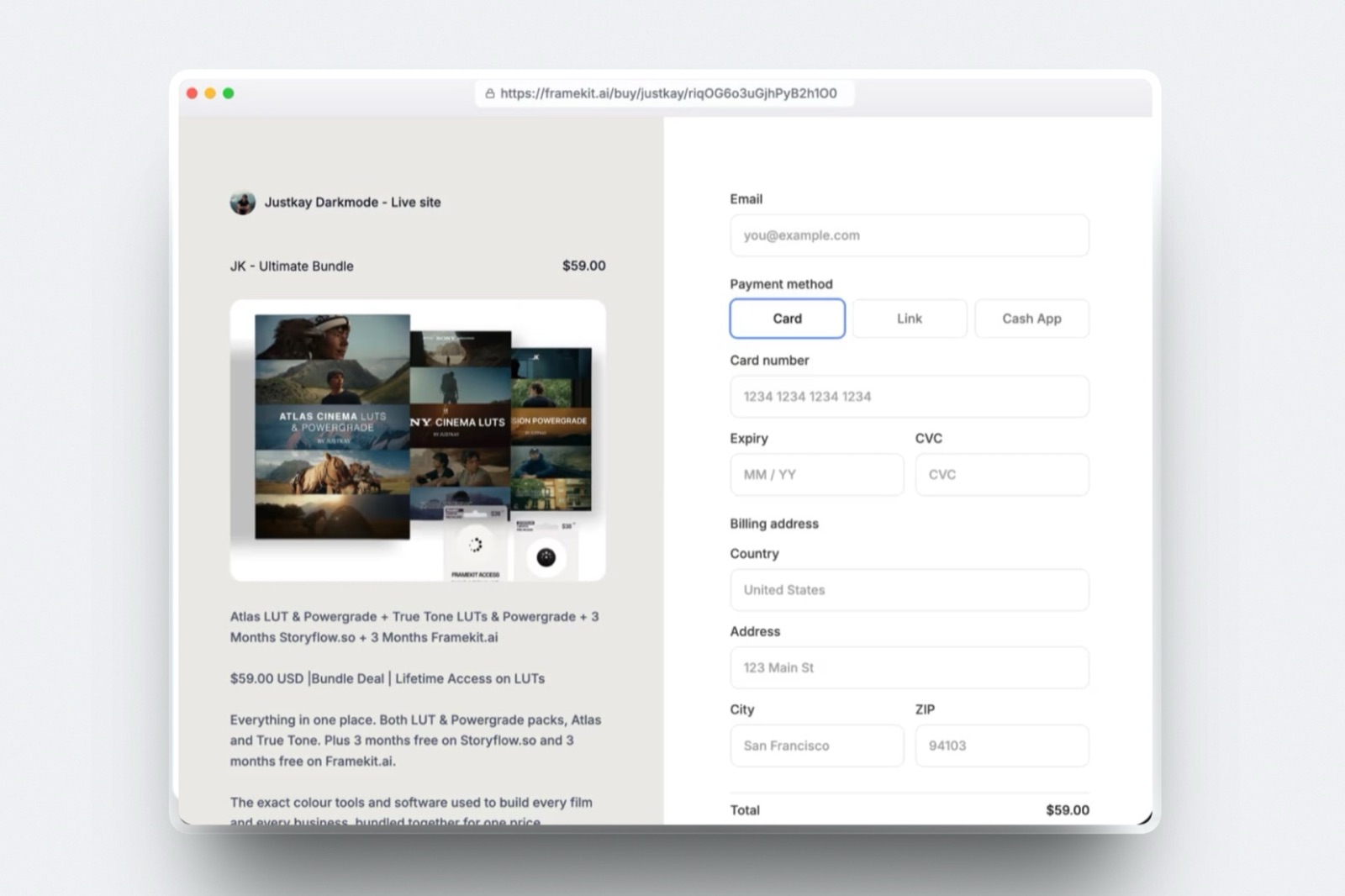
- The payment step runs on a Framekit-hosted page at framekit.ai/buy, with your name and logo and a small Powered by Framekit line
- Built for creators with a following, not for discovery from scratch
Skip it ifyou specifically want Gumroad's merchant-of-record tax handling and cannot manage your own tax - Lemon Squeezy is the closer swap - or you need marketplace discovery, which Etsy provides.
Verdict: Framekit is the best Gumroad alternative for a creator who drives their own traffic and wants to stop paying rent on it. You get a store you own and a fee that falls to 0%, in exchange for handling your own tax. Start free at framekit.ai, or see the full field in our best free product-selling software comparison.
2. Payhip: A Free Dedicated Store
Our rating: 8.7/10
Payhip is the closest straight swap for a creator who likes how simple Gumroad is but resents a fee that only falls past $20,000 of sales in a month.
It gives you a genuinely free, hosted storefront that takes 5% per sale on the free plan - half of Gumroad's 10% - and paid plans buy that percentage down toward 0% (Payhip's pricing).
It is a real dedicated store rather than a single link, so it reads as a business, not a checkout page.
It delivers files automatically, runs coupons and an affiliate program, and manages EU VAT on digital goods, which most tools that are not a merchant of record leave entirely to you.
On a $24 product the free plan nets about $21.80 against Gumroad's $20.10, and every paid tier keeps more.
Best forCreators who want lower fees than Gumroad on a real, dedicated storefront without paying anything to start.
Key features:
- A genuinely free hosted storefront, not a time-limited trial
- A 5% free-plan fee that paid plans buy down toward 0%
- Automatic file delivery after purchase
- Built-in coupons and an affiliate program
- Automatic EU VAT handling on digital goods
The real numberon a $24 product the free plan nets about $21.80 versus Gumroad's $20.10, and because the fee is a flat 5% with no $0.50 rider, cheap products keep a bigger share than they do on Gumroad.
Pricinga free plan at 5% per sale, with paid monthly plans that lower the fee toward 0%.
Pros:
- A real free storefront at half Gumroad's fee
- EU VAT handled for you on digital goods
- Coupons, affiliates, and file delivery included
Cons:
- Every Payhip store uses the same template, so it looks like Payhip, not your brand
- The 5% applies until you pay to upgrade
- The store lives on Payhip, not a domain you own
Skip it ifyou want the store to be unmistakably your own on your own domain, which is where a website builder wins.
What reviewers say elsewherePayhip rates about 4.3/5 on G2 and 4.5/5 on Capterra, praised for its free plan and ease, with notes on generic storefront design.
Verdict: Payhip is the best free Gumroad alternative for lower fees on a real store, and the EU VAT handling makes it punch above its price. See our best Payhip alternatives, or our best free product-selling software guide. Visit Payhip
3. Lemon Squeezy: Keeping Tax Handled for You
Our rating: 8.5/10
Lemon Squeezy is the closest like-for-like swap when the thing you actually value about Gumroad is that it handles your tax.
It is a merchant of record too, so it collects and remits global VAT and sales tax on your behalf, at a lower headline fee of 5% + $0.50 per sale (Lemon Squeezy's pricing).
On a $24 product that nets about $22.30 against Gumroad's $20.10, with the tax still off your plate.
It was built first for software billing - licenses, subscriptions, and trials - so it is at its strongest if that is what you sell, behind a clean, modern checkout.
Best forCreators who want to keep Gumroad's merchant-of-record tax handling at a lower fee, especially sellers of software and subscriptions.
Key features:
- Merchant of record that collects and remits global VAT and sales tax
- A 5% + $0.50 per-sale fee, below Gumroad's 10% + $0.50
- Licensing, subscription, and trial billing built in
- A clean, modern checkout
- Global payment methods handled for you
The real numberon a $24 product you net about $22.30 versus Gumroad's $20.10, but the surcharges stack - an extra 1.5% for international cards, 1.5% for PayPal, and 0.5% for subscriptions - so the true rate depends on how your buyers pay.
Pricing5% + $0.50 per sale as a merchant of record, plus surcharges for international cards, PayPal, and subscriptions.
Pros:
- Global tax collected and remitted for you
- A lower headline fee than Gumroad
- Strong for licenses, subscriptions, and trials
Cons:
- Surcharges stack on international cards, PayPal, and subscriptions
- Payouts run about twice a month with a lag
- Since the Stripe acquisition, some creators report slower support
Skip it ifyou sell simple one-off downloads to a domestic audience - you pay for billing machinery and a flat fee you may not need.
What reviewers say elsewhereLemon Squeezy runs mixed on Trustpilot and Product Hunt, with recurring concerns about support and payout holds.
Verdict: Lemon Squeezy is the best Gumroad alternative when you want to keep merchant-of-record tax handling at a lower fee, especially for software and subscriptions. Visit Lemon Squeezy
4. Sellfy: A Quick All-in-One Store
Our rating: 8.3/10
Sellfy gives you a quick all-in-one store that charges 0% in transaction fees on its paid plans, so unlike Gumroad's per-sale cut you keep your full price minus only card processing once you subscribe.
It sets up fast and covers digital products, subscriptions, and print-on-demand merch in one place, from roughly $29 a month.
That makes it a fit for a creator who wants to sell files and physical merch side by side without stitching separate tools together - as long as you are ready to pay from day one, because there is no genuine free plan behind it.
Best forCreators who will commit to a subscription for 0% fees and want merch alongside their digital products.
Key features:
- 0% transaction fees on every paid plan
- Digital products, subscriptions, and print-on-demand merch together
- A fast, guided store setup
- Built-in email and upsell tools
- A hosted storefront that covers the essentials
The real numberonce you subscribe, Sellfy takes 0% per sale, so a $24 product keeps its full value minus only processing - but the entry plan runs about $348 a year, which you pay whether or not the product sells.
Pricingpaid plans from roughly $29 a month with 0% transaction fees; a trial rather than a permanent free plan.
Pros:
- 0% transaction fees on every paid plan
- Digital products and print-on-demand merch in one store
- Quick to set up and start selling
Cons:
- No genuine free tier, only a trial, so you pay from day one
- The flat cost stings before you have proven sales
- The storefront lives on Sellfy, not a domain you own
Skip it ifyou are still testing whether a product sells, where a free-plan store risks nothing.
Verdict: Sellfy is worth it once you commit to a subscription for 0% fees and want merch alongside digital products. See our best Sellfy alternatives, or our best free product-selling software guide. Visit Sellfy

5. Ko-fi: Creators With a Following
Our rating: 8.1/10
Ko-fi is the friendliest Gumroad alternative for a creator who sells alongside tips and memberships rather than running a product catalog first.
It takes 0% on donations even on the free plan, and its shop fee is low - Ko-fi Gold drops it toward zero for about $12 a month - so a creator monetizing a community with a handful of products keeps most of what comes in.
The trade is that your storefront is a Ko-fi page rather than a site you own, and the tool is built around support more than a serious product catalog, so a product-first business eventually outgrows it.
Best forCreators monetizing a following through a mix of tips, memberships, and the occasional product.
Key features:
- 0% fee on donations, even on the free plan
- A low shop fee that Ko-fi Gold reduces toward zero
- Tips, memberships, and product sales in one page
- Fast, welcoming setup with no upfront cost
- Automatic delivery of digital downloads
The real numberKo-fi takes 0% on donations even free, and Ko-fi Gold at about $12 a month drops the shop fee toward zero, so a creator whose income is mostly support keeps far more than Gumroad's 10% + $0.50 would leave.
Pricinga free plan with 0% on donations and a low shop fee; Ko-fi Gold at about $12 a month lowers the shop fee toward zero.
Pros:
- 0% on donations and a low shop fee
- Tips, memberships, and products in one place
- Welcoming and fast for a community-first creator
Cons:
- The storefront is a Ko-fi page, not a site you own
- Built for support more than a serious product catalog
- A product-first business will outgrow it
Skip it ifproducts are your main line rather than a sideline to tips and memberships, where a dedicated store keeps the catalog front and center.
Verdict: Ko-fi is the best Gumroad alternative for a creator whose income is a mix of support and the occasional product, welcoming and cheap to run. Visit Ko-fi
6. Podia: Products Plus Courses
Our rating: 7.9/10
Podia is the Gumroad alternative for a creator who also teaches, bundling digital products, courses, and email marketing so the catalog and the mailing list live in one place.
Podia retired its free plan in October 2024, so the entry point is Mover at $42 a month plus a 5 percent fee, and Shaker at $84 a month removes the percentage entirely.
It is heavier than a pure download seller needs, so it earns its place when courses and email are part of the plan rather than an afterthought.
Best forCreators building an education business who want products, courses, and email in one tool.
Key features:
- Digital products, courses, and downloads in one catalog
- Built-in email marketing to your buyer list
- A free plan to start, at about an 8% fee
- Paid plans that remove the transaction fee
- Membership and community options alongside products
The real numberPodia has no free tier, so a $24 product costs $1.20 in Podia fees on Mover on top of $42 a month - cheaper per sale than Gumroad on cheap products, and only once your volume covers the subscription.
Pricinga free plan at about 8% per sale; paid monthly plans remove the transaction fee.
Pros:
- Products, courses, and email in one place
- Paid plans remove the transaction fee
- Keeps the buyer list where you can market to it
Cons:
- The free plan's about 8% fee is steep for pure downloads
- Heavier than a simple file seller needs
- The store lives on Podia, not a domain you own
Skip it ifyou only sell downloads and never plan to teach, where a lighter, cheaper dedicated store fits better.
Verdict: Podia suits creators building an education business around their products, not just selling files. Selling more than teaching? See our best Podia alternatives. Visit Podia
7. Shopify: A Full Store at Scale

Our rating: 7.7/10
Shopify is the Gumroad alternative for a creator building a serious storefront brand, with a trusted checkout, endless integrations, and hosting on your own domain, so you keep more ownership than a gumroad.com page gives you.
For physical-plus-digital catalogs at scale, little else matches its depth.
The catch for digital products is that secure file delivery needs a third-party app, typically another $10 to $30 a month on top of the plan, so a digital store on Shopify costs more than the headline suggests.
Best forSellers scaling into a broad product business who want a trusted checkout on their own domain.
Key features:
- A trusted checkout buyers recognize
- Hosting on your own domain
- A deep app and integration ecosystem
- Physical and digital products in one store
- Staff, inventory, and shipping tools for scale
The real numbersecure digital delivery on Shopify usually means a third-party app at about $10 to $30 a month on top of your plan, so the real monthly cost of a digital store runs well above the sticker price.
Pricingmonthly plans plus payment processing; digital delivery typically requires a paid third-party app at about $10 to $30 a month.
Pros:
- A trusted checkout on your own domain
- An app ecosystem nothing here matches
- Built to scale into a broad catalog
Cons:
- Digital delivery needs a paid third-party app
- More platform than a single-download seller needs
- The true monthly cost runs above the headline plan
Skip it ifyou sell a single download or a small preset pack, where Gumroad's simplicity or an owned-site builder fits better.
Verdict: Shopify suits sellers scaling into a broad product business rather than selling one file - see our best website builders to sell digital products. Visit Shopify
8. Stan Store: Link-in-Bio Selling
Our rating: 7.5/10
Stan Store is built for selling straight from a social bio link, which suits a creator whose audience lives on Instagram or TikTok.
It charges 0% in transaction fees on a flat subscription of about $29 a month, so once bio-link traffic converts you keep your full price minus only processing.
It is a cleaner funnel than a raw Gumroad link for bio traffic, but the flat cost with no free plan makes it pricey at low volume, and the storefront is a simple bio page rather than a site you own.
Best forCreators selling directly to a strong Instagram or TikTok following through a bio link.
Key features:
- A bio-link storefront built for social traffic
- 0% transaction fees on a flat subscription
- A guided, mobile-first buying funnel
- Digital products, courses, and coaching in one link
- Fast checkout designed for impulse buys
The real numberStan Store's flat subscription of about $29 a month buys 0% transaction fees, so at high bio-link volume you keep nearly everything - but with no free plan, that same $29 is dead weight until the traffic converts.
Pricinga flat subscription of about $29 a month with 0% transaction fees; no free plan.
Pros:
- 0% transaction fees on a flat monthly cost
- A clean funnel tuned for bio-link traffic
- Simple, mobile-first buying experience
Cons:
- No free plan, so it is pricey at low volume
- The storefront is a bio page, not a site you own
- Built for social traffic more than a full catalog
Skip it ifyour traffic is light or irregular, where a free-plan store costs nothing to keep open between sales.
Verdict: Stan Store fits creators selling directly from a strong social following, once bio-link traffic converts consistently enough to cover the flat fee. Visit Stan Store
9. Etsy: Search Traffic
Our rating: 7.4/10
Etsy is the one Gumroad alternative that brings its own buyers - people search Etsy for digital planners and templates with a card already out - which is real value for a seller without an audience of their own. No owned store can match that built-in demand.
But the fees stack: $0.20 per listing, a 6.5% transaction fee, payment processing, and a possible 15% Offsite Ads cut, which together can rival Gumroad's take - and Etsy keeps the customer entirely, so you cannot build a list from the buyers it sends you.
Best forSellers without an audience who want Etsy's search traffic and treat it as paid acquisition.
Key features:
- Built-in marketplace search traffic
- Buyers who arrive ready to purchase
- Instant digital-download delivery
- Listing tools tuned for planners and templates
- A trusted checkout buyers already know
The real numberEtsy's stack - $0.20 per listing, 6.5% transaction, processing, and up to a 15% Offsite Ads cut - can rival Gumroad's effective rate, so the traffic is not free even when it converts.
Pricing$0.20 per listing plus a 6.5% transaction fee and processing, with a possible 15% Offsite Ads fee on attributed sales.
Pros:
- Brings its own buyers, unlike any owned store
- Strong demand for digital planners and templates
- Fast, familiar checkout and download delivery
Cons:
- Stacked fees can rival Gumroad's take
- Etsy keeps the customer, so you build no list
- No branding or storefront you own
Skip it ifyou already have an audience, where paying a marketplace to reach followers who know you is money spent twice.
Verdict: Etsy suits sellers who want search traffic and treat it as a discovery feeder, not a home - move repeat buyers to a store you own. Our best Etsy alternatives for digital sellers guide covers the move. Visit Etsy
10. Square Online: A Free Basic Store
Our rating: 7.3/10
Square Online offers a genuinely free basic store with no platform cut beyond payment processing of about 2.9% + 30 cents, which makes it one of the few honestly free Gumroad alternatives - especially if you already take payments with Square in person.
The storefront is basic and built for physical and local commerce, and digital delivery is a weaker afterthought, so it works for a straightforward download but is not digital-first.
Best forSellers who want a free store and already live in the Square ecosystem.
Key features:
- A genuinely free basic online store
- No platform cut beyond payment processing
- Tight integration with Square in-person payments
- Inventory and physical-goods tools built in
- A familiar, reliable checkout
The real numberSquare Online keeps nothing beyond processing of about 2.9% + 30 cents, so a $24 download nets close to $23 - as much as a 0% plan - without any subscription at all.
Pricinga free plan with no platform fee beyond processing of about 2.9% + 30 cents; paid tiers add features.
Pros:
- Free with no platform cut beyond processing
- Keeps more than Gumroad on every sale
- Native to the Square in-person ecosystem
Cons:
- The storefront is basic and physical-goods first
- Digital delivery is a weaker afterthought
- Not built for a digital-first catalog
Skip it ifdigital products are your main line and you want a polished download experience, where a digital-first tool delivers files better.
Verdict: Square Online fits sellers who want a free store and already live in the Square ecosystem, and it keeps more than Gumroad - just check the download experience for your files first. Visit Square Online
11. Beacons: Link-in-Bio Creators
Our rating: 7.1/10
Beacons is a link-in-bio tool with a store built in, convenient if you already use it for your bio and want to attach product sales without adding another tool. Delivery is handled, and the store sits right where your social traffic already lands.
The cost is the fee: its free store plan carries around a 9% cut - close to Gumroad's and among the highest here - which drops on paid plans, and the storefront is a Beacons page rather than a site you own.
Best forCreators already using Beacons for their bio who want a store bolted on.
Key features:
- A store built into a link-in-bio page
- Handled delivery of digital downloads
- Product sales where your social traffic lands
- A free plan to start selling
- Paid plans that lower the per-sale fee
The real numberBeacons' free store plan takes around 9%, close to Gumroad's 10%, so on a $24 product the platform fee is about $2.15 before processing - which makes it expensive once you sell regularly, until a paid plan lowers it.
Pricinga free store plan at around 9% per sale, with paid plans that reduce the fee.
Pros:
- A store attached to your existing bio link
- Delivery handled for digital downloads
- Convenient if you already live in Beacons
Cons:
- The free-plan fee is around 9%, among the highest here
- The storefront is a Beacons page, not a site you own
- Margin-focused sellers pay too much until they upgrade
Skip it ifyou sell regularly and care about margin, where a 9% free-plan cut is close to the Gumroad fee you are trying to escape.
Verdict: Beacons fits creators already living in it who want a store bolted onto their bio, rather than sellers optimizing margin. Visit Beacons
12. Big Cartel: A Simple Product Store
Our rating: 7.0/10
Big Cartel is a simple store builder aimed at artists and makers, with flat monthly plans and no per-sale platform cut - so for a steady seller, a fixed cost can beat Gumroad's percentage that climbs with every sale.
It is oriented toward physical goods and small catalogs, so digital delivery is workable but not its focus, and the design is basic rather than polished.
Best forArtists selling a small range of products who want a flat cost instead of a per-sale fee.
Key features:
- Flat monthly plans with no per-sale platform cut
- A simple store aimed at artists and makers
- Support for small, curated catalogs
- Physical and digital product listings
- Straightforward setup and management
The real numberBig Cartel takes no per-sale platform cut, so at steady volume the flat monthly plan can cost less than Gumroad's 10% + $0.50 - the more you sell, the better the flat fee looks.
Pricingflat monthly plans with no per-sale platform commission.
Pros:
- No per-sale platform cut, only a flat plan
- Simple and quick for a small catalog
- Predictable cost that steady sellers can plan around
Cons:
- Oriented toward physical goods, not digital-first
- The design is basic rather than polished
- Best for small catalogs, not a growing range
Skip it ifyou sell digital products first, where a dedicated tool or an owned site delivers files and presents the catalog better.
Verdict: Big Cartel is the flat-fee, small-catalog option for an artist who wants a predictable cost instead of a per-sale cut. Visit Big Cartel
13. SendOwl: Digital Delivery Engine
Our rating: 6.8/10
SendOwl is a digital-delivery and checkout engine rather than a storefront, built to sell and deliver files reliably from a flat subscription with no per-sale commission. It is the plumbing behind a sale, not a store you browse.
That makes it a fit for a seller who already has a website and wants a dependable checkout-and-delivery layer without Gumroad's cut - it handles secure delivery, license keys, and drip content well, but it is not a brand you own or a shop a buyer explores.
Best forSellers who already have a website and want a flat-fee delivery-and-checkout layer without a per-sale cut.
Key features:
- Secure file delivery from a flat subscription
- No per-sale commission on what you sell
- License-key generation for software and tools
- Drip content for staged delivery
- Checkout that attaches to your existing pages
The real numberSendOwl charges a flat subscription and takes no per-sale commission, so on a $24 product it keeps nothing beyond processing - the more you sell, the more the flat fee beats Gumroad's percentage.
Pricinga flat monthly subscription with no per-sale commission.
Pros:
- No per-sale commission, only a flat subscription
- Reliable secure delivery, license keys, and drip content
- Attaches to a website you already run
Cons:
- Not a storefront you browse or a brand you own
- Requires your own site to sit behind
- Little presentation or discovery on its own
Skip it ifyou want a store buyers can browse or a brand of your own, rather than a delivery layer behind your site.
Verdict: SendOwl fits sellers who want a flat-fee delivery engine attached to their own pages, not a storefront to build a brand on. Visit SendOwl
What Leaving Gumroad Actually Saves
In one lineGumroad's 10% + $0.50 only falls after $20,000 of sales in a calendar month, so on real volume the switch to a fee that drops to 0% saves the price of the subscription many times over - about $580 a month at 200 sales of a $24 product.
The headline fee is the whole reason to leave, and it compounds. Take our seller: a $24 product, 200 sales a month, $4,800 in sales.
Gumroad keeps about $580 a month - close to $7,000 a year - and at $4,800 a month it never reaches the $20,000 threshold where the rate drops.
On Framekit's Business plan at 0%, the platform keeps nothing beyond processing for a flat $39 a month, so the same sales keep about $540 a month more.
On Payhip's free plan at 5%, about $340 a month more than Gumroad, with no subscription at all.
Here is the platform's annual take at three volumes, holding the $24 product:
| Monthly sales | Gumroad (10% + $0.50) | 5% plan (Payhip/Framekit free) | Framekit Business (0%, $39/mo) |
|---|---|---|---|
| $2,000 (about 83) | ~$2,900 | ~$1,200 | ~$468 plan only |
| $4,800 (about 200) | ~$7,000 | ~$2,880 | ~$468 plan only |
| $10,000 (about 417) | ~$14,500 | ~$6,000 | ~$468 plan only |
Processing applies on top of every column. Run it on your own numbers: last month's sales times Gumroad's effective rate, times twelve, is what it keeps whether your year is good or bad.
If that beats a year of a flat 0% plan, you are paying rent on your own success. Our best free product-selling software guide runs the full comparison.
The Discover Trap and the Customer You Never Get
In one linetwo of Gumroad's costs are invisible until later - the 30% Discover fee on sales you did not choose, and the fact that every buyer is Gumroad's customer, not yours - and an owned store removes both.
Beyond the headline fee, Gumroad has two costs that only show up once you are established.
The first is Discover: sales Gumroad's marketplace attributes to itself are charged 30%, not 10%, and you have limited control over which ones get tagged, so your effective rate is unpredictable.
The second is deeper - the buyer is Gumroad's customer. Gumroad keeps the email, so you cannot build a list, retarget, or move the relationship, and every sale grows Gumroad's audience rather than yours.
An owned store removes both. There is no Discover marketplace to reclassify your sales, and the customer lands on your domain and joins your list, so the next product launches to an audience you own.
This is the real cost of a rented storefront, and it is why creators who drive their own traffic eventually leave - covered in depth in our guide to selling from your own website.
How to Choose a Gumroad Alternative: A Decision Tree
Start with the question that decides it for you, and take the first branch that fits.
Do you need sales tax handled for you as merchant of record?
- Yes, tax must be off my plate. Choose Lemon Squeezy - merchant of record like Gumroad, at a lower 5% + $0.50 fee. Stop here; that is the trade.
- No, I can handle my own tax. Go to the next question.
Do you want the store on a website you own?
- Yes, my own domain and customer. Choose Framekit - a store you own with a fee that drops to 0%.
- A hosted store is fine. Go to the next question.
What matters most?
- The lowest fee on a free store: Payhip at 5%.
- 0% fees and you will pay a subscription: Sellfy.
- Marketplace discovery: Etsy, as a feeder.
- Tips and memberships too: Ko-fi. Selling from a bio link: Stan Store.
Frequently Asked Questions
What is the best Gumroad alternative in 2026?
The best Gumroad alternative in 2026 is Framekit, because you sell from a website you own and pay a fee that starts at 5% and drops to 0% on a flat plan, instead of Gumroad's 10% + $0.50 plus processing, and you keep the customer and email list.
The trade-off is that you handle your own tax, where Gumroad is merchant of record - so if tax handling is essential, Lemon Squeezy is the closest swap, and Payhip is the best free dedicated store.
What percentage does Gumroad take, and how do alternatives compare?
Gumroad takes 10% + $0.50 per sale plus card processing, about 16% of a $24 product, and 30% on sales its Discover marketplace attributes to itself.
Alternatives take far less: Payhip and Framekit's free plan take 5%, Lemon Squeezy 5% + $0.50, and Framekit's Business plan 0%.
On a $24 product, Gumroad keeps about $3.90 while a 0% plan keeps everything beyond processing, so the alternatives keep about $1.70 to $2.90 more per sale.
Is there a Gumroad alternative with no fees?
No platform is truly free, since payment processing (about 2.9% + $0.30) always applies, but several remove the platform cut.
Framekit's Business plan and Sellfy's paid plans take 0% platform fee, and Square Online has no cut beyond processing. Payhip's top plan also reaches 0%.
The catch is these usually require a subscription, so the cheapest option depends on volume - a free 5% plan below a certain volume, a flat 0% plan above it.
See our best zero-commission selling platforms for the full breakdown.
Which Gumroad alternative is best for keeping tax handled?
Lemon Squeezy is the best Gumroad alternative for keeping tax handled, because like Gumroad it is a merchant of record, collecting and remitting global VAT and sales tax, but at a lower 5% + $0.50 fee.
If you sell internationally and do not want to touch tax, it is the closest swap to Gumroad.
Framekit, Payhip, and most others are not merchant of record, so you handle your own tax - Payhip does automatically manage EU VAT on digital goods as a partial exception.
Can I move my products and customers off Gumroad?
You can move your products easily by downloading and re-uploading the files, but the customer relationship is harder.
If you have been collecting buyer emails into your own email tool, you keep them; if you relied on Gumroad to hold the customer, you may not be able to export a usable list, since Gumroad owns that relationship.
This is exactly why moving to a store you own matters before you have a list worth keeping - so the next platform's customers are yours.
Why is Gumroad's fee higher on cheap products?
Because Gumroad's fee includes a flat $0.50 per sale on top of the 10%, and a fixed amount is a bigger share of a cheap product.
On a $24 product the effective cut is about 16%, but on a $10 product the same 10% + $0.50 plus processing climbs to about 21%, and on a $50 product it drops to about 14.5%.
If you sell low-priced digital products like presets, the flat fee hurts most, which makes a percentage-only or 0% alternative more valuable the cheaper your products are.
Gumroad vs Framekit: which keeps more of your money?
Framekit keeps more of each sale.
On a $24 product, Gumroad's 10% + $0.50 plus processing leaves about $20.10, while Framekit's Business plan (0% fee) leaves about $23.00, and even Framekit's free plan (5%) leaves about $21.80 - all more than Gumroad.
Gumroad wins if you want tax handled as merchant of record and the fastest first sale; Framekit wins on cost and on owning your store and customer, for a creator driving their own traffic.
What is the best free Gumroad alternative?
Payhip is the best free Gumroad alternative, because its free plan gives you a real dedicated storefront and takes 5% per sale - half of Gumroad's 10% - while handling EU VAT and file delivery.
Framekit's free plan also takes 5% and lets you sell from a site you own, and Square Online is free with no cut beyond processing.
Among free options, Payhip is the best dedicated store and Framekit the best owned store; both beat Gumroad's free-to-use-but-10% model.
Does Gumroad still charge 30% on Discover?
Yes. While Gumroad's direct fee is 10% + $0.50, sales it attributes to its Discover marketplace are charged 30%, and sellers have limited control over which sales get tagged that way, making the effective rate unpredictable.
This is one of the main reasons creators who drive their own traffic leave - on an owned store like Framekit, there is no marketplace to reclassify your sales, so your rate is the one you signed up for.
If you drive your own traffic, the Discover fee is pure margin at risk.
Which Gumroad alternative is best for selling to my own audience?
For selling to an audience you already have, the best Gumroad alternative is a store you own, because you are not paying a marketplace to reach followers who already know you.
Framekit lets you sell from your own website and keep the customer and email list, at a fee that drops to 0%. Payhip and Sellfy are strong hosted options that also lower the fee.
The marketplaces - Etsy especially - only earn their higher cut when they bring buyers you could not reach yourself.
Is Gumroad worth it in 2026, or should I switch?
Gumroad is worth it if you value simplicity, want tax handled for you, and sell at low enough volume that 10% + $0.50 does not sting.
The switch pays off once your annual Gumroad fees exceed a year of a flat-fee plan - around $325 a month in sales of a $24 product, and by $2,000 a month Gumroad keeps roughly $2,900 a year against a flat 0% plan's $468.
If you are past that point and driving your own traffic, moving to a store you own keeps most of that money.
How fast can I start selling on a Gumroad alternative?
Fast, on most, though we have not timed any of them and setup speed depends on how ready your files are.
Gumroad is built to get a single link live quickly; Framekit, Payhip and Sellfy each ask for a short run of steps (a store or site, a product, a price) before the first sale.
Marketplace-style platforms like Etsy take longer, because of shop setup and listing fees.
The main variable is connecting a payment processor, which is instant where the platform pays you out and a few extra minutes where you connect your own Stripe.
Final Verdict: The Best Gumroad Alternative
Gumroad is the easiest place to start selling and, for a creator with an audience, an expensive place to stay - a 10% + $0.50 cut plus processing that only falls past $20,000 of sales in a month, on a page that carries its brand and keeps your customer.
Framekit is the best Gumroad alternative in 2026 for a creator who drives their own traffic.
You sell from a website you own, keep the customer and email list, and pay a fee that drops to 0% on a flat plan instead of a percentage that stays at 10% for most sellers - about $540 a month more kept at 200 sales of a $24 product, after the $39 plan.
Where Framekit loses: creators who need tax handled as merchant of record, where Lemon Squeezy is the closer swap, and sellers with no audience who need a marketplace's buyers, where Etsy brings discovery Framekit does not.
Payhip is the best free store at half Gumroad's fee, Lemon Squeezy is the merchant-of-record swap, and Sellfy is the 0%-fee subscription pick. But if you drive your own traffic, sell from a site you own and stop paying rent on your audience.
For more, read our best free product-selling software comparison, our best platforms to sell presets, our guide to selling Lightroom presets from your own website, and if you photograph clients, the best client gallery platforms.
_Fees and payout terms confirmed against each platform's pricing pages, July 2026._
Two head-to-heads go deeper on the most common swaps: Gumroad vs Payhip and Gumroad vs Lemon Squeezy.
Creators arriving here from a tip-and-shop page rather than a storefront should read our Ko-fi alternatives comparison, which prices the same platforms against tips and memberships as well as sales.