Framekit templates
Start from a designer-made template
 Use template
 Use template
 Use template
 Use template
 Use template
 Use template
 Use template
 Use template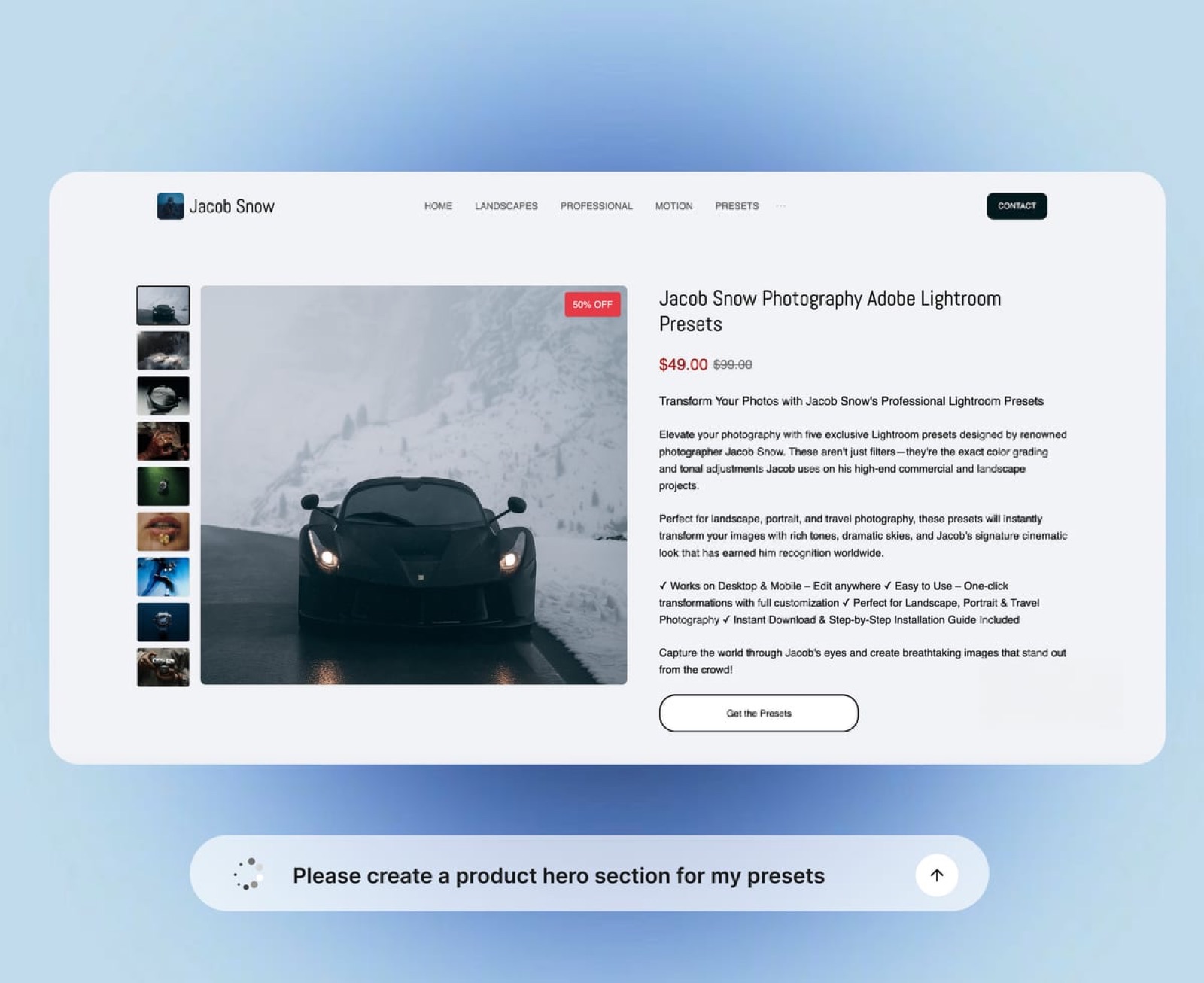
A wedding and travel filmmaker spends six weeks on a film-grain and LUT pack, two more weeks on the sales page, watches four tutorials about email funnels, launches, and sells two copies in a fortnight.
Both buyers are people who had already hired her. Neither came from the funnel.
That is the ordinary shape of it, and the reason getting your first 10 sales as a digital creator feels impossible is that almost every piece of advice about it is written for someone on their four hundredth.
The first 10 are a counting problem. You already know the people who will buy, you have probably already shown them the thing, and what closes them is proof of it in use rather than a launch discount.
A first digital product sale is a transaction from inside your existing audience: somebody who has already watched your work, in most cases for months, paying to skip the part they watched you figure out. Treat it that way and the job shrinks from marketing to arithmetic.
Get your first 10 sales by auditing the warm audience you already have, picking the product those specific people have already asked you about, pricing it above $25 so 10 sales are worth the afternoon, and publishing proof of the thing in use rather than announcements about it.
Ship a single page with one buy link and stop building.
Framekit suits this because the product page, the buy link and your portfolio sit on one domain and one account, and the store is free to start at a 5% fee rather than a monthly subscription you pay before sale one.
Use Gumroad if a marketplace is how you expect to be found, Lemon Squeezy if you want somebody else to own the tax liability, and a dedicated email tool alongside any of them, because Framekit does not send newsletters.
Full disclosure: Framekit is our own product, so treat the recommendation as interested and the numbers as checkable. Competitor fees here were read on each vendor's published page in September 2026 and linked where they are used, and where a page served European pricing to this session it is quoted as listed rather than converted. Framekit has no email marketing, no affiliate program and no upsell or funnel tooling, and those gaps matter more at sale five hundred than at sale 10.
How the numbers in this guide were arrived at
There is one thing this guide deliberately does not contain, and it is worth saying so before the first table, not burying it, because its absence is a choice and not an oversight.
No conversion benchmark. No primary source publishes a defensible figure for what fraction of a solo creative's followers buy a first product, and an invented one would do real damage here, because it would tell you to give up or to keep going on the strength of a number nobody measured.
Instead, every rate in this guide is arithmetic you run on your own list, and the worked example shows the method rather than the answer.
Read at the source. Platform fees, plan prices and stated limits were read on each vendor's own published page in September 2026 and linked at the point of use.
Where a creator platform refused to serve its pricing to an automated reader, it is left out of the tables rather than estimated.
Calculated. The example throughout is one filmmaker selling one product: a film-grain and LUT pack at $34, to a warm audience of roughly 2,000 people spread across Instagram, a small newsletter and a client list. 10 sales is $340 gross, and that figure is held constant in every table below.
Your first 10 sales by the numbers
These are the figures that decide whether the plan in this guide is worth a weekend, and the useful move is to replace each one with yours before reading further.
- $340 is what 10 sales of the carried $34 pack brings in gross, which is the number every fee below is measured against.
- 10% plus $0.50 is what Gumroad takes on a direct sale, rising to 30% on a sale that came through its Discover marketplace.
- 5% plus 50 cents is Lemon Squeezy's rate, which buys merchant-of-record status so the tax liability is theirs rather than yours.
- 5% is the Framekit store fee on Free and Starter, falling to 3% on Pro and 0% on Business, with no subscription required to start.
- $29 a month is the entry price of Stan Store, which has no free plan, so a creator there pays $290 before the tenth sale of a $34 product has covered the year.
- Zero is the number of email newsletters Framekit can send, which is why the list step in this guide names a separate tool.
In one linethe fee difference between the cheapest and dearest route on 10 sales of a $34 product is under $30, which tells you that the platform decision is not the thing standing between you and sale one, and the audience count is.
Step 1. Count the warm audience you actually have
Before you build anything, write down every place where somebody has already chosen to receive things from you, and put a real number next to each one, because that list is the entire addressable market for your first 10 sales.
Warm means they know your work. A follower who has watched three of your reels is warm. A past client is very warm. A person who once liked a post two years ago is not, and neither is anyone in the audience you are imagining acquiring later.
| Where | How to count it | What it is worth for sale one |
|---|---|---|
| Email list | Subscribers who opened something in the last 90 days, not total signups | The highest-intent channel you own, and the only one you keep if a platform changes |
| Past and current clients | Everyone you invoiced in the last two years | Already paid you once, so the price objection is mostly gone |
| Instagram, TikTok or YouTube | Followers, then the number who reliably watch a post through | Reach without permission; good for proof, weak for asking |
| Group chats, Discords, forums | People who would recognise your name in a thread | Small, warm, and the source of most awkward first sales |
| Colleagues and peers | Other creatives in your field who use the same tools | They buy tools, and they tell other people who buy tools |
For the carried example the count is 1,840 Instagram followers, 310 newsletter subscribers who opened something recently, and 46 past clients, which overlaps down to roughly 2,000 distinct humans.
That is the number. 10 sales out of 2,000 warm people is a different problem from 10 sales out of nothing, and most of the despair in first-product launches comes from not doing this arithmetic.
If the total is under about 300, the honest answer is that you have an audience problem and not a product problem, and how to get clients from your website is a better use of the weekend than a store.
If you have been building that audience entirely on one platform, moving from Instagram to your own website is the part of this that compounds.
The thing that goes wrongthe audit gets done with follower counts rather than with attention, so a creator with 12,000 followers and no email list concludes they have a huge audience, then discovers that a post reaching 600 people is not the same as 600 people hearing about the product.
Step 2. Pick the product those specific people already asked you for
The right first product is not the one with the biggest market; it is the one you have already been asked about, because a question in your inbox is the only demand signal you can verify without spending money.
Go through your messages, comments and client emails from the last year and count the questions. How did you get that colour. What mic is that. Can you send me the template you used for the quote.
Which of those you can answer with a file is your first product, and the count of times it was asked is your evidence.
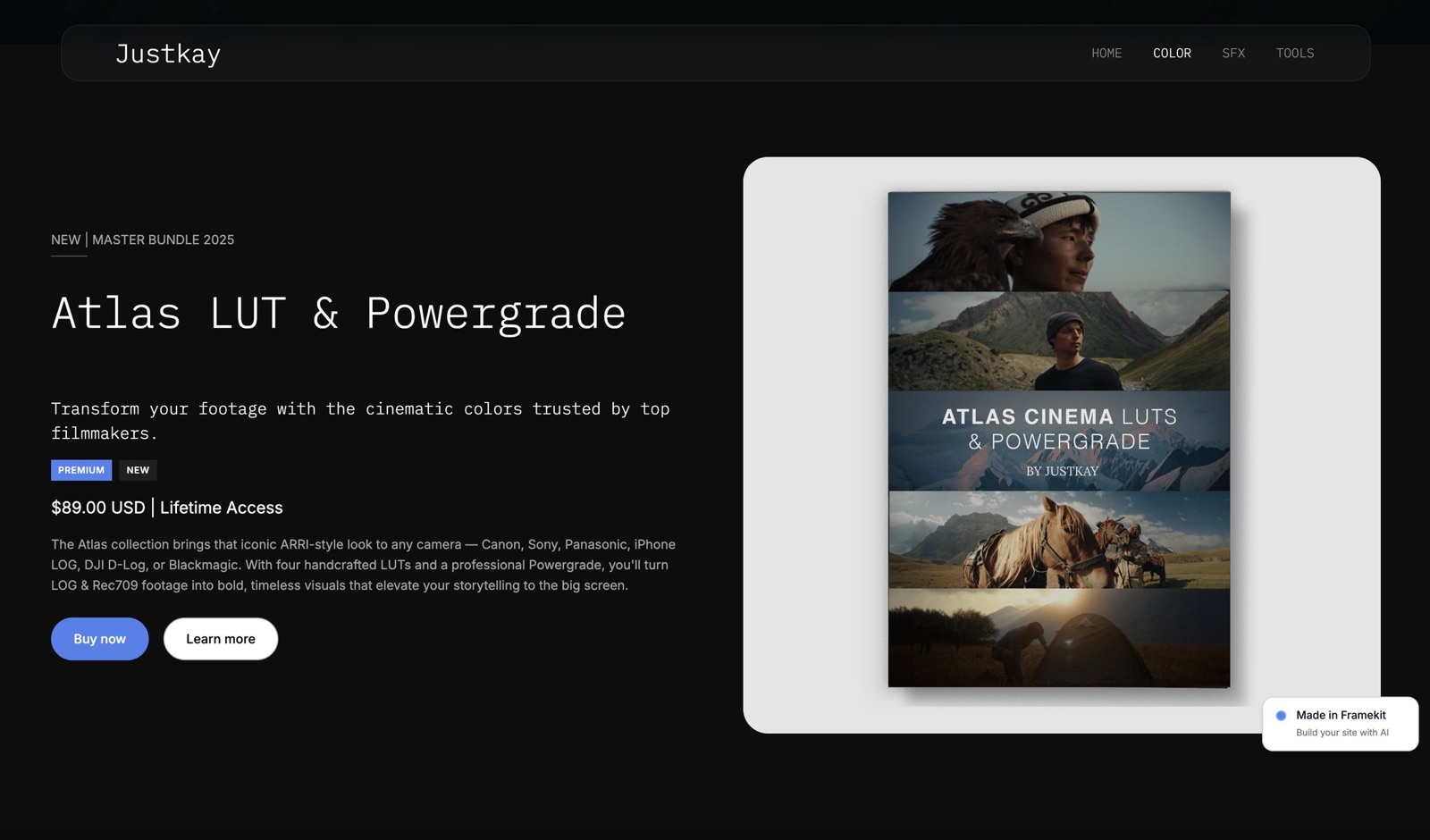
Scope it to one afternoon of packaging, not six weeks of building.
A first product exists to prove that people will pay you for a file, and every extra week you spend on it raises the price of finding out they will not. 10 LUTs you already use beats 40 you made for the launch, and a six-page PDF that actually explains your process beats a 40-page ebook you will resent.
Three shapes work particularly well for a first product by a photographer or filmmaker: the preset or LUT pack, the template or document you already use with clients, and the short reference guide that answers the question you get most. What digital products are worth selling goes wider, and if presets are your answer, selling Lightroom presets from your own website is the specific version.
The thing that goes wrongthe creator builds the product they wish people wanted. A course has the highest ceiling, and it also has the highest build cost and the longest feedback loop, which is exactly wrong for a first sale.
Step 3. Price it so that 10 sales are worth the afternoon
Price is the single lever on this list that changes the outcome most and costs nothing to move, and almost every first product is priced too low because the creator is pricing their nerves rather than the file.
10 sales at $7 is $70, minus fees, for an afternoon of packaging and a week of posting. 10 sales at $34 is $340.
The work is identical and the audience is the same people, and a $7 price tag communicates something about the product that no amount of good copy undoes.
Under about $25 you are also fighting fixed per-sale costs: a flat 50 cents on top of a percentage is 7 percent of a $7 sale and 1.5 percent of a $34 one.
Set the price against what the buyer saves rather than against what it cost you to make.
For the carried pack, the honest frame is that it saves an editor an evening of building a grade from scratch, so $34 is not a bargain or a stretch, it is an hour of their time.
For a template that replaces a lawyer-adjacent document or a quoting spreadsheet, the frame is the same.
Do not open with a discount.
A launch discount on a first product teaches the only 10 people who will ever buy at full price that your prices are soft, and it is worth noting that Framekit's discount codes are a Pro-plan feature anyway, so on Free or Starter the decision is made for you.
The detailed version of this argument is in how to price digital products.
The thing that goes wrongthe creator prices at $9 to reduce the chance of rejection, sells six copies, earns $54, and concludes that digital products do not work. The experiment was real; the price made the result meaningless.
Step 4. Build one page and one buy link, then stop building
The page is where first-time sellers spend the weeks they should have spent posting, so give it an afternoon and a fixed list of contents and then close the tab.
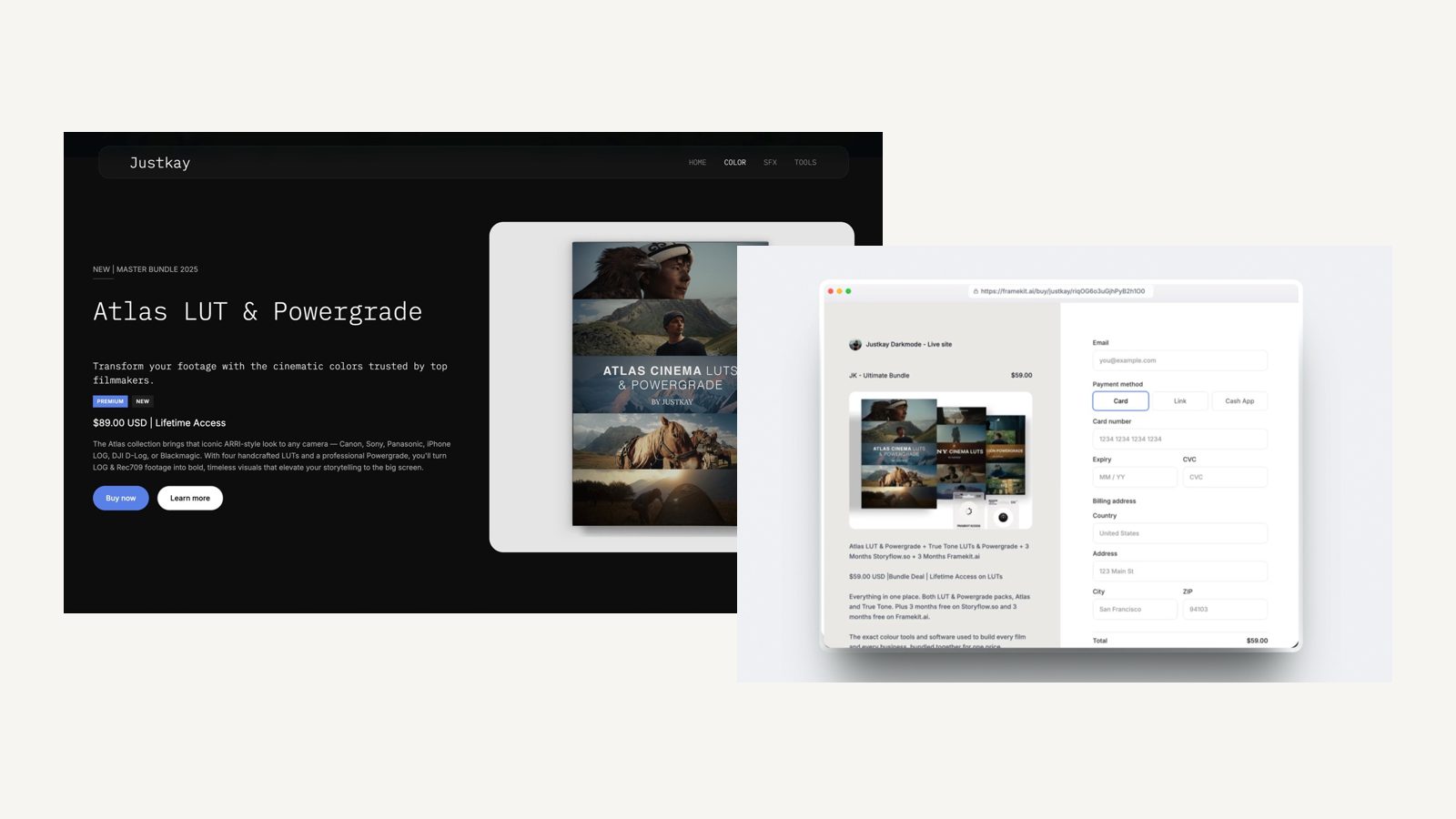
Seven things belong on it and nothing else does: what the product is in one sentence, who it is for, what is inside with file counts and sizes, what it works with, three or four images of it in use, the price with a buy button, and a short refund line.
Everything else you are tempted to add is a substitute for sending the first message.
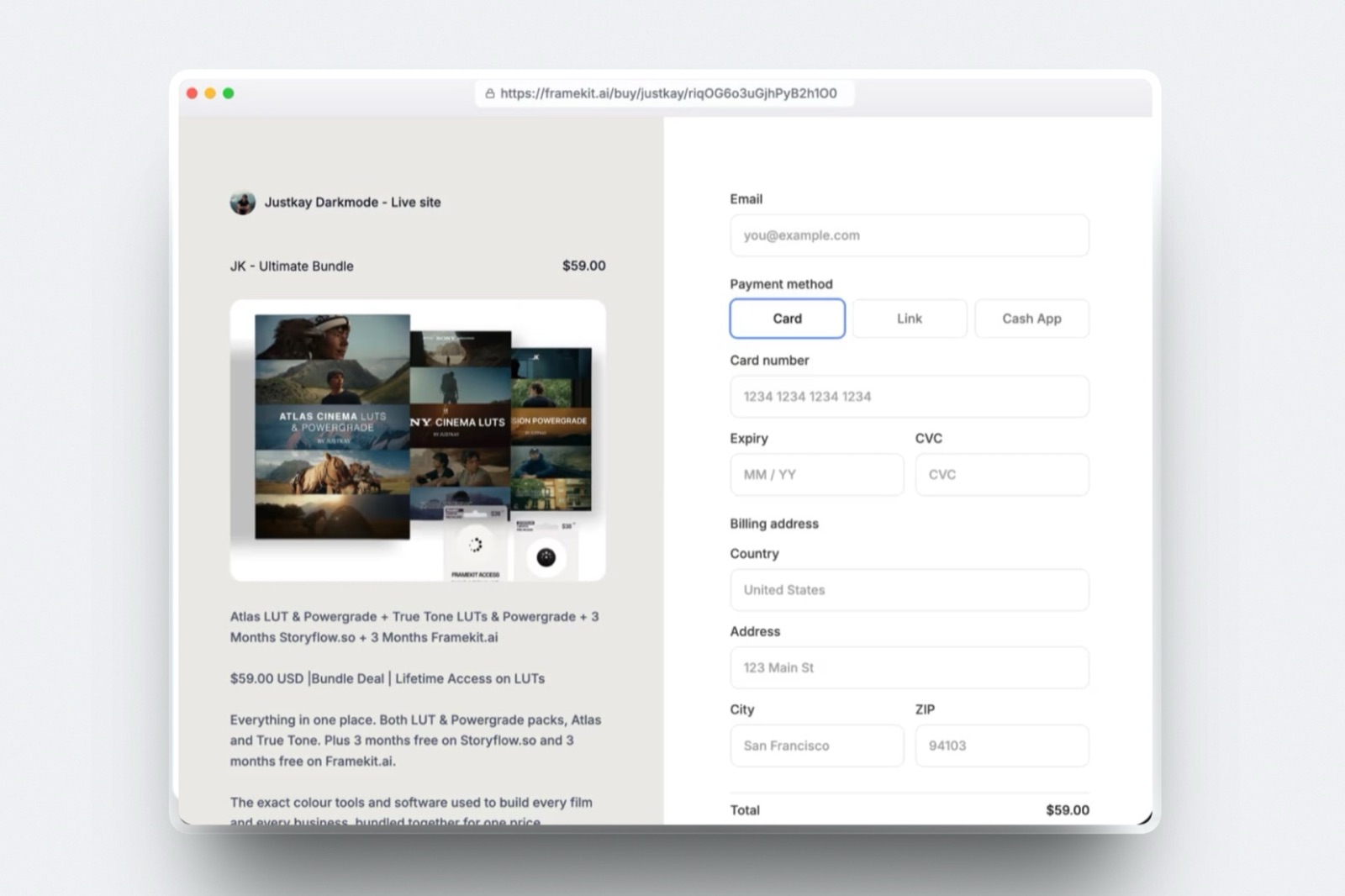
The buy link matters more than the page at this stage. A product with its own direct link can be pasted into a reply, a story, a DM, a newsletter or a video description, which is where your first 10 sales are actually going to come from.
Framekit gives each product a direct buy link as well as a page on your own site, so the same product can live in a story sticker and on your portfolio without being duplicated.
Keep it on the domain your work already lives on.
A buyer who clicks from your portfolio to a checkout on a stranger's domain hesitates, and the store that sits on your own site keeps the traffic, the SEO and the customer relationship with you rather than with a marketplace.
Framekit is an AI website builder whose store attaches a checkout to the portfolio you already publish, so the buy link and the work that earned the buyer's trust share one domain and one bill.
Check the whole thing on a phone before you tell anyone it exists. Not the page: the whole path, from the link to the payment to the file arriving.
Most first-sale traffic is a thumb on a small screen, and a checkout that scrolls badly is a problem you can see in 90 seconds and never notice on a desktop.

The thing that goes wrongthe creator treats the page as a design project, rewrites the headline 11 times, and never sends the launch email, because the page is a thing they know how to work on and the email is not.
Step 5. Post proof of the thing in use, in five formats
Announcements do not sell first products and demonstrations do, so the content plan for your first 10 sales is five kinds of post that all show the product doing its job on real work rather than describing it.
| Format | What it shows | Where it goes | How long it takes |
|---|---|---|---|
| Before and after | One frame ungraded, one graded with the pack, no commentary | Feed post, carousel, or a still on your site | 20 minutes |
| Over the shoulder | A screen recording of you applying it to a real client job | Reels, Shorts, TikTok | 40 minutes |
| The question answered | The exact question you get asked, answered in full, with the product mentioned last | Caption, newsletter, or a blog post | An hour |
| The ugly version | What the shot looked like before you fixed it, including the mistake | Stories, where lower polish is expected | 10 minutes |
| Somebody else's result | A buyer's frame, with their permission and credit | Anywhere, and it is the most persuasive of the five | 5 minutes plus the asking |
Run them in that order, because the last one does not exist until you have buyers, which is the whole reason the first 10 sales are the hardest 10 you will ever make.
Two rules keep this from turning into an advertising campaign your audience mutes. Teach something in every post whether or not anyone buys, so the feed is still worth following.
And mention the product last, once, in plain language, rather than leading with it. People who watched you grade a shot will follow a link; people shown a price will not.
Where you post matters less than most guides suggest, with one exception: put the work on the platform where your audience already watches you, and put the permanent version on your own site.
The platform-specific tactics for the social side are in selling digital products on Instagram.
The thing that goes wrongthe launch is a single announcement post, which reaches a fraction of the audience once, on a day when most of them were not looking. 10 posts that teach beat one post that announces, and the arithmetic of reach is why.
Step 6. Send the three messages that actually ask
At some point you have to ask people to buy, and the reason most first products stall at three sales is that the creator posted for two weeks and never once wrote directly to a person.
The list email. One email to everyone who has subscribed, sent on a weekday morning, structured as the problem, the thing you made, what is in it, the price and the link. Do not apologise for selling.
Framekit does not send newsletters, so this is a separate tool, and email marketing tools for photographers covers the ones worth paying for at this size.
The reply. Every time someone asks you the question your product answers, reply with the real answer in full, then one line at the end: I also packaged this up if you want the files, and the link.
The answer is the value and the link is the footnote. This single habit produces more first sales than any scheduled campaign.
The direct message that is not spam. Write to the 10 specific people who you know have this problem, by name, one at a time, with no template.
It reads roughly like this: you mentioned you were struggling with skin tones on that shoot, I finally packaged the grade I have been using, here it is, no pressure and tell me if it is useless.
That message is not spam because it is true, it is specific to them, and it accepts no as an answer. A hundred copies of it sent to strangers is spam, which is why the number is 10 and not a hundred.
Past clients get their own version of the message and they convert best, because they have already paid you and the price is small next to what they paid.
Send them the product free if it is relevant to the job you did together and ask what they think; a past client who uses it and says so in one sentence is worth more than the $34 you did not charge.
The thing that goes wrongthe DM gets written as a broadcast and sent to everyone, which burns the exact relationships that would have produced sales three through eight. One at a time or not at all.
Step 7. Turn buyers one to 10 into the proof that sells the next hundred
The first 10 buyers are not 10 small transactions, they are the raw material for every piece of evidence you will use for the next year, and almost nobody asks them for it in the window when they will say yes.
Write to each buyer between three and seven days after the purchase, when they have used it and before they have forgotten. Ask two questions, not a form: what did you use it on, and was anything confusing.
The first question produces the quote and the image. The second produces the fix that stops your next 10 buyers from emailing you.
Ask explicitly for permission to use their words and one frame, and offer credit and a link back. Most creatives say yes, because a credit on your site is worth something to them too. Then put those quotes on the product page under the price, where the next buyer is deciding.
The other thing the first 10 give you is data you did not have: which question they asked before buying, which platform they came from, and which of the five post formats preceded the sale.
Framekit puts orders, refunds and revenue in the dashboard, and site analytics on every plan, so the answer to the second question is in front of you rather than reconstructed from memory.
The thing that goes wrongthe creator waits to ask for testimonials until there is a marketing reason to want them, by which point the buyer has moved on and the specific job the product helped with is a blur. Ask inside the first 14 days, while the buyer can still name what changed.
What is left of $340 after the checkout takes its cut
The fee question feels enormous before the first sale and turns out to be small, and it is worth seeing the actual numbers so it stops occupying the space where the audience audit should be.
10 sales at $34 is $340 gross on every row below. Card processing sits on top of each one and is charged by the processor rather than the platform, so it is listed separately and not folded in.
| Route | Platform cut on $340 | Subscription before sale one | What you get for it |
|---|---|---|---|
| Framekit Free | 5%, or $17.00 | $0 | Store, site, hosting and a buy link, with a Framekit badge and no custom domain |
| Framekit Starter | 5%, or $17.00 | $7 a month billed yearly | The badge gone, your own domain, 50GB of pooled storage |
| Gumroad direct | 10% plus $0.50 a sale, or $39.00 | $0 | A hosted page and a marketplace you might be found in |
| Lemon Squeezy | 5% plus 50 cents a sale, or $22.00 | $0 | Merchant-of-record status, so the sales tax filing is theirs |
| Stan Store Creator | None stated on the plan page | $29 a month, no free tier | A creator storefront with booking, courses and subscriptions built in |

Two readings of that table matter.
The spread between the cheapest and the most expensive percentage route is $22 on 10 sales, which is less than an hour of your time, so choosing a platform on fees alone at this stage is optimising the wrong variable.
And a $29 monthly subscription is a different kind of commitment entirely: it is $290 over a year, which the carried product does not cover until roughly its ninth sale of the year, before any fees.
On Stripe's side, the figure worth knowing before your first refund is that processing fees are not returned when you refund a sale, and Stripe's published page, which served European pricing to this session, lists 20 euros for each dispute received.
Framekit also keeps its platform fee on a refund today. Neither is a reason to panic at 10 sales, and both are reasons to write a clear refund line on the page.
Run it on yours: take your intended price, multiply by 10, multiply by the fee percentage, then add the flat per-sale fee times 10.
If the answer changes your decision by less than an hour of your billable rate, pick the platform on where the buyer lands, not on the fee.
The wider fee landscape is in free product-selling software and what it costs to sell digital products online.
In one linethe fee difference across every realistic route is under $25 on your first 10 sales, while the difference between a warm audience of 200 and one of 2,000 is the whole outcome, so put the attention where the difference actually is.
When to stop tweaking the page and start again
There is a point where continuing to adjust a product that is not selling becomes a way of avoiding the harder question, and knowing where that point sits saves months.
Give the launch two weeks of real activity: the list email sent, at least six proof posts published, 10 individual messages written. Then look at what happened, not at how it felt.
| What happened in two weeks | What it means | What to do next |
|---|---|---|
| Fewer than 100 people saw the page | A reach problem, not a product problem | Post more proof, and write to people individually |
| Traffic but no checkouts started | The page is not answering an objection | Add file counts, compatibility and two more images in use |
| Checkouts started and abandoned | A price or a payment problem | Check the path on a phone, and read the price aloud in the buyer's terms |
| Sales but confused buyers | A delivery or instruction problem | Fix the install PDF before you touch the marketing |
| Nothing at all, and nobody asked you about this topic in the first place | You guessed at demand instead of counting it | Go back to your inbox and pick a different product |
The last row is the one people avoid. If nobody ever asked you the question your product answers, the launch did not fail; the hypothesis did, and that is a cheap thing to learn in two weeks and an expensive thing to learn in six months.
Pick the next product from the actual questions, keep the page, and run it again.
If 10 sales did happen, the next job is not a second product.
It is making the first one easier to find: a real product page indexed by search, the proof from your buyers on it, and a link from every piece of work that shows the result. How to start selling digital products and platforms for selling presets are the sensible next reads.
In one linetwo weeks of genuine effort is enough to distinguish a reach problem from a page problem from a demand problem, and each of those three has a different fix, which is why guessing between them is what wastes the months.
Which route to pick, as a short set of questions
Answer these in order and stop at the first one that applies to you, because the correct answer at 10 sales is different from the correct answer at a thousand.
Do you already have a portfolio site with traffic? Then put the store on it. The buy link belongs on the domain that earned the trust, the SEO accrues to you, and on Framekit that costs 5% with no subscription to start.
Do you have no site and no plan to make one this month? Then a hosted storefront is the faster path, and Gumroad's 10% plus $0.50 on direct sales is the price of skipping the setup.
Do you sell into the EU and the UK as well as your own country, and dread the tax question? Then a merchant of record such as Lemon Squeezy at 5% plus 50 cents is worth the extra points, because Framekit's checkout runs as a direct charge on your own Stripe account, which makes the tax yours.
Do you need discount codes, upsells, an affiliate program or email sends on day one? Then Framekit is the wrong pick and you should say so plainly: discount codes are Pro and up, and affiliates, upsells, funnels and newsletter sending do not exist there at all.
Is your real problem that under 300 people know your work? Then no store fixes it, and the next month belongs to the audience rather than to the product.
Frequently Asked Questions
How do you get your first sale as a digital creator?
Your first sale almost always comes from your warm audience rather than from strangers, so the fastest route is to write individually to 10 people who have already asked you the question your product answers, and to reply to every future instance of that question with the full answer plus a link.
Publishing proof of the product doing real work supports those messages. A funnel built before the first sale is optimisation without a signal to optimise.
How many followers do you need to sell a digital product?
There is no threshold, because what matters is how many people pay attention rather than how many accounts follow you.
A useful working rule is to count only the people who have engaged with your work in the last 90 days plus everyone who has paid you, and if that total is under about 300 across all channels, the audience is the bottleneck and a store will not move it.
A 300-person email list gave you 300 addresses you can write to; 10,000 passive followers gave you a view count you cannot email.
What should you charge for your first digital product?
Price a first digital product above $25 so 10 sales are worth the work, and set the figure against what the buyer saves rather than what it cost you to make.
Under $25 the flat per-sale fees start eating a meaningful share of the price, and a very low number signals low value to exactly the audience most likely to buy.
Avoid a launch discount, since it trains your first buyers to wait for the next one.
Is Gumroad or your own website better for a first product?
Gumroad is better if you have no site and want to be selling this week, at 10% plus $0.50 on a direct sale and 30% on a sale found through Discover.
Your own site is better if you already have a portfolio with traffic, because the buy link sits on the domain that earned the buyer's trust and the fee is lower.
On Framekit that means 5% on Free and Starter with no subscription, falling to 3% on Pro and 0% on Business.
Does Framekit do email marketing for a product launch?
No. Framekit does not send newsletters, broadcasts or automated email sequences, and it has no affiliate program, no upsells and no funnel builder.
It handles the product page, the direct buy link, the checkout and the delivery, and site analytics show where the traffic came from.
For the launch email itself you need a dedicated email tool alongside it, which is the correct setup anyway, because an email list you control should not depend on your store.
How long should it take to build a first digital product?
Package a first product in an afternoon rather than building one over six weeks, because its job is to find out whether people will pay you for a file. 10 LUTs you already use, a template you already send clients or a six-page guide answering the question you are asked most are all enough.
Every additional week raises the cost of discovering the demand was not there, and delays the only feedback that is worth anything.
Should you give your first product away to past clients?
Give it free to past clients where it genuinely relates to the work you did together, and ask them what they think, not for a review.
A past client who uses it and writes you one honest sentence is worth more than the sale price, because that sentence goes on the product page where the next buyer is deciding.
Always ask permission before publishing their words or an image from their job.
What happens to your fee if a first buyer asks for a refund?
On Framekit the platform fee is kept rather than reversed when you refund, so the sale costs you both the revenue and the fee.
Stripe's published policy is likewise that the payment processing fee from the original transaction is not returned on a refund, and Stripe's page lists a dispute fee for each dispute received.
At 10 sales none of that is material, but it is a reason to write the refund terms and the compatibility notes out in full on the page before launch.
Do you need a custom domain to sell digital products?
No, you can sell on a free subdomain, and Framekit's Free plan includes the store and hosting with a Framekit badge and no custom domain attached.
A custom domain does two things that matter later rather than at sale one: it makes the link look like yours in a DM, and it keeps the search authority you build attached to an address you own.
On Framekit the domain arrives on any paid plan, starting at $7 a month billed yearly.
What is the fastest way to get 10 sales from a small audience?
Reply personally to everyone who has ever asked the question your product answers, send one clear email to your list, write 10 individual messages to specific people, and publish proof of the product doing the job on real work, not announcements about it.
That sequence uses the audience you already have instead of waiting for one to arrive, and it is why a creator with 300 attentive people regularly reaches 10 sales faster than one with 20,000 passive followers.
Final Verdict
Your first 10 sales are an audit, a price and seven messages.
Count the people who already know your work, pick the product they have already asked you for, price it above $25, build one page with one buy link in an afternoon, post proof of it doing the job on paid work, not announcements, write to 10 people by name, and then ask the first buyers for the sentence that sells the next hundred.
For a photographer or filmmaker who already has a portfolio, Framekit is the pick here: the product page, the buy link and the work that earns the trust live on one domain and one account, the store is free to start at a 5% fee rather than a subscription you pay before selling anything, delivery is instant and buyers can come back for their files.
Where Framekit losesit does not send a single email, so the launch email that produces most of your first 10 sales happens somewhere else entirely.
There is no affiliate program, no upsell or order bump, no funnel builder and no membership tier, and discount codes only appear on Pro.
If your plan depends on any of those from day one, Framekit is not for you and a creator storefront such as Stan Store or a merchant-of-record platform such as Lemon Squeezy is the better fit.
Framekit also will not find you an audience, and if fewer than 300 people know your work, no store on this list changes that.
Related readinghow to start selling digital products, how to price digital products, the best digital products to sell, getting clients from your website and moving from Instagram to your own website.
When you want a dated event rather than a slow start, how to launch a digital product builds the calendar, and how to set up a free online store as a creator shows what a free tier actually costs you per sale.