Framekit templates
Start from a designer-made template
 Use template
 Use template
 Use template
 Use template
 Use template
 Use template
 Use template
 Use template

The awkward part of Framekit vs Carrd belongs at the top, because you would find it in two clicks anyway: if your site is genuinely one page, Carrd is cheaper, and it stays cheaper.
Carrd Pro Standard puts a site on your own domain for $19 a year. Carrd Pro Plus, at $49 a year, adds payment-enabled forms that run through your own Stripe account, and Carrd's documentation mentions no Carrd fee on those payments.
Framekit's cheapest plan with a custom domain is $84 a year billed yearly, and its store takes 5% of sales on that plan. For a single page with a single product, no honest arithmetic puts Framekit ahead.
The comparison changes the moment the job outgrows one scroll: a second real page, a client gallery, a cut that needs notes, a catalogue of files to deliver. That is the territory this page is really about.
A one-page website builder is a tool for publishing a single scrolling page, such as a profile, a landing page or a link hub, and Carrd is the best-known of them.
Framekit is an AI website builder that publishes multi-page sites and holds client galleries, video review, Slides decks and a digital-download store in one account.
Carrd is the better buy for a genuine one-pager: $19 a year with your own domain on Pro Standard, $49 on Pro Plus for Stripe-powered payment forms with no Carrd cut, and up to 10 or 25 sites per plan.
Framekit is the better buy once you need separate pages, client galleries, video review or a store that delivers files for you, because it includes all of them from a permanent free plan with 10 pages, and in our worked examples it costs less than Carrd plus a gallery, review and selling service.
Full disclosure: Framekit is our product and it loses the headline price comparison here. Carrd facts come from Carrd's Pro plans page and its documentation, read on 12 October 2026. We describe both tools by what their makers publish and claim no hands-on test.
What changed in this October 2026 update: the earlier version said Carrd's $19 plan takes payments through your own Stripe account.
Carrd's documentation says payment-enabled forms need Pro Plus, at $49 a year; Pro Standard can embed Stripe, PayPal or Gumroad buttons as widgets instead.
We corrected that, removed a claim that we built the same site on both tools, re-verified every Carrd tier, and added worked costs, a limits table and a switching checklist, then counted card processing in the yearly bills and made clear that Framekit galleries keep a small footer credit on every plan.
How This Comparison Was Built
This comparison uses published plan limits, Carrd's own documentation and cost arithmetic you can redo with your own numbers, because the decision between a one-page builder and a fuller platform is mostly about scope, and scope is what plan pages describe.
Sources. Carrd's Pro plans page, its documentation on using sections and on payment-enabled forms, Framekit's pricing page and product pages, and for the services a Carrd user adds beside the site, the pricing pages of Pixieset, Frame.io and Gumroad.
All read on 12 October 2026.
Five questions. What a page on your own domain costs; how each tool takes money and delivers a file; what happens when you need a second page; how photographers and filmmakers deliver work to clients; and what the full setup costs over one and three years.
Not claimed. The previous version described hands-on builds and checkout tests. This one does not; where a figure is ours rather than the vendor's, the text says so.
Framekit vs Carrd at a Glance
Carrd is the cheaper and simpler tool for one page and a handful of small sites, while Framekit is the fuller account for a multi-page portfolio with delivery, review and a store, and the table below shows the published limits behind that split.
| Framekit | Carrd | |
|---|---|---|
| Free plan | 10 pages, 10GB, galleries, review, decks and a store on a framekit.ai address | Up to 3 sites with "Made with Carrd" branding |
| Cheapest plan with your domain | Starter, $84 a year billed yearly | Pro Standard, $19 a year |
| Sites per plan | One site per website plan | 3 on Pro Lite, 10 on Pro Standard, 25 on Pro Plus |
| Pages | 10, 30, 200 or unlimited separate pages | One page per site; sections simulate pages |
| Taking payments | Built-in store with file delivery, 5%, 5%, 3% or 0% fee | Stripe payment forms on Pro Plus; Stripe, PayPal or Gumroad widgets on Pro Standard |
| Client galleries | Unlimited, photo and video | Not offered |
| Video review | Every plan | Not offered |
| Redirects and password protection | Neither on the site; galleries take a password and download PIN | Both on Pro Plus |
| Download the site's files | Not offered | Pro Plus |
Where Carrd Wins, and It Genuinely Does
Carrd wins on price, on fees and on focus for anyone whose site is a single page, and on Pro Plus it adds owner-friendly controls such as redirects, password protection and downloadable site files that Framekit's website builder does not offer at any price.
Price. $19 a year for Pro Standard with your own domain, forms, widgets, embeds and analytics, against $84 a year for Framekit Starter. Over three years that is $57 against $252.
No platform cut. Carrd's payment-enabled forms put a Stripe Checkout step in front of the form, using your own Stripe API keys, and Carrd's documentation describes no Carrd fee.
Framekit takes 5% on Free and Starter, 3% on Pro and 0% only on Business at $31 a month billed yearly.
Many small sites for one price. Pro Standard publishes 10 sites, Pro Plus 25, and larger bundles go up to hundreds. A creator who runs a separate launch page for each product or event gets them all for one annual fee. On Framekit, each website is its own plan.
Control a site builder rarely gives. Pro Plus adds redirects, password protection, a canonical URL setting, site files and the option to download your sites.
Framekit has no redirect manager, robots.txt is not editable and there is no way to export the site as files.
Focus. A Carrd page is one scroll with no structure to plan. For a link hub, a waitlist, an event page or a single profile, that constraint removes decisions rather than adding them.
Verdict: if the deliverable is one page, now and in a year, buy Carrd. Our Framer vs Carrd and Carrd vs Linktree comparisons cover the other common one-page choices.
Where Framekit Wins

Framekit is an AI website builder that publishes real multi-page sites and carries client galleries, frame-accurate video review, Slides and a store that delivers files, so it wins every time the brief grows past one scroll, which for working photographers and filmmakers is usually week one.
Separate pages, free. The Free plan publishes up to 10 pages, Starter 30, Pro 200 and Business unlimited, each a page of its own with its own title and description for search.
Carrd's own documentation describes sections as a way to simulate multiple pages on a one-page site.
Client delivery and review. Unlimited galleries with photos and video together, favourites, full or favourites-only downloads and a separate download PIN, plus review links where clients comment at the exact frame.
Carrd has neither, so a photographer on Carrd also pays a gallery service.
A store that delivers the file. Framekit's store hosts the product, takes payment through your own Stripe account and gives the buyer an instant download they can come back to.
A Carrd payment form takes the money; Carrd's documentation does not describe any file delivery after payment, so that part is yours to arrange.
A draft to react to. Templates built with AI and trained by senior designers, an AI that writes copy and generates whole sections, and the option to rebuild a layout from a screenshot.
Every plan includes a monthly AI allowance for that work, and editing by hand never touches it.
Verdict: the moment a second page or a client deliverable appears, Framekit stops being the expensive option and starts being the one that does the whole job.
Taking Money: Carrd's Payment Forms Against Framekit's Store
Carrd lets you take payments with no platform fee but leaves product delivery to you, while Framekit runs a full download store with a fee that falls from 5% to 0%, so the cheaper option depends on how many products you sell and how much fulfilment work you want to own.
On Carrd. Pro Standard, at $19 a year, can embed payment widgets from Stripe, PayPal or Gumroad, which means the checkout and its fees belong to that third party; Gumroad, for example, charges 10% plus $0.50 per direct sale and handles file delivery and sales tax.
Pro Plus, at $49 a year, adds payment-enabled forms: submitting the form opens Stripe Checkout, and the form only processes once payment succeeds. You then deliver the file yourself.
On Framekit. Every plan, Free included, sells unlimited digital products, from presets and LUTs to templates, brushes and guides, plus free lead-magnet products.
Payment runs through Stripe Connect into your own Stripe account, which makes you the merchant of record, so VAT and sales tax are yours.
Buyers download instantly and can return for their files; order emails carry links valid for 7 days that you can resend.
The fee is 5% on Free and Starter, 3% on Pro and 0% on Business, on the post-discount price, kept on refunds, with Stripe's processing on top.
Checkout is a hosted framekit.ai page with your name and logo and a "Powered by Framekit" line, and a direct buy link works anywhere without a site.
What Framekit's store does not do. Physical products, subscriptions or memberships, courses, license keys, pay-what-you-want pricing, order bumps and abandoned-cart emails are not offered.
Here is the fee arithmetic for one $29 product at three volumes, in a year, with card processing left out because it applies on both:
| Monthly sales | Carrd Pro Plus, own Stripe | Framekit Starter (5%) | Framekit Pro (3%) | Framekit Business (0%) |
|---|---|---|---|---|
| $150 | $49 | $84 plus $90 = $174 | $180 plus $54 = $234 | $372 |
| $500 | $49 | $84 plus $300 = $384 | $180 plus $180 = $360 | $372 |
| $1,500 | $49 | $84 plus $900 = $984 | $180 plus $540 = $720 | $372 |
Carrd is cheaper at every row, and we will not dress that up. What the table does not price is fulfilment: on Carrd you send each file and handle each "my link expired" email; on Framekit the store does that.
For one product that work is small. For twelve products and a few hundred buyers it is a part-time job.
When One Page Stops Being Enough
Carrd users tend to outgrow it at four specific moments rather than gradually, and knowing which one is coming tells you whether $19 a year is a bargain to keep or a stopgap to plan around.
A second real page. Case studies, a services page with prices, an about page that reads like a person. Sections can fake this inside one page, but every "page" shares the same address and the same search listing.
The first client delivery. The first time a client needs a gallery rather than a download link, a one-page builder has no answer, and a second subscription starts.
A catalogue. One product on a payment form is easy. Eight products, discount codes and automatic delivery is a store, and assembling one from forms and widgets stops being cheaper in hours even where it is cheaper in dollars.
Search. If commissions arrive through search, separate pages for each kind of work give you more chances to rank. A single page can rank well for one focused query; it cannot target five.
Forms, Email Signups and Analytics
Carrd is stronger at feeding an email list from a page, connecting its signup forms directly to twenty newsletter and email services, while Framekit keeps enquiries and bookings inside its own dashboard with a monthly submission allowance, so the better choice depends on where your leads should land.
Carrd. Pro Standard adds contact, signup, custom and payment-enabled forms, and its signup forms connect to services including ActiveCampaign, beehiiv, Brevo, Kit, Klaviyo, Mailchimp, MailerLite and Sendy.
Analytics are optional and come from the tool you plug in, such as Google Analytics, Plausible or Matomo. For a waitlist page whose only job is to grow a list in your newsletter tool, that is exactly the right shape.
Framekit. Contact and booking forms are on every plan, and enquiries land in your Framekit dashboard and your inbox. Submissions run 500 a month on Free, 1,000 on Starter, 5,000 on Pro and unlimited on Business.
Visitor analytics showing pages and sources are built into the dashboard on every plan, and a cookie consent banner for EU visitors is included too.
Which matters more. If the page exists to collect newsletter signups, Carrd's integrations are the shorter route.
If it exists to bring in commissions and shoot bookings, Framekit's forms keep those enquiries next to the galleries and review links the same client will receive later.
The Work Around the Site
Most of what separates Framekit from Carrd happens after the site is live, in the galleries, review rounds, decks and downloads that a photographer, filmmaker or designer handles every week and that a one-page builder was never meant to touch.
Client galleries
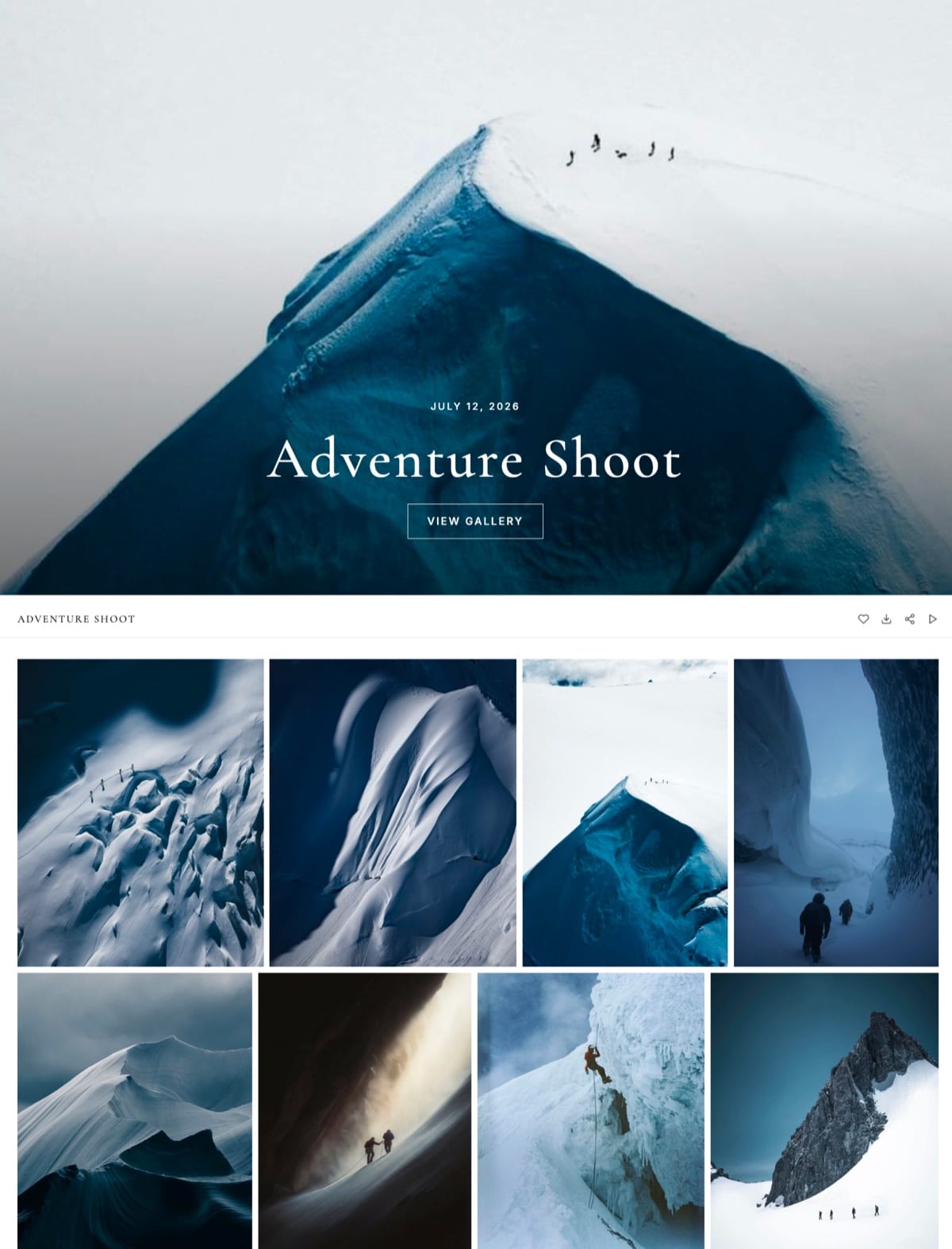
One link per shoot holds the photos and the film together. Clients heart their favourites and filter to them, download everything or only the picks, and can be asked for a PIN before any download, on top of the gallery password.
Photos can be watermarked; videos are transcoded for smooth playback and never watermarked. Photo files reach 100MB, video files 500MB on Free up to 3GB on Business, and paid plans serve galleries from your own domain.
Not offered: print sales, client uploads or a native app.
Video review
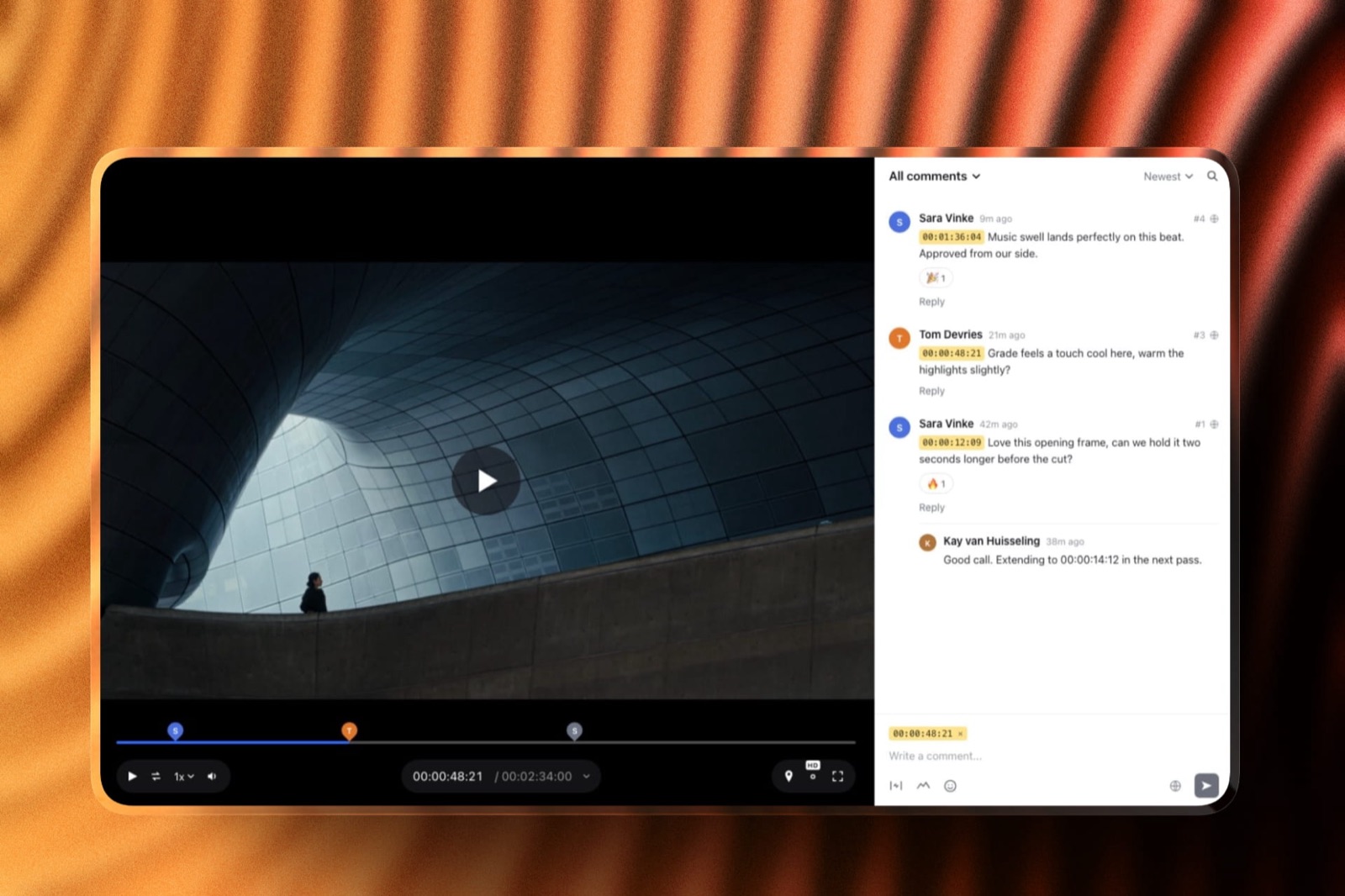
A review link opens in the browser with no account. The client clicks the frame, types the note, draws on the picture if it helps, and you reply in the thread.
New versions stack on the old ones with their notes kept, and each round carries a status from needs review to approved. Review videos can run 2 hours, and files on comments open on Pro.
Not offered: side-by-side version compare, editing-suite panels or proofing for stills and PDFs.
Slides
A rate card, a treatment or a proposal can sit beside the site instead of in a separate deck tool.
Ask for a deck and the AI asks up to three quick questions, picks a style and colour theme, asks you to paste the real numbers, proposes an outline for your OK, then builds the slides with speaker notes, flagging anything you did not supply as a placeholder.
Share a link or export a PDF on every plan; PowerPoint export, as images and up to 60 slides, opens on Pro.

What Each Setup Costs in Year One and by Year Three
Carrd is cheaper for the two one-page creatives below and Framekit is cheaper for the photographer and the studio, by about $80 to $740 a year once card processing is counted, because the services a Carrd site needs beside it cost more than the site itself.
Assumptions you can change: yearly billing, US prices read on 12 October 2026, prices held flat for three years, domain registration left out on both sides, and card processing left out of the cells and worked in the note below them.
For selling beside a Carrd page without Pro Plus forms we use Gumroad's direct-sale fee of 10% plus $0.50 per sale from its pricing page.
| Creative | Framekit setup | Framekit year one | Framekit by year three | Carrd setup | Carrd year one | Carrd by year three |
|---|---|---|---|---|---|---|
| One page on your domain, nothing sold | Starter | $84 | $252 | Pro Standard | $19 | $57 |
| One page selling a $29 preset pack, 100 sales ($2,900) | Starter ($84) plus 5% fee ($145) | $229 | $687 | Pro Plus, own Stripe, no Carrd fee | $49 | $147 |
| Photographer, about 80GB of galleries live, 40 preset sales at $25 | Pro, 300GB ($180), plus 3% fee ($30) | $210 | $630 | Pro Standard ($19) plus Pixieset Plus ($192) plus Gumroad ($120) | $331 | $993 |
| Studio of 3, review on every job, 100 template sales at $50 | Business, 2TB ($372), 0% fee | $372 | $1,116 | Pro Standard ($19) plus Frame.io Pro for 3 ($540) plus Gumroad ($550) | $1,109 | $3,327 |
Outside prices, each read on its vendor's page in October 2026: Pixieset's client gallery plans list Plus at $16 a month billed yearly with 100GB, and Frame.io's pricing page lists Pro at $15 per member a month on monthly billing, with annual billing saving 13%.
Card processing. Stripe's standard 2.9% plus 30 cents applies to both the Framekit store and Carrd's payment forms, so it does not change the preset-seller row.
It adds about $41 a year to the photographer's Framekit bill and $175 to the studio's, taking them to $251 and $547.
Gumroad's pricing page lists 10% plus $0.50 a sale without saying whether card processing comes on top, so the Carrd routes stay at $331 and $1,109 or rise with it, and Framekit stays cheaper by about $80 to $740 a year either way.
What the totals leave out. The preset seller on Carrd delivers every file by hand, which Framekit automates. Gumroad is a merchant of record that handles sales tax, which neither Carrd's forms nor Framekit's store do.
Frame.io Pro brings far more storage, 2TB plus 2TB per extra member, and passphrase-protected shares.
On Framekit one account holder uploads the studio's cuts and owns its galleries and decks, while the other two edit the website as team members and clients comment without an account.
The studio could also run on Framekit Pro at $180 plus a 3% fee of $150 if 150GB of video storage is enough.
Run it yourselfcount the pages you actually need and the services you pay for beside your current site. If the answer is one page and none, keep Carrd.
If it is more than one page or any gallery, review or store subscription, add them up and compare with one Framekit plan plus its fee on last year's sales.
Which Tool for Which Job
Carrd and Framekit barely overlap once you list the jobs, because one is built for a single focused page and the other for a site plus the client work around it, so choosing job by job usually makes the answer obvious.
| Job | Better tool | Why |
|---|---|---|
| A link hub, waitlist or event page | Carrd | One scroll, $19 a year on your domain |
| Ten small landing pages for ten launches | Carrd | 10 sites on Pro Standard, 25 on Pro Plus |
| Selling one product with no platform cut | Carrd | Stripe payment forms on Pro Plus, no Carrd fee |
| A portfolio with a page per project | Framekit | Separate pages from the Free plan up |
| Delivering a shoot or a film to a client | Framekit | Unlimited galleries, photo and video together |
| Getting a cut approved | Framekit | Frame-accurate review links |
| Selling a catalogue with automatic delivery | Framekit | Built-in download store, 5% to 0% fee |
| A treatment, rate card or proposal deck | Framekit | Slides in the same account |
Limits and Specs Side by Side
These are the published limits that decide daily use, taken from Carrd's Pro page and documentation and Framekit's pricing page in October 2026, and each row is one that a creator outgrowing a single page tends to meet.
| Limit | Framekit | Carrd |
|---|---|---|
| Prices, yearly | $0, $84, $180, $372 | $0; Pro Lite $9; Pro Standard $19; Pro Plus $49; larger site bundles cost more |
| Custom domain | Starter and up | Pro Standard and up |
| Branding removed | Starter and up | Every Pro plan |
| Pages | 10, 30, 200, unlimited | One page per site, sections inside it |
| Image and video uploads on the site | Video 15MB on Free, 100MB on paid, plus Vimeo and YouTube embeds | Images up to 16MB and videos up to 64MB on Pro |
| Storage | 10GB, 50GB, 300GB, 2TB pooled | Not published |
| Forms | Contact and booking forms, 500 to unlimited submissions a month | Contact, signup and custom forms on Pro Standard; advanced and payment forms on Pro Plus |
| Analytics | Visitor analytics in the dashboard | Google Analytics, Plausible, Matomo and others on Pro Standard |
| Galleries and review | Unlimited galleries; review on every plan | Not offered |
| Redirects, password, site download | None of the three on the site | All three on Pro Plus |
| Team | 3 members on Pro, unlimited on Business, editing the website only | Not published |
What Happens When Something Changes
These are the situations that come up after the first month on either tool, answered from what Carrd and Framekit publish, so you can see where each one bends before a buyer or a client finds out for you.
A buyer pays but never gets the file. On Carrd's payment forms, delivery is your job, so the fix is yours too. On Framekit, buyers return for their files and you can resend fresh download links.
A buyer asks for a refund. You refund through Stripe on both. Framekit keeps its fee, charged on the post-discount price; on Business that fee is 0%. Carrd takes no fee to keep.
You rename a page. Carrd Pro Plus can redirect the old address. Framekit has no redirect manager, so plan slugs before publishing and keep them.
You stop paying. A lapsed Framekit plan can fall back to the permanent Free plan on a framekit.ai address with a badge, if the site fits in 10 pages and 10GB. Carrd's free tier allows up to 3 sites with Carrd branding and no custom domain.
A client has no account. Framekit gallery and review links open without one. On Carrd, client delivery depends on whichever gallery or transfer service you link to.
Moving From Carrd to Framekit
Moving from Carrd to Framekit is a small rebuild rather than an import, and for most one-page sites it takes an afternoon, so the steps below focus on keeping links working and moving payments in the right order.
- Ask whether you need to move. If the site is still one page and you only need galleries or review, keep Carrd and link to Framekit gallery and review links.
- Keep the Carrd site live while you build. Draft on Framekit's free plan: upload a screenshot of your Carrd page for the AI to rebuild, or start from a template.
- Split sections into pages. Give each section that was standing in for a page its own Framekit page, with its own title and description.
- Move products. Recreate each product in the Framekit store, connect Stripe, and swap Carrd payment forms or Gumroad widgets for Framekit buy links.
- Point the domain. Connect it on Starter or above. Old #section links will land on the homepage, so update the links in your bios and email signatures.
- Cancel the Carrd plan last. Once forms, checkout and every link work on Framekit, let the Carrd plan lapse; if you used Pro Plus, download the site's files first for your records.
For more one-page options, the best Carrd alternatives and the best one-page website builders cover the field.

Which One Should You Pick?
This decision path asks the questions in the order that settles Framekit vs Carrd fastest, starting with whether one page is genuinely the whole job, because if it is you can stop reading and buy Carrd.
1. Is one page genuinely the whole site, now and in a year? If yes, Carrd at $19 a year; stop here. If no, go to question 2.
2. Do you sell one product and want no platform cut? If yes, and you can deliver the file yourself, Carrd Pro Plus at $49 a year. If no, go to question 3.
3. Do you deliver photos or video to clients, or send cuts for review? If yes, Framekit; Carrd has no galleries and no review. If no, go to question 4.
4. Do you need a page per project or service? If yes, Framekit, where 10 separate pages are free. If no, go to question 5.
5. Do you run many small sites, such as one per product launch? If yes, Carrd's 10 or 25 sites per plan are hard to beat; each Framekit website is its own plan.
Frequently Asked Questions
Is Carrd cheaper than Framekit?
Yes, for a single page. Carrd Pro Standard is $19 a year with your own domain and Pro Plus is $49 with Stripe payment forms and no Carrd fee, against Framekit Starter at $84 a year plus a 5% store fee.
Framekit becomes cheaper once you add a gallery, review or selling service beside Carrd.
Can Carrd take payments without a platform fee?
Carrd's payment-enabled forms run Stripe Checkout with your own Stripe keys and require Pro Plus or higher, at $49 a year; Carrd's documentation describes no Carrd fee on top of Stripe's processing.
On Pro Standard you can embed Stripe, PayPal or Gumroad widgets instead, and those services' fees apply.
Does Carrd deliver digital files after payment?
Carrd's documentation on payment forms says the form processes after a successful Stripe payment but does not describe file delivery, so sending the file is your job.
Framekit's store delivers an instant download after payment, lets buyers come back for their files and sends order emails with links valid for 7 days.
Can Carrd build a multi-page portfolio?
Not as separate pages. Carrd's documentation describes sections that simulate multiple pages on a one-page site, which works for navigation but keeps one page underneath.
Framekit publishes separate pages, 10 on the Free plan, 30 on Starter, 200 on Pro and unlimited on Business, each with its own title and description.
Framekit vs Carrd for photographers: which is better?
Framekit is better for most photographers, because client galleries with favourites, download PINs and video come in the same account as the site and a preset store.
On Carrd, a photographer pays a separate gallery service; in our example Carrd plus Pixieset and Gumroad costs $331 a year against $210 on Framekit Pro, or $251 once Stripe's processing on the preset sales is added.
Does Framekit have a free plan like Carrd?
Both have free plans that withhold different things. Carrd Free allows up to 3 one-page sites with Carrd branding and no custom domain.
Framekit Free publishes a 10-page site with a small badge on a framekit.ai address, with unlimited client galleries, video review, unlimited decks and a working store at a 5% fee.
How many sites can I run on Carrd and Framekit?
Carrd Pro Lite and Free allow 3 sites, Pro Standard 10, Pro Plus 25, and larger bundles run to hundreds. On Framekit, website plans attach to a site, so each extra website needs its own plan; galleries, review, Slides and the store are shared across the account.
Is a one-page site bad for SEO?
A one-page site is a constraint for SEO rather than a penalty. One page can rank well for a focused query, but it cannot target several different searches with different pages, which is how most portfolios earn traffic.
If commissions come through search, separate pages per service or project, as Framekit publishes, give you more ways in.
Does Carrd have redirects or password protection?
Yes, on Pro Plus at $49 a year, along with a canonical URL setting, site files and the option to download your sites.
Framekit's website builder has no redirect manager, robots.txt is not editable and sites cannot be exported, though Framekit galleries take a password and a separate download PIN on every plan.
What does Framekit's 5% fee apply to?
Framekit's fee applies only to product sales through its store: 5% on Free and Starter, 3% on Pro and 0% on Business, charged on the post-discount price and kept on refunds.
It does not apply to client galleries, review links or work you invoice elsewhere. Stripe's processing fee applies on top on every plan.
Can I keep Carrd and use Framekit for galleries?
Yes. Framekit gallery and review links work on their own, so a creator can keep a Carrd page as the front door and link to Framekit for client galleries, review rounds, decks and the store.
On paid Framekit plans those pages run on your own domain with your fonts and logo, and galleries keep a small Made with Framekit line in the footer on every plan. You pay for both tools.
Can I move a Carrd site to Framekit?
Not automatically; neither tool imports the other's sites. For a single page the rebuild is small: draft on Framekit from a screenshot of your Carrd page, split sections into real pages, recreate products, then point your domain.
Keep the Carrd plan running until every form and checkout works on Framekit.
Does Framekit use AI credits?
Yes. Every Framekit plan, Free included, has a monthly AI allowance that grows with the plan, and AI generation for site sections, copy and decks draws on it.
Editing pages or slides by hand never uses the allowance, and decks are unlimited. Carrd's Pro page does not list AI site generation.
The Verdict: Framekit vs Carrd in 2026
Carrd is better than Framekit at the job it does, and it does one job: a single page on your domain for $19 a year, payment forms with no platform cut for $49, and up to 25 small sites on one plan.
For a link page, a launch page, a waitlist or one product with a checkout, buy Carrd.
Where Framekit loses: it costs more for one page, its store takes a fee on every plan below Business, each website is its own plan, and it has no redirects, no editable robots.txt and no site export, all of which Carrd Pro Plus covers.
Its checkout runs on a hosted framekit.ai page, and sales tax is yours to handle.
Choose Framekit when the work needs more than a scroll: a page per project, client galleries with photo and video, review links for a cut, a store that delivers the file, or a deck to send.
That is four jobs Carrd does not do, and the free plan lets you find out whether you need them before paying anyone.
Related reading: Framekit vs Linktree covers the other bio-link choice, Gumroad vs Framekit prices the store side in detail, and Framekit pricing explains every plan.