Framekit templates
Start from a designer-made template
 Use template
 Use template
 Use template
 Use template
 Use template
 Use template
 Use template
 Use template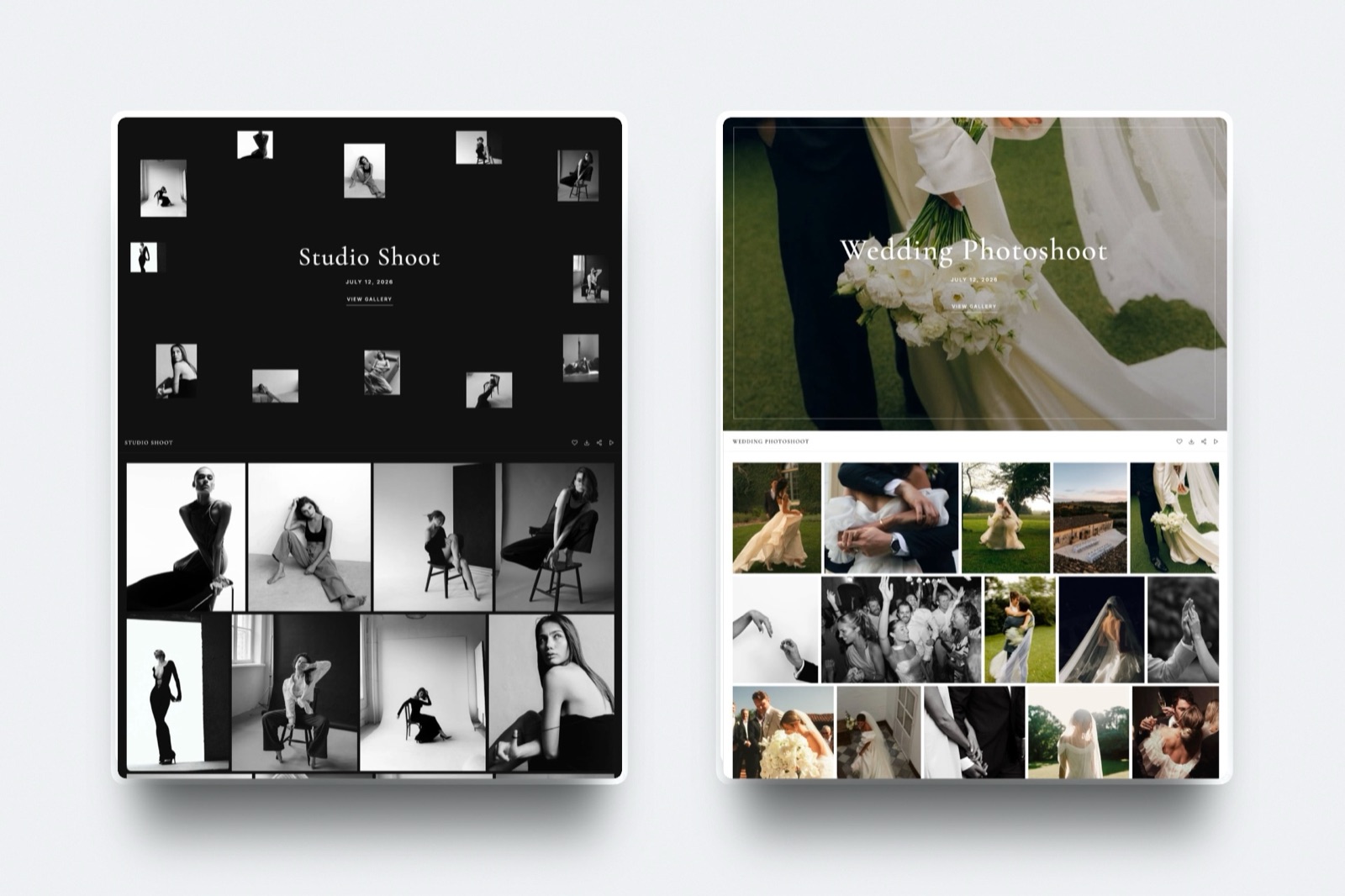
Search for tools for hybrid photo and video shooters and you get camera reviews. The camera question was settled years ago: one body, one card workflow, stills and motion from the same rig.
The part nobody solved is what happens on Tuesday, when 240 stills and four cuts have to reach a client who will open exactly one email.
So this list is about the software, not the bodies. A hybrid shooter is a photographer who also delivers motion from the same job, and the cost of being one is two subscriptions and two upload workflows.
On the figures below a split stack runs about $372 a year and sends the client two links; one account runs $180 and sends one.
In neither case does the client create an account, so the number worth counting is the vendors you administer, not anything the client signs up for.
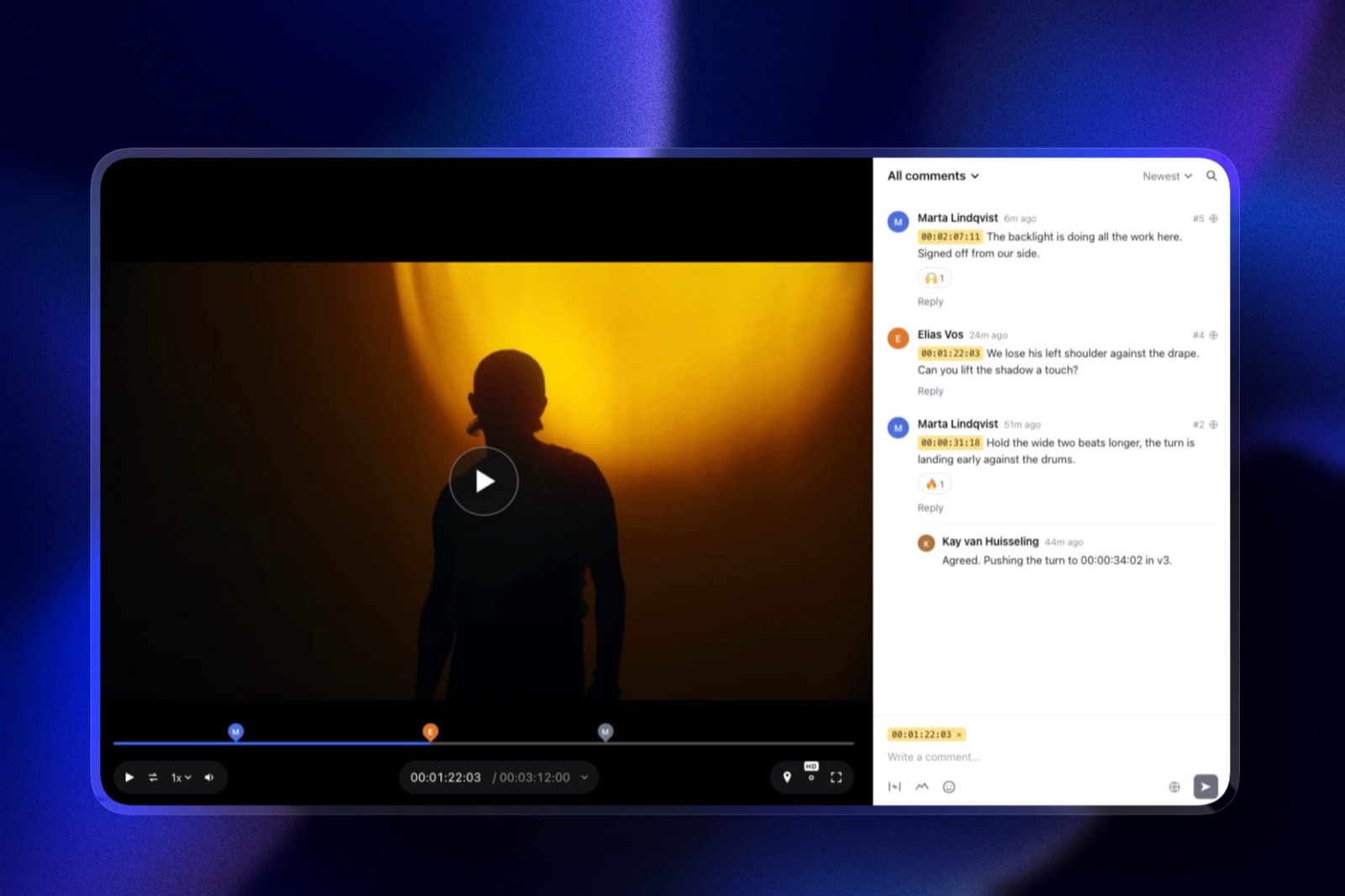
Framekit ranks first for a hybrid shooter because one gallery accepts the stills and the cuts from the same job, so the client gets one link with one password instead of two deliveries to keep track of, and the video review tool sits on the same account for the approval round before it.
The constraint to check first is the per-file video cap, which is 500MB on Free, 1GB on Starter, 2GB on Pro and 3GB on Business, and the maximum video length anywhere on Framekit is 2 hours.
Pixieset is the stronger pick if print revenue matters, Pic-Time if you want photo and video metered as two numbers you can watch separately, and Frame.io if your review round runs inside Premiere or Resolve.
Full disclosure: Framekit is our product, so treat the ranking as an argument and not a verdict, and check the numbers, all of which come from pages we link. Every competitor figure here was read on the vendor's own published page in September 2026, none of these products was trialled hands-on for this article, and nothing is scored on a rubric we invented to flatter ourselves. Framekit has no print lab, no print store and no order fulfilment, so Pixieset, Pic-Time and ShootProof beat us outright on any job with a print line. Frame.io beats us on Camera to Cloud, editing-software panels and transcription, none of which Framekit has.
How This Ranking Was Built
Three kinds of statement appear below, and they are worth separating before you trust any of them, because a comparison page that blurs them is a page you cannot check.
Read at the source. Every price, storage allowance, file format and limit in this article was read on the vendor's own live page in September 2026, and each one is linked at the point it is used. Pixieset publishes its Client Gallery tiers, Pic-Time publishes photo and video as separate allowances, ShootProof publishes a combined figure on some tiers and a split one higher up, SmugMug publishes unlimited JPEG storage, Frame.io publishes per-member storage and Zenfolio publishes a storage figure with a video hours estimate on its top tier.
Calculated here. Every file size, every annual total and every shoots-per-plan figure is arithmetic on a stated bitrate or a stated monthly price.
The formula is published in full further down so you can redo it with your own export preset. None of it is measured and none of it is a benchmark.
Not established. Vimeo's plan table renders in JavaScript and returned nothing readable, and WeTransfer's pricing page refused to load for an automated request, so neither is priced here.
Where a vendor does not publish a number, this article says not published instead of estimating one.
The carried example throughout is a one-day brand shoot delivered as 240 edited JPEGs, one 90-second hero cut, three 15-second vertical social cuts and one 6-minute behind-the-scenes piece.
It is the ordinary commercial job a hybrid shooter does thirty times a year, not an extreme case.
The Hybrid Shooter's Numbers
A handful of figures do most of the work in this comparison, and they are all either printed on a vendor page or one line of arithmetic away from one.
- 2,958MB: the size of the carried brand shoot at the export settings below, or about 2.96GB per job.
- 450MB: the biggest single file in that delivery, the 6-minute behind-the-scenes piece at 10 megabits per second.
- 500MB: the per-file video cap on the Framekit free plan, which the 450MB file clears with room left.
- 3: the number of those shoots that fit in Framekit's 10GB free pool before you need a paid plan.
- 101: the number that fit in the 300GB pool on Framekit Pro at $15 a month billed yearly.
- 0 of 6: the rival client galleries here that publish a per-file video size cap in megabytes, against a 5 TB per-file ceiling published by Google Drive, which is not a gallery.
- 2: the number of vendor subscriptions a split photo-plus-video stack makes you administer and pay for, against one.
The Four Jobs a Hybrid Shooter Has to Cover
Every hybrid job splits into the same four pieces of software work, and the category is confusing because most tools do one of them brilliantly and quietly leave you to buy the other three somewhere else: get the cuts reviewed and approved, deliver the stills, deliver the finished motion, and show the work publicly so the next client finds you.
| Tool | Review round | Stills delivery | Video delivery | Public portfolio |
|---|---|---|---|---|
| Framekit | Yes, timecoded | Yes | Yes, same gallery | Yes, site included |
| Pixieset | No | Yes | Yes, paid plans only | Yes, separate product |
| Pic-Time | No | Yes | Yes, separate allowance | Portfolio page |
| ShootProof | No | Yes | Yes, paid plans only | Simple site |
| SmugMug | No | Yes | Not published | Yes |
| Zenfolio | No | Yes | Yes, MP4 and MOV | Yes, site included |
| CloudSpot | No | Yes | Links only | Social site |
| Frame.io | Yes, timecoded | Limited | Yes | No |
| Vimeo | Yes | No | Yes | Yes |
| Dropbox | Replay, separate | Files only | Files only | No |
| Google Drive | No | Files only | Files only | No |
| WeTransfer | No | Files only | Files only | No |
In one lineOnly two tools on this page cover the review round and both halves of the delivery inside one account, and the difference between them is that one was built for an editing team and the other for the client who receives the finished work.
What the Split Stack Costs a Hybrid Shooter
A hybrid shooter running two specialist tools pays twice for one job, and the second bill is smaller than the second annoyance, which is that the client now has two places to look.
Here is the arithmetic on the cheapest realistic pairings, using each vendor's own annual rate as published in September 2026.
| Stack | Annual cost | Links the client receives | What it misses |
|---|---|---|---|
| Framekit Pro alone | $180 | 1 | Print sales, invoicing, editing-software panels |
| Pixieset Plus alone | $192 | 1 | Timecoded review, per-file cap published |
| Pixieset Plus plus Frame.io Pro | $372 | 2 | A single link for the client |
| Pic-Time Professional alone | $252 | 1 | Timecoded review |
| ShootProof Professional alone | $320.04 | 1 | Timecoded review |
| Pic-Time Professional plus Frame.io Pro | $432 | 2 | A single link for the client |
Frame.io Pro is $15 per member per month plus tax, so $180 a year for one person, which is where the $372 and $432 rows come from. Framekit Pro billed yearly is $15 a month, or $180 a year, and covers both the review round and the delivery.
In one lineThe financial gap between a single account and a split stack is roughly $192 a year at the cheap end, which is real money but smaller than the gap in client experience, because the split stack always produces two links and clients reliably open one.
1. Framekit: Best for One Link That Carries Both

Framekit is the pick here because the stills and the motion from one job live in the same gallery object, which means the client receives one address, one password and one download control instead of a photo link on Monday and a film link on Thursday.
Framekit is an AI website builder for photographers and filmmakers whose client galleries accept both file types, whose video review tool handles the approval round, and whose store and Slides sit on the same account and the same bill.
The texture of it. You upload the JPEGs and the cuts into one collection, set a gallery password and a separate download PIN, and send one address.
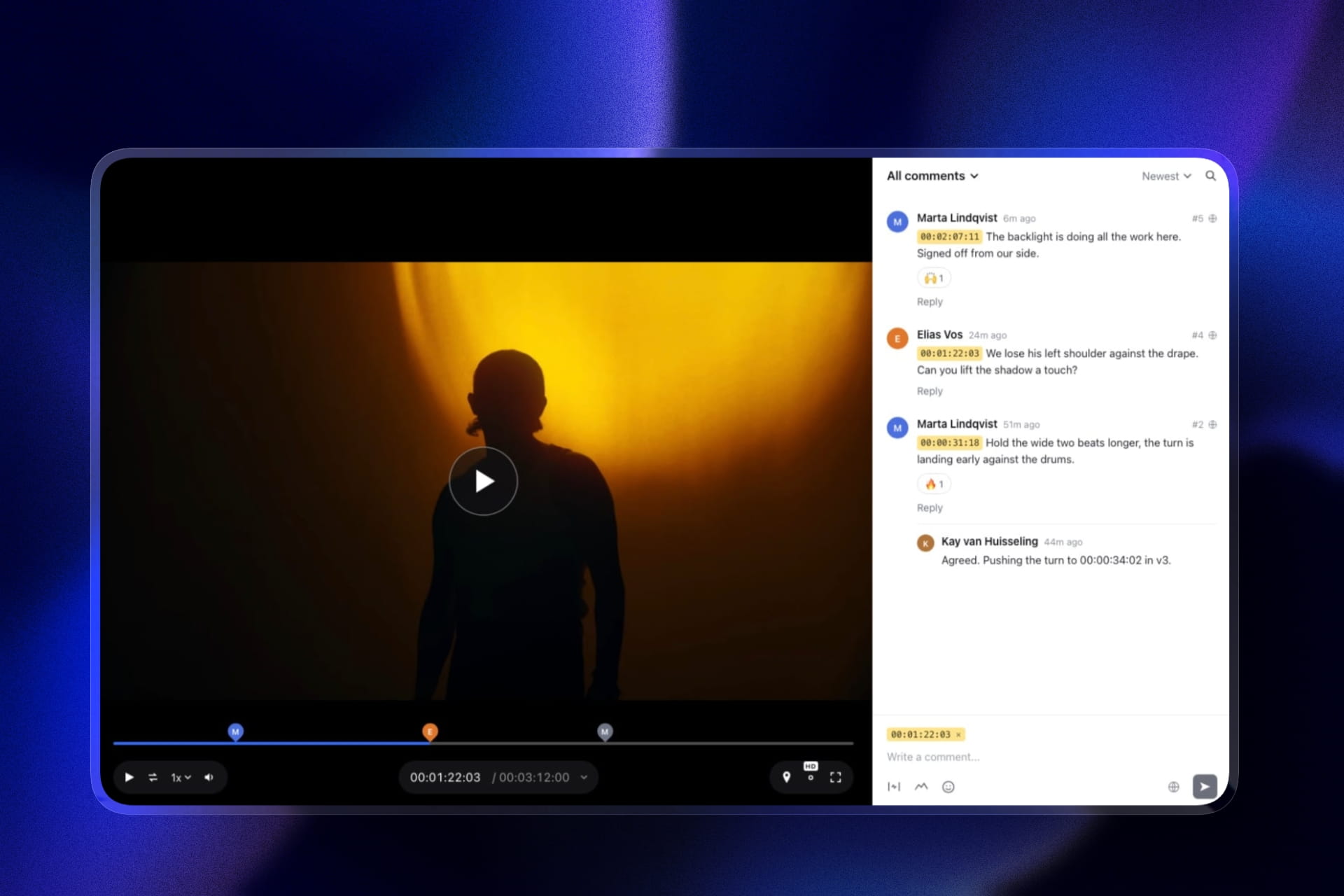
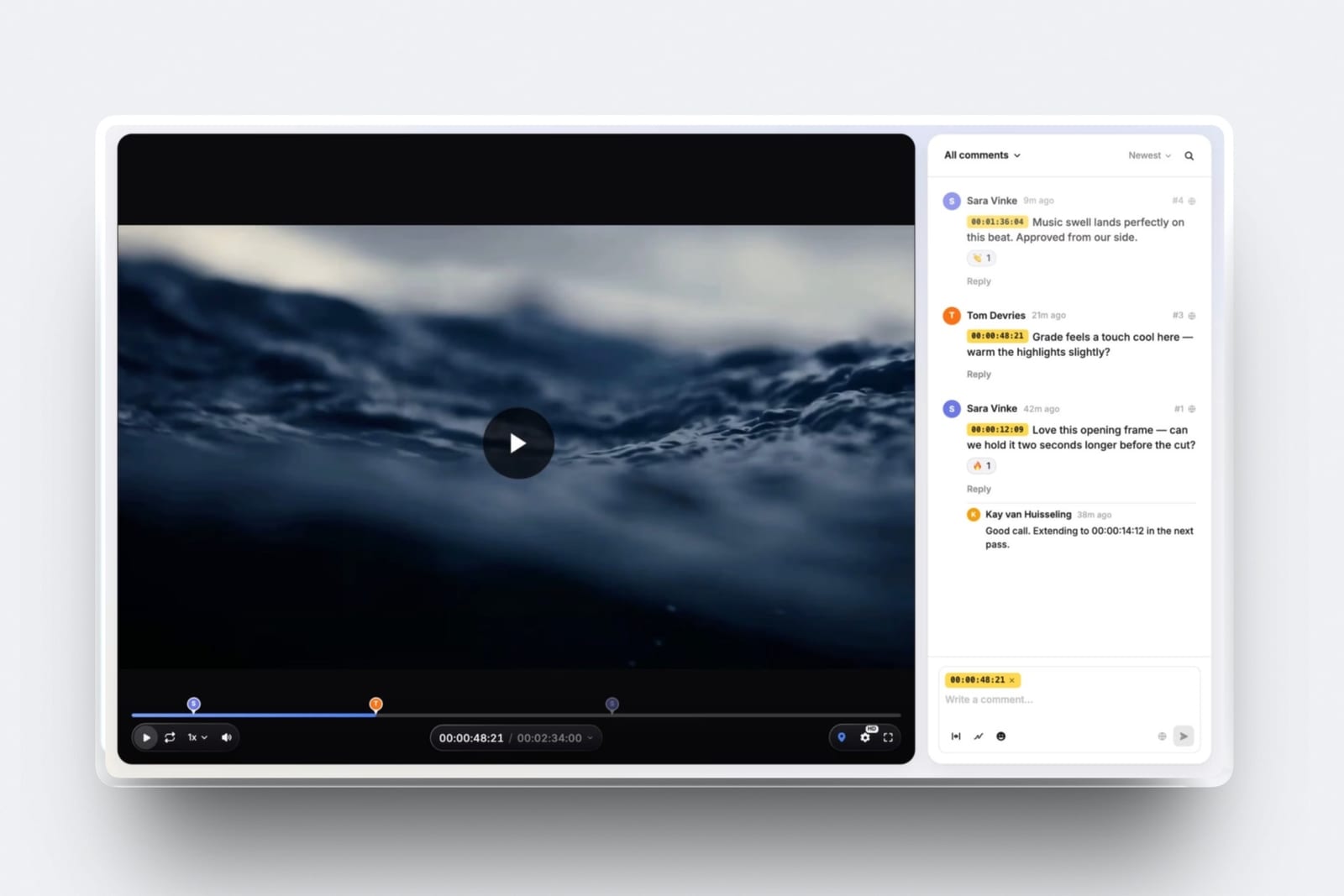
The client signs up for nothing, and a guest on a review link can leave timecoded comments, replies and reactions without an account either.
Because storage is a single pool shared by the website, the galleries and the video reviews, you are not deciding in advance how much of your allowance is stills and how much is motion.
Every plan, including the free one, gets unlimited galleries, watermarking, full-resolution and ZIP downloads, favourites-only downloads, slideshows, email registration, auto expiry and client-exclusive sets.
The number to carry. The carried brand shoot is 2,958MB, or about 2.96GB, and the free 10GB pool therefore holds three of them. Pro's 300GB pool holds 101, which at $15 a month billed yearly works out at $1.78 per delivered shoot across a hundred shoots a year.
The detail nobody writes down. Framekit publishes a per-file video ceiling and its competitors mostly do not.
It is 500MB on Free, 1GB on Starter, 2GB on Pro and 3GB on Business, and the maximum length of any single video is 2 hours.
That is a real constraint, not a feature, but it is a constraint you can plan against before you pay, which is more than most of this list offers.
The gotcha that arrives in week three. The 2GB per-file cap on Pro is the one that bites, and it bites on long-form, not on volume.
A 40-minute edit exported at 10 megabits per second is 3,000MB and will not upload to Pro at all, no matter how much of the 300GB pool is free.
The fix is either a lower bitrate, a split into parts, or Business at $31 a month billed yearly for the 3GB cap. Work out your longest file before you pick a tier, not after.
Who should skip it. Anyone whose revenue includes prints should not make Framekit the only platform, because there is no print lab, no print store and no fulfilment, and there is no roadmap claim here to soften that.
Anyone whose approval round runs through an editing-software panel should keep Frame.io. Anyone who needs invoicing, contracts or a CRM will need a separate tool, because Framekit does none of those.
Verdict: For a hybrid shooter who is judged on the handover and not on print margin, this is the cheapest way to stop sending two links, and the per-file cap is the single number to check before you commit.
2. Pixieset: Best for a Photo-Led Hybrid With Prints to Sell
Pixieset is the default in wedding and portrait work for good reasons, and the strongest of them is that the gallery your client already recognises is also a storefront, which turns a delivery into a revenue event instead of a file handover.
Where it is genuinely strong. The galleries look expensive, the mobile app is included on every Client Gallery tier, and print sales run through an integrated storefront with automatic fulfilment.
On the free plan that store carries a 15% commission fee; on Basic and above, Pixieset's pricing page lists commission-free sales.
The number to carry. Video is metered in time, not bytes.
Basic at $8 a month billed annually lists "HD video storage: 30 minutes", and Pixieset's own announcement of gallery video says you can upload "up to 5 hours of video content" depending on plan, with extra hours sold at $5 a month each.
Thirty minutes is one ceremony edit and nothing else.
The detail nobody writes down. Pixieset is the only platform in this comparison that answers the per-file size question head on, and its answer is that there is not one.
Its file size and format article states plainly that there are no limits to the video size you can upload, while recommending 4K or smaller.
Stills are capped at 100MB for JPEG and PNG, 85MB for GIF.
The gotcha that arrives in week three. Video upload is a paid feature.
The same announcement says upload is available for paid Client Gallery plans and Suite users, while free accounts get embedding from YouTube or Vimeo instead.
So a hybrid shooter cannot test the actual workflow without paying, and the free tier's 3GB is photo-only anyway.
A second trap: the help article states that video files can be downloaded from the gallery but cannot be sold through the integrated store, so your motion work is not part of the storefront that makes Pixieset worth buying.
Who should skip it. A motion-led hybrid whose deliverable is a 40-minute film should not start here, because 30 minutes of allowance on the entry tier and hour-based add-ons is an awkward shape for long-form.
Already on Pixieset and wondering whether the numbers still work for you? The Pixieset pricing breakdown walks the tiers in detail.
Verdict: Still the best gallery in this list if prints pay part of your rent, and a poor shape for long-form video, which is an odd thing to say about a platform that markets video so heavily.
3. Pic-Time: Best for Watching Photo and Video as Two Numbers
Pic-Time takes the opposite design decision to a pooled allowance and meters photo and video as two separate figures on every tier, which is more honest than it first appears because it stops a run of long edits quietly eating the storage your stills need.
Where it is genuinely strong. The galleries are the most designed in the category, the print store reaches more than thirty global labs with automatic fulfilment, and Professional and above are commission-free with custom products and self-fulfilment.
The number to carry. Professional at $21 a month billed annually gives 100GB of photo storage and 30GB of video, which the pricing page annotates as approximately 3 hours.
Advanced at $42 gives unlimited photo storage and 60GB of video, about 6 hours. The carried brand shoot uses 798MB of video, so Professional's video allowance holds about 37 of them before the photo side is even relevant.
The detail nobody writes down. Pic-Time's pricing page describes its client galleries as offering "clips and photos side-by-side (in beta)", which is the only place in this whole comparison where a vendor labels its own hybrid feature as beta on a pricing page.
It is a small thing and it is also exactly the kind of thing you want to know before you build a delivery workflow on it.
The gotcha that arrives in week three. The free tier reduces its 10GB photo allowance to 3GB after a period, and the pricing page states that period as three months in the comparison table and six months on the plan card.
Two figures on one page is a minor thing to catch a vendor on, but if you are planning around a free trial, work on the shorter number.
Who should skip it. A shooter who wants one allowance to manage will find two numbers tiring, and a shooter with no print line is paying for a storefront they will not use.
If you are weighing it against the other print-first option, ShootProof and Pic-Time compared is the head-to-head.
Verdict: The most thoughtful gallery on this list for a photographer who sells, and the separate video meter is a feature and not a limitation once you accept that you have to watch two gauges.
4. Frame.io: Best for the Review Round Before Delivery
Frame.io is the strongest review tool in this comparison by a distance, and if your approval round involves an editor, a producer and a brand manager arguing about a cut, nothing else here is close.
Where it is genuinely strong. The free tier alone includes Camera to Cloud, which uploads takes the moment the director calls cut, plus transcription and captions.
Pro at $15 per member per month plus tax adds unlimited projects, passphrase-protected shares, share link expiry, comment attachments and a static watermark template.
The comparison grid lists a Premiere integration and a comparison viewer, neither of which has an equivalent anywhere else on this page.
The number to carry. The free plan gives 2GB of storage and up to 2 projects for up to 2 members, which is a demo, not a working allowance. Pro's 2TB, at $180 a year for one person, is the real entry point, and storage scales at 2TB per additional member.
The detail nobody writes down. Storage on Frame.io is attached to members, not to the account, so a solo shooter who adds one collaborator does not split 2TB, they get 4TB.
That is unusually generous and it also means the pricing punishes exactly the shape of team a hybrid shooter has, which is one person plus an occasional freelancer.
The gotcha that arrives in week three. Frame.io is a production tool, not a client delivery surface.
There is no print store, no favourites workflow a couple would recognise, no ZIP of the full-resolution stills the way a gallery does it, and no public portfolio. You will still need somewhere to put the finished job.
That is the reason Frame.io appears in the $372 and $432 stack rows above instead of as a standalone answer.
Who should skip it. A hybrid shooter whose review round is one client saying "looks great, send the files" is buying a lot of aeroplane for a short trip.
If you want the wider field, the review and approval tools roundup covers the specialists.
Verdict: The best review round money can buy and the wrong place to end a job, which is why it belongs in almost every serious hybrid stack and is almost never the whole stack.
5. SmugMug: Best for an Unlimited JPEG Archive
SmugMug sells a promise no one else on this page makes, which is that you will never delete another photograph, and for a shooter with fifteen years of archives that promise is worth more than any feature comparison.
Where it is genuinely strong. Every paid plan carries unlimited full-resolution JPEG storage, Lightroom sync, custom domains, watermarking and 24/7 human support.
Portfolio at $23.50 a month billed annually adds print and digital download sales with full-service fulfilment, and Pro at $37 adds multiple price lists, coupons, packages, client favouriting and download limits.
The number to carry. Unlimited applies to JPEG. RAW storage is a paid add-on at $10 a month for up to 1TB, then $6 a month for each additional terabyte, which is a fair deal and also a reminder that the unlimited word has a file type attached to it.
The detail nobody writes down. The plans page does not mention video anywhere. Not a storage figure, not a length limit, not a format list, not a per-file cap.
The support centre returns a block to automated requests, so this article states what the public plans page states and stops there: the video terms are not published in a place a prospective buyer can read before paying.
The gotcha that arrives in week three. The archive-first design shows up as friction on a fast turnaround.
The galleries are built for a portfolio that lives for years, not for a delivery that has to be opened, favourited and downloaded inside a week and then expired.
Who should skip it. A motion-led shooter, on the simple grounds that you cannot plan a video workflow against terms that are not published.
Weighing it against the other long-archive option? SmugMug and Zenfolio compared is the one to read.
Verdict: Excellent as the place your stills live forever, unproven in public as the place your motion work lives at all, and the gap between those two statements is the whole review.
6. ShootProof: Best for Contracts and Invoices Beside the Gallery
ShootProof bundles the paperwork most gallery tools leave out, and its plans page makes a point of saying that galleries, contracts, invoices, selling, slideshows and video are all included in every paid plan instead of being staged across tiers.
The storage shape is worth reading carefully. The plans page lists the free tier as 3GB photo only with video formats not included, Starter at $8.33 a month billed annually as 20GB of photo and video combined, Standard at $16.67 as 100GB combined, and then Professional at $26.67 splits into 1000GB of photo plus 50GB of video.
Premium at $50 is unlimited photo plus 150GB of video. That switch from one pool to two happens between Standard and Professional, which is the most confusing part of the lineup and the thing to check against your own mix.
The gotcha$320.04 a year for Professional is the highest single-platform figure in this comparison, and the free tier cannot take video at all, so a hybrid shooter cannot evaluate the hybrid workflow without a card.
For a photographer who currently pays separately for contracts and invoices, the maths can still land in ShootProof's favour.
Already comparing? The Framekit and ShootProof head-to-head sets the two side by side.
Verdict: The best answer on this page if you want the business paperwork and the delivery in one account, and an expensive answer if you only want the delivery.
7. Zenfolio: Best for a Gallery and a Website on One Bill
Zenfolio has quietly become the most complete single-vendor answer for a photographer who wants galleries, proofing, a storefront and a real website without assembling them, and it states its video support on the pricing page instead of burying it.
The pricing page served European pricing with a discount running, and the undiscounted figures it prints are €9 a month for Basic, €20 for Professional and €36 for Advanced.
Storage is 15GB, 150GB, and on Advanced unlimited JPEG plus 150GB of video, which the page annotates as approximately 10 hours with 4K support. Basic and Professional list HD video; 4K arrives on Advanced.
Client galleries are unlimited on every tier and the storage line names its accepted video formats as MP4 and MOV.
The gotchathe 4K tier is the expensive one, so a shooter delivering 4K work is effectively on a €36 a month plan, and the video-hours figure is an estimate attached to a byte allowance and not a hard limit you can plan a single file against.
Verdict: The best-value all-in-one for a photographer who wants one vendor for the site and the galleries, provided you are content delivering HD until the top tier.
8. CloudSpot: Best Gallery for a Shooter Whose Video Lives Elsewhere
CloudSpot is fast, cheap and pleasant, and its studio management side is genuinely good, with contracts, e-signatures, questionnaires, scheduling, invoicing and a 2.5% processing rate on the full-suite tiers.
Read the file types row before you plan a hybrid workflow on it. The pricing page lists Free at 5GB with up to 3 galleries and JPEG only, Entry at $7 a month with 15GB and up to 15 galleries, Lite at $17 with 100GB and unlimited galleries, Pro at $34 with 500GB and Unlimited at $50.
The footnote defining the higher tiers' "All" file types names JPEG, GIF, TIFF, PNG, PSD and PDF, and no video format appears in it.
The gallery feature is called "Add video links", and the integrations list describes adding a Vimeo or YouTube video into your galleries.
The gotchathat means the motion half of your delivery is not hosted by CloudSpot. It is hosted by whoever you embed from, under their terms, with their player, and your client is one click from that platform's own recommendations.
For a hybrid shooter that is a structural issue, not a minor one.
Verdict: An excellent photo gallery and studio manager that points at someone else's video instead of holding yours, which is fine if you already pay for video hosting and a problem if you do not. The CloudSpot alternatives guide covers the platforms that do host both.

9. Vimeo: Best Home for the Finished Film in Public
Vimeo remains the place a finished film looks like a finished film, with a clean player, no recommendations pulling the viewer away and privacy controls a client can live with.
Its plan table renders in JavaScript and returned nothing readable to an automated request in September 2026, so no price, storage figure or upload limit is quoted here.
That is a statement about what could be read, not a criticism of the product.
What is not in dispute is the shape of the tool: it hosts and presents motion and it is not a stills gallery, so it solves half a hybrid delivery and leaves the other half open.
Verdict: Keep it for the public showreel and the film page you send to future clients, and do not expect it to be where a client collects 240 edited JPEGs. Frame.io and Vimeo compared covers the review-versus-hosting question in more depth.
10. Dropbox: Best for Handing Raw Footage to Another Professional
Dropbox is the correct tool for one job on a hybrid shoot, which is moving very large files to another professional who will open them in an application and not in a browser.
The plans page, served in euros to a European request, lists Basic free at 2GB, Plus at €9.99 a month with 2TB and transfers up to 50GB, Standard at €12 per user per month starting at 3TB for the team with transfers up to 100GB, and Advanced at €18 per user per month from 15TB.
Password-protected and branded transfers sit on the paid rows.
The gotchaa client who receives a folder receives a folder. There is no favourites list, no download PIN separate from the link password, no expiry that a couple would notice, no watermark and no way to present a film as anything other than a file.
For a second shooter's cards it is ideal. For the people who paid you it is a step down.
Verdict: The right answer for professional-to-professional handover and the wrong one for the client-facing end of the job. The gallery versus Dropbox comparison puts numbers on that difference.
11. Google Drive: Best Published Per-File Ceiling
Google Drive earns its place on one fact that matters in a comparison about file sizes: it publishes the clearest per-file ceiling of anything here, and it is enormous.
Google's own documentation states that the maximum size for all files other than the named Google formats is up to 5 TB, and lists MOV, AVI, MPEG4, WMV and FLV among the previewable video types.
Storage pricing, published as Google One plans, starts at 15GB free, with 100GB at €1.99 a month, 2TB at €9.99 and 5TB at €21.99 as served to a European request.
The gotchaeverything else. No client presentation, no proofing, no watermarking, no expiry that reads as professional, and a sharing model that regularly confuses people who do not have a Google account. It is storage, correctly priced, with no delivery experience attached.
Verdict: The best cold archive on this page and the worst client experience, which is exactly what it was designed to be. Galleries versus Google Drive is the comparison for anyone tempted to skip the gallery entirely.
12. WeTransfer: Best for the Single File You Forgot
WeTransfer is the fastest way in the world to move one file to one person, and on a shoot day that is occasionally the only thing you need.
Its pricing page returned an error to an automated request in September 2026 and the plan table could not be read, so the only figure used here is the one the page's own meta description states, which is that free transfers go up to 2GB.
Everything else about its paid tiers is left out instead of guessed at.
The gotchatransfers expire and nothing is presented. There is no gallery, no favourites, no timecoded comment, no portfolio and no record a month later of what you sent.
Verdict: Keep the free tier bookmarked for the file you forgot and never build a delivery workflow on it. The gallery versus WeTransfer comparison explains where the line sits.
The One File That Decides Which Plan You Can Buy
In one lineThe plan you need is decided by your single largest video file and not by your total storage, and you can work that file's size out in one line of arithmetic before you hand over a card, which is the most useful thing in this article.
Megabytes equals the bitrate in megabits per second, multiplied by the length in seconds, divided by eight, and that single line is the whole formula behind every file size quoted in this article.
Run it on the carried brand shoot and the sizes fall out immediately.
| Deliverable | Count | Export | Size each | Line total |
|---|---|---|---|---|
| Edited JPEGs | 240 | Full resolution | about 9MB | 2,160MB |
| Hero cut | 1 | 90 sec at 25 Mbps | 281MB | 281MB |
| Vertical social cuts | 3 | 15 sec at 12 Mbps | 22.5MB | 67.5MB |
| Behind the scenes | 1 | 6 min at 10 Mbps | 450MB | 450MB |
| Delivery total | 2,958.5MB, about 2.96GB |
The largest single file is 450MB, which clears even the 500MB free-plan ceiling on Framekit. A commercial hybrid shooter delivering short-form is rarely troubled by per-file caps at all. The people it catches are the ones delivering long-form, and it catches them without warning.
Here is the same arithmetic on a long edit, which is where plans break.
| Length | 6 Mbps | 8 Mbps | 10 Mbps | 12 Mbps |
|---|---|---|---|---|
| 10 minutes | 450MB | 600MB | 750MB | 900MB |
| 20 minutes | 900MB | 1,200MB | 1,500MB | 1,800MB |
| 40 minutes | 1,800MB | 2,400MB | 3,000MB | 3,600MB |
| 60 minutes | 2,700MB | 3,600MB | 4,500MB | 5,400MB |
A 40-minute edit at 10 megabits per second is 3,000MB and does not fit Framekit Pro's 2GB per-file cap. At 6 megabits per second the same edit is 1,800MB and does. Nothing about the pictures changed; only the export preset did.
Run this on your own work. Open the longest file you delivered last year, note its size in megabytes, and compare it to the per-file cap of every plan you are considering.
If a vendor does not publish one, that is your answer about how much planning you can do in advance.
How Many Links Does the Client Actually Get?
In one lineEvery extra platform in a hybrid stack creates another address, another password and another set of instructions for a client who was never going to read the first set, and that cost is invisible on a pricing page but obvious on a delivery day.
Count it honestly, and count the right thing.
The client is not signing up for anything: a Framekit gallery opens with a gallery password and a separate download PIN, and a review guest leaves timecoded comments and replies without creating an account at all.
What multiplies is on your side. A photo gallery plus a video host is two subscriptions, two dashboards and two renewal dates. Add a review tool and it is three, and a portfolio site on a fourth vendor makes four.
The practical failure is not confusion, it is silence. The client opens the first link, downloads the stills, tells three people the photos are lovely, and the film sits unwatched because it arrived two days later in a second email.
You did the harder half of the job and it is the half nobody saw.
One account fixes the address problem and nothing else. It will not give you a print store, it will not invoice anyone, and it will not open your timeline.
What a Hybrid Year Actually Costs
In one linePriced over a full year at thirty jobs, the single-platform options cluster within about $140 of each other, which means price is not the thing that separates them and you should decide on something else.
Thirty brand shoots at 2.96GB each is 88.8GB of delivery a year, inside a 100GB tier on most platforms and inside Framekit Pro's 300GB pool with the website's own assets alongside it.
| Option | Annual cost | Cost per delivered job |
|---|---|---|
| Framekit Pro, billed yearly | $180 | $6.00 |
| Pixieset Plus, billed annually | $192 | $6.40 |
| Pic-Time Professional, billed annually | $252 | $8.40 |
| ShootProof Professional, billed annually | $320.04 | $10.67 |
| Pixieset Plus plus Frame.io Pro | $372 | $12.40 |
ShootProof's higher number buys contracts and invoicing the other rows do not include, so it is not simply the expensive option. The real separation is whether a platform sells prints, whether it publishes its video limits, and the number of links your client ends up holding.

Choosing in Order: A Short Decision Guide
In one lineWork through these questions in the order they are written, because the first one that returns a yes ends the process and every question below it stops mattering for your business.
Is a print order part of a normal job for you? If yes, your primary platform is Pixieset, Pic-Time or ShootProof, and any single-link platform without a store becomes the second tool and not the first. If no, continue.
Does your approval round happen inside Premiere, Resolve or Final Cut? If yes, Frame.io is not optional, because nothing else here has an editing-software panel or Camera to Cloud.
Budget $180 a year for it and pick a delivery platform separately. If no, continue.
Is your longest single video file over 2GB at your normal export settings? If yes, either drop the bitrate using the table above, split the file, or go to Framekit Business at $31 a month billed yearly for the 3GB cap. If no, continue.
Do you deliver stills and motion from the same job more than once a month? If yes, one account that holds both is the change that shows up in your week, and Framekit is the cheapest of them at $180 a year.
If no, keep your current gallery and add motion however you like, because the problem is not big enough to restructure around.
Do you need contracts, invoices and a CRM in the same account? If yes, ShootProof or CloudSpot's full suite is your answer, because Framekit does none of those and will not.
Frequently Asked Questions
What is the best tool for hybrid photo and video shooters in 2026?
Framekit is the best single tool for hybrid photo and video shooters in 2026 because one client gallery holds both the edited stills and the finished cuts, so the client receives one link with one password instead of two separate deliveries.
Video review with timecoded comments sits on the same account for the approval round.
The constraints are the per-file video cap of 500MB on Free, 1GB on Starter, 2GB on Pro and 3GB on Business, a 2 hour maximum length, and the absence of any print store.
Pixieset is the better first choice for a photographer who sells prints.
Can you put photos and video in the same client gallery?
Yes. Framekit client galleries accept photographs up to 100MB each and video files up to the per-file cap of your plan in the same collection, delivered under one link.
Pixieset, Pic-Time, ShootProof and Zenfolio also hold both, though each meters video differently: Pixieset counts hours, Pic-Time keeps a separate byte allowance, ShootProof combines the two on its lower tiers and splits them higher up.
CloudSpot is the exception, because its published file types list no video format and its galleries embed video links from elsewhere.
Which gallery platform publishes a per-file video size limit?
Framekit is the only client gallery platform in this comparison that publishes a per-file video size cap by plan, at 500MB on Free, 1GB on Starter, 2GB on Pro and 3GB on Business.
Pixieset addresses the question directly and states that there is no limit on video file size, recommending 4K or smaller.
Pic-Time, ShootProof, SmugMug, Zenfolio and CloudSpot publish no per-file video figure on any page readable without an account. Google Drive publishes a 5 TB per-file ceiling, and a Drive folder is not a client gallery in any other respect.
Is Frame.io or a client gallery better for hybrid work?
Frame.io is better for the review round and a client gallery is better for the handover, and most hybrid shooters need both jobs done.
Frame.io has Camera to Cloud, transcription, a Premiere integration and a comparison viewer on its published feature grid, none of which any gallery platform here offers.
A gallery has favourites, full-resolution and ZIP downloads, watermarking, expiry and a print store. Framekit covers the review round and the handover in one account, which is cheaper than running both but has no editing-software panel.
How much does a hybrid photo and video stack cost per year?
A single-platform hybrid stack costs between $180 and $320.04 a year at 2026 published annual rates, depending on whether you need a print store and business paperwork.
Framekit Pro is $180 billed yearly, Pixieset Plus is $192, Pic-Time Professional is $252 and ShootProof Professional is $320.04. Running a gallery alongside Frame.io Pro at $180 a year takes a split stack to $372 or more.
The extra cost of the split is roughly $192 a year plus a second vendor dashboard to administer and a second link for every job.
Does Pixieset let you upload video on the free plan?
No. Pixieset states that video upload is available on paid Client Gallery plans and for Suite users, while free accounts can embed video from YouTube or Vimeo instead. The free tier's 3GB allowance is described as photo storage.
Basic at $8 a month billed annually is the entry point for uploads and lists 30 minutes of HD video storage, with additional hours sold at $5 a month each and a stated ceiling of up to 5 hours depending on plan.
What happens if my video file is too big for the plan?
The upload is refused regardless of how much storage remains, because a per-file cap and a storage pool are separate limits.
Re-exporting at a lower bitrate is the usual fix: a 40-minute edit at 10 megabits per second is 3,000MB, while the same edit at 6 megabits per second is 1,800MB. Splitting a long edit into two parts also works.
On Framekit, moving from Pro to Business raises the per-file ceiling from 2GB to 3GB.
Do hybrid shooters need a separate video host like Vimeo?
Only if the film needs a public home as well as a private delivery. A client gallery that holds video covers the private handover, but it is not a showreel page and it will not be indexed or embedded the way a public video host is.
The usual arrangement is a public host for the portfolio piece and the gallery for the client copy. Framekit covers the public half differently, with a website on the same account instead of a separate video platform.
Which platform is cheapest for a hybrid shooter with no print sales?
Framekit Pro at $180 a year billed yearly is the cheapest platform in this comparison that holds photos, holds video, publishes its file limits and includes a review tool and a website on the same account.
Pixieset Plus at $192 a year is close, and is the better buy the moment prints enter the picture, because Framekit has no print store at all. CloudSpot Lite at $17 a month is cheaper per month than both but does not host video.
Does a hybrid workflow need different export settings than a photo-only one?
Yes, and the reason is the per-file cap, not quality. Deliver short-form at whatever bitrate looks right, because a 90-second hero cut at 25 megabits per second is only 281MB.
For long-form, work backwards from the cap: divide the cap in megabytes by the length in seconds, multiply by eight, and you have the highest bitrate that will upload.
A 40-minute edit under a 2GB ceiling needs roughly 6.7 megabits per second or less.
Final Verdict
Framekit is the pick for a hybrid photo and video shooter whose job ends with a handover and not a print order, because one gallery carries both file shapes, the review round happens on the same account, and the whole thing is $180 a year billed yearly against $372 for the cheapest split stack that does the same two jobs.
Where Framekit loses is not subtle.
There is no print lab, no print store and no fulfilment, so a wedding or portrait photographer with a real print line should run Pixieset, Pic-Time or ShootProof as the primary platform and treat any single-link tool as secondary.
There is no Camera to Cloud, no editing-software panel and no transcription, so a production workflow that lives inside Premiere or Resolve needs Frame.io. There is no invoicing, no contracts and no CRM, and those are not coming from us.
And the per-file video cap is a genuine ceiling: 2GB on Pro will refuse a 40-minute edit at 10 megabits per second, which is a perfectly normal export.
Framekit is not for a shooter whose revenue depends on prints, and it is not for a team whose approval round runs through an editing-software panel.
For everyone else in this category, the decision is whether your client should receive one link or two, and that is a question you can answer without a spreadsheet.
Related readingthe client gallery platforms that support video covers the gallery field in more depth, galleries built for videographers looks at the motion-first end, how much storage photographers actually need puts numbers on a working year, delivering photos and video from one shoot is the step-by-step version of this workflow, and the all-in-one platforms comparison covers the wider single-account question.