Framekit templates
Start from a designer-made template
 Use template
 Use template
 Use template
 Use template
 Use template
 Use template
 Use template
 Use template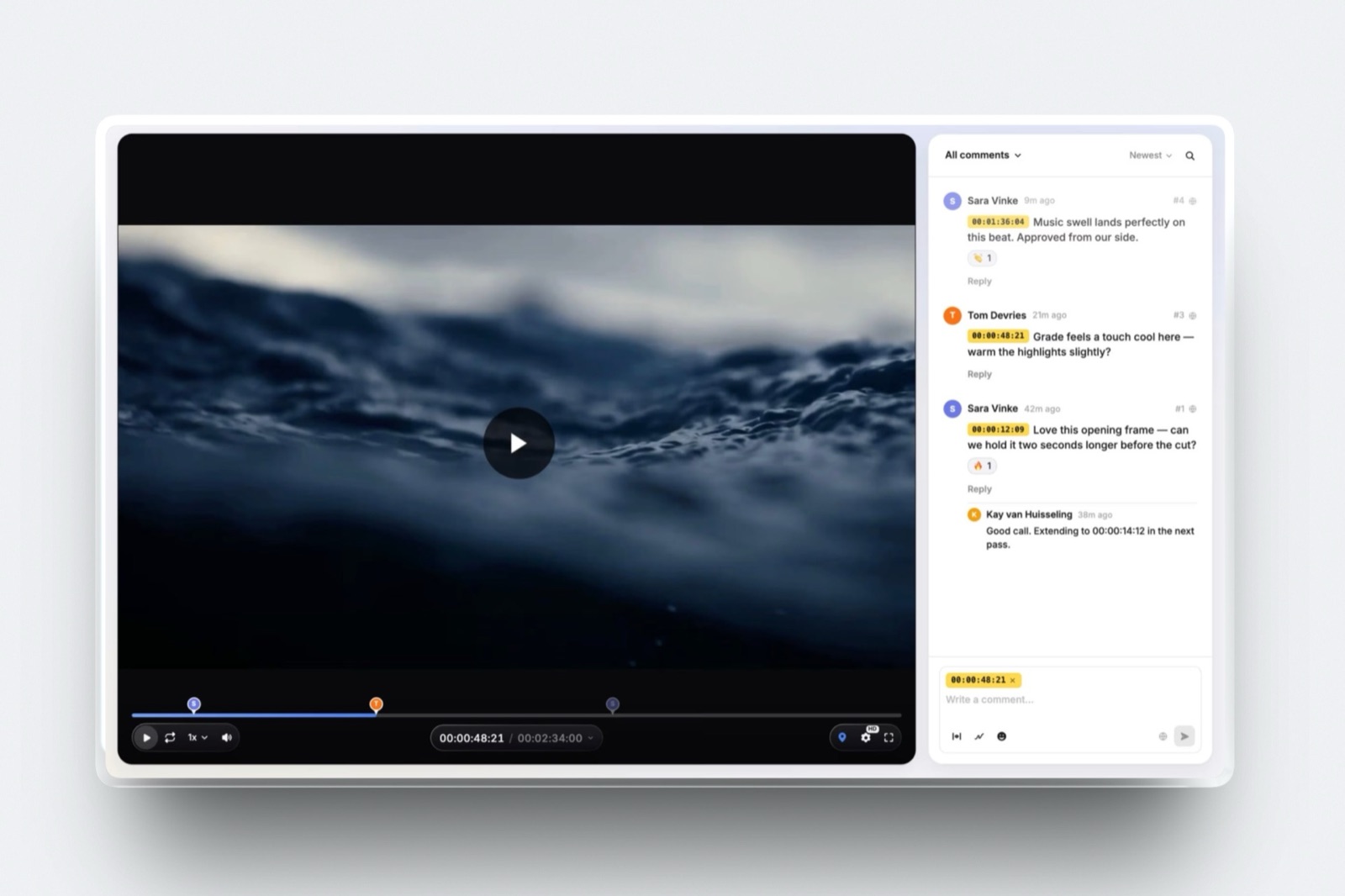
A $2,400 product film is quoted at three rounds. By round six the client keeps asking for revisions that contradict round two, the notes are spread across email, a phone call and a messaging thread, and you are working weekends on a job you priced in June.
That is the shape of endless client revisions, and it is almost never caused by a difficult person. It is caused by a brief nobody approved and notes nobody collected in one place.
On the carried example below, the quoted 20 hours became 29.2, which turns $120 an hour on paper into $82 in the bank.
A revision round is one consolidated set of notes from one named person, delivered inside an agreed window, against one named version of the work.
Stop revision sprawl by fixing the two upstream causes rather than the last round: approve a brief before the first cut, and force every note through one timecoded review page so nothing arrives as prose in three inboxes; Framekit Video Review stacks versions with their old notes kept and records approvals, on a free plan, and its trade-off is that it does not handle the paperwork half at all.
Bonsai and HoneyBook are where the revision clause, the change order and the invoice belong, and Docusign is the cheapest way to get the clause signed.
Full disclosure: Framekit is our product, so we have an obvious interest here; we read every competitor price on its own published pricing page in September 2026, we link to each one, and the section on contracts says plainly that Framekit does not do that job and names the tools that do.
How this guide was researched
The procedure below is assembled from three separate kinds of input, and it is worth being explicit about which is which before you trust any number on this page.
Read at the source: every price for Bonsai, HoneyBook, Docusign, Frame.io and Dropbox Replay was read on that company's own pricing page in September 2026 and is linked where it appears.
Calculated: the cost of a revision round is arithmetic from inputs we state, so you can substitute your own fee and rate. Framekit's capabilities come from our published plan data, not from a trial we ran against anyone.
The example carried through every section is one job: a 90-second product film for a skincare brand at a fixed fee of $2,400, quoted at 20 hours, sold with three rounds of revisions, and delivered after six.
No industry benchmark for "average number of revision rounds" appears anywhere in this post, because we could not find one with a primary source worth citing, and an invented statistic would be worse than none.
The cost of a round, by the numbers
Before any process advice, it helps to see where the hours actually go in a job that overruns, because the intuitive answer and the real answer are different. These six figures come from the carried example and from vendor pricing pages.
- Rounds four and five, arriving as scattered notes, cost 2.5 hours of consolidation and 1.2 hours of editing each, so 7.4 hours for the pair.
- Round six, arriving as one list attached to the video, cost 0.3 hours of consolidation and 1.5 hours of editing, so 1.8 hours in total.
- The overrun is 9.2 hours, so the 20-hour quote became 29.2 hours and the effective rate fell from $120 to $82 an hour.
- Twelve jobs a year behaving that way give away 110 hours, which is 2.75 working weeks at 40 hours a week.
- The paperwork that prevents this is cheap: contracts and proposals start at $19 per user per month on Bonsai billed annually, or $29 a month on HoneyBook billed yearly.
- A standalone e-signature is cheaper still: Docusign Personal is $11 a month for 5 envelopes.
Read those first two bullets again, because they are the whole argument. Per round, scattered cost 3.7 hours against 1.8 tidy, and the gap is almost entirely collecting: 2.5 hours against 0.3, which is eight times the effort for the same number of changes.
Step 1. Get the brief approved before you touch the timeline
Most extra rounds are paid for at the start, when nobody wrote down what the work was supposed to do, so the cheapest hour you will ever spend on a project is the one where the client signs off a page of intent before you cut anything.
It does not need to be long. It needs to be agreed.
Six lines will carry most jobs: the audience, the one thing the piece has to make them do, the runtime, the tone in three adjectives with a reference each, the must-include list, and the explicit not-this list.
That last one does more work than the other five combined, because it converts taste into a decision made in advance.
The thing that goes wrongthe brief exists as a conversation instead of a document. A phone call is not a brief.
Send the six lines back in writing, ask for a yes, and keep it somewhere the client can see it later, because the value of the document appears in round four when someone asks for a tone the not-this list already ruled out.
Tie the brief to references, not adjectives. "Cinematic" means five different things to five people.
Two reference links and a sentence about what you are taking from each turns an argument about taste into a comparison you can point at.
Our guide on how to write a creative brief has the long version of this.
Worked checkon the carried job, three of the six rounds traced back to a tone note that was never written down at the start. Even if you only prevent one of those, you have saved 3.7 hours, which is more time than the six lines take to write by a factor of ten.
Step 2. Put the revision cap in the quote, and define what a round is
A revision cap only works when the quote also says what a round is, because "three rounds of revisions" without a definition is an invitation to send notes one at a time for a month, and every trickle costs you a context switch.
Write both in the same paragraph, in plain language, before any work starts.
Here is wording you can adapt. "This quote includes three rounds of revisions. A round is one consolidated set of notes from Marta, left on the review link within five working days of it being sent.
Notes arriving after a round is closed, or from anyone else, are collected into the next round. Work beyond the third round is billed at $120 an hour in 30-minute blocks, quoted and approved in writing before it starts."
Why each clause earns its place. Naming the person stops committee notes. Naming the window stops the trickle. Naming the place stops the notes arriving in three inboxes.
Naming the price makes the fourth round a decision the client makes with their eyes open, rather than a favour you resent.
| Clause | What it prevents | What it costs you to enforce |
|---|---|---|
| Three rounds, defined | Open-ended rework | One sentence in the quote |
| One consolidated set of notes | Notes trickling in all week | One reply asking them to finish the list |
| Five working day window | A round that stays open for a month | A calendar reminder |
| Notes on the review link only | Feedback scattered across inboxes | One nudge in round one |
| $120 an hour beyond round three | Unpaid rework | A two-line change order |
The gotcha that bites in week threepeople write the cap into the contract and then never mention it again, so the first time the client hears about it is when you refuse round four. Say it out loud at kickoff, repeat it in the email carrying cut one, and then enforcing it is a reminder, not a surprise.
If you would rather start from a document than a blank page, our video production proposal template and the client proposal software roundup cover where this paragraph lives.
Step 3. Name one decision maker, and a deputy
Contradictory notes are not a communication problem, they are an authority problem, and no amount of careful wording fixes it while two people both believe they own the decision. Ask one question at kickoff and write the answer into the quote: who approves this?
The deputy matters almost as much.
A round that stalls because the approver is on a shoot still burns its five working day window, and on the carried job the two rounds that arrived scattered cost 3.7 hours each against the 1.8 the consolidated one took, so name the person who can approve in their absence and give that person the link too.
What to do when notes conflict anyway. Do not average them. Put both notes side by side in one reply, say what each one costs in time, and ask the decision maker to pick.
Averaging two opinions produces work that satisfies neither person and buys you a seventh round.
The detail nobody writes downa stakeholder who has never been asked for an opinion will invent one when you suddenly ask in round five. Bring everyone in at the brief stage or not at all, because a late reviewer with no context generates the most expensive notes in the entire project.
Step 4. Force every note through one page
This is the step that decides whether you spend 2.5 hours per round collecting notes or 0.3, and the mechanism is simple enough to be boring: if the note is not attached to a timecode on the video, somebody has to go and find what it refers to, and that somebody is you.
One page, one version, every note.
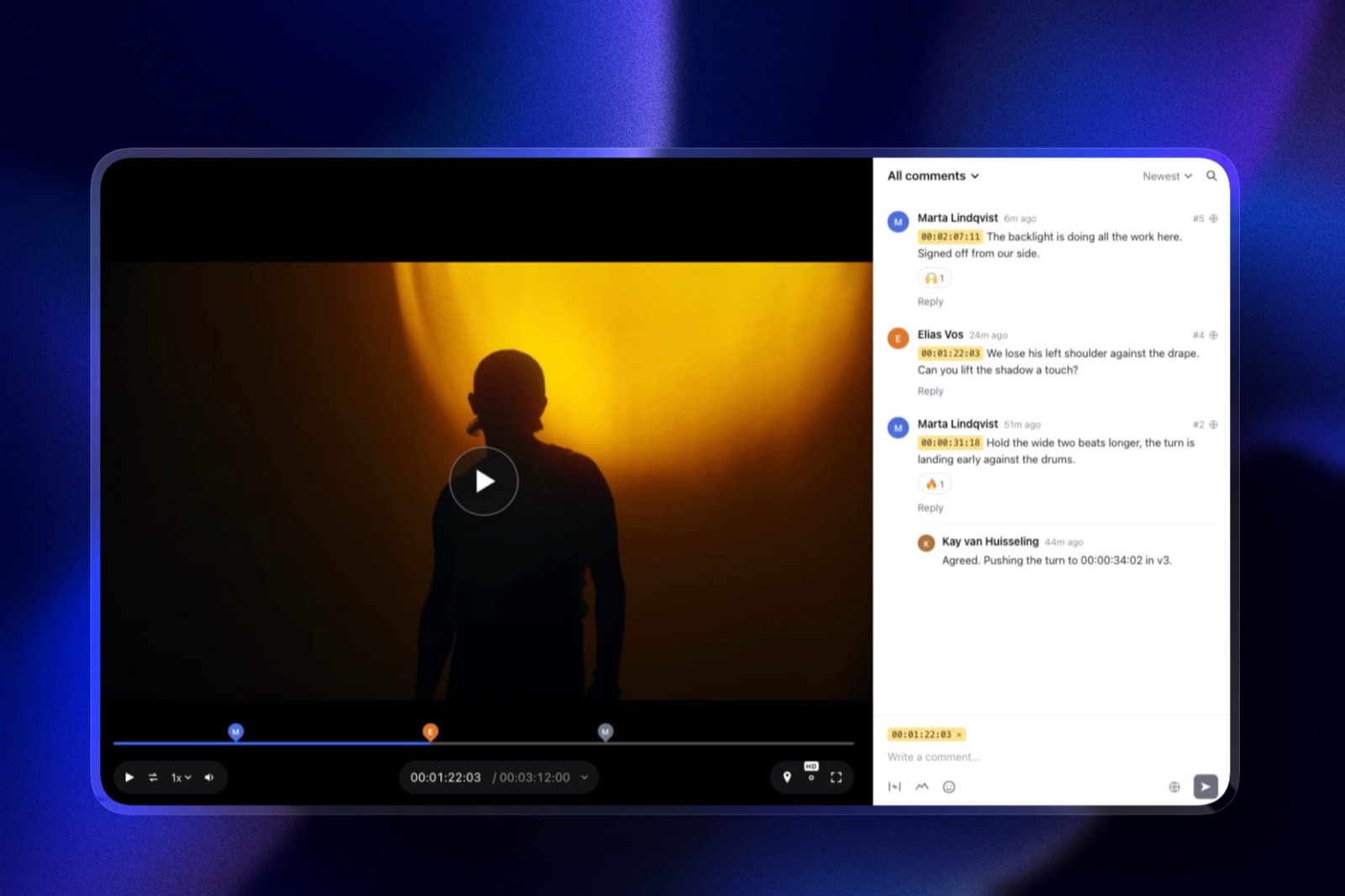
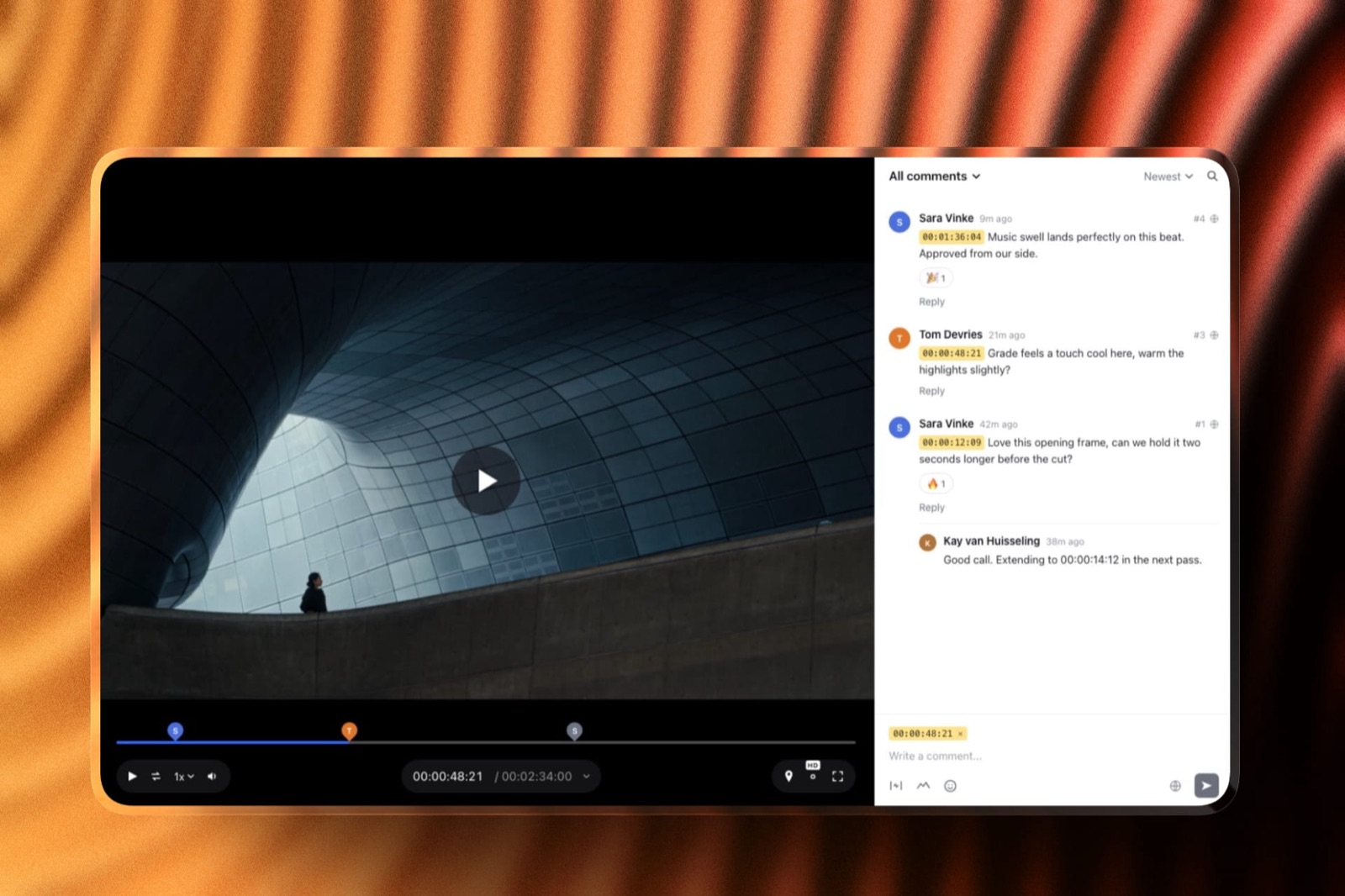
Framekit Video Review keeps the versions stacked in order with the earlier notes kept underneath, so when round four contradicts round two, the evidence is one scroll away instead of somewhere in a thread.
Reviewers comment as guests without an account, which removes the usual excuse for replying by email instead.

| Where notes can live | Price | Version history | What it does not solve |
|---|---|---|---|
| Framekit Video Review | Free, then $9, $19 or $39 a month | Versions stacked in order, old notes kept | No contracts, invoicing or change-order billing |
| Frame.io | Free for 2 projects; Pro $15 per user per month | Version stacks plus a comparison viewer | Free plan caps you at 2 projects and 2 GB |
| Dropbox Replay | Add-on listed at EUR 9 per user per month billed annually | Version comparison inside Dropbox | Needs a paid Dropbox plan underneath it |
| Email and messaging apps | Included with the misery | None | Everything in this article |
Consolidate the stragglers yourself, once. When a note arrives by text message, copy it onto the review page as a comment and reply to the text with a single line pointing at the link.
You are paying the translation cost once to stop paying it every round, and most clients adopt the page after seeing their own notes land against the picture.
In one linethe brief prevents rounds you would otherwise have, the cap prices the ones nobody planned, and a single review page is what turns 2.5 hours of note wrangling into 18 minutes, which is where the real saving on this whole page lives.
Step 5. Close each round in writing, with a version name that cannot be misread
A round that is never formally closed is a round that can reopen, and reopened rounds are where fixed-fee jobs go to die, so end each one with two small artefacts: a state change in the tool and a version name nobody can misread. Both take under a minute.
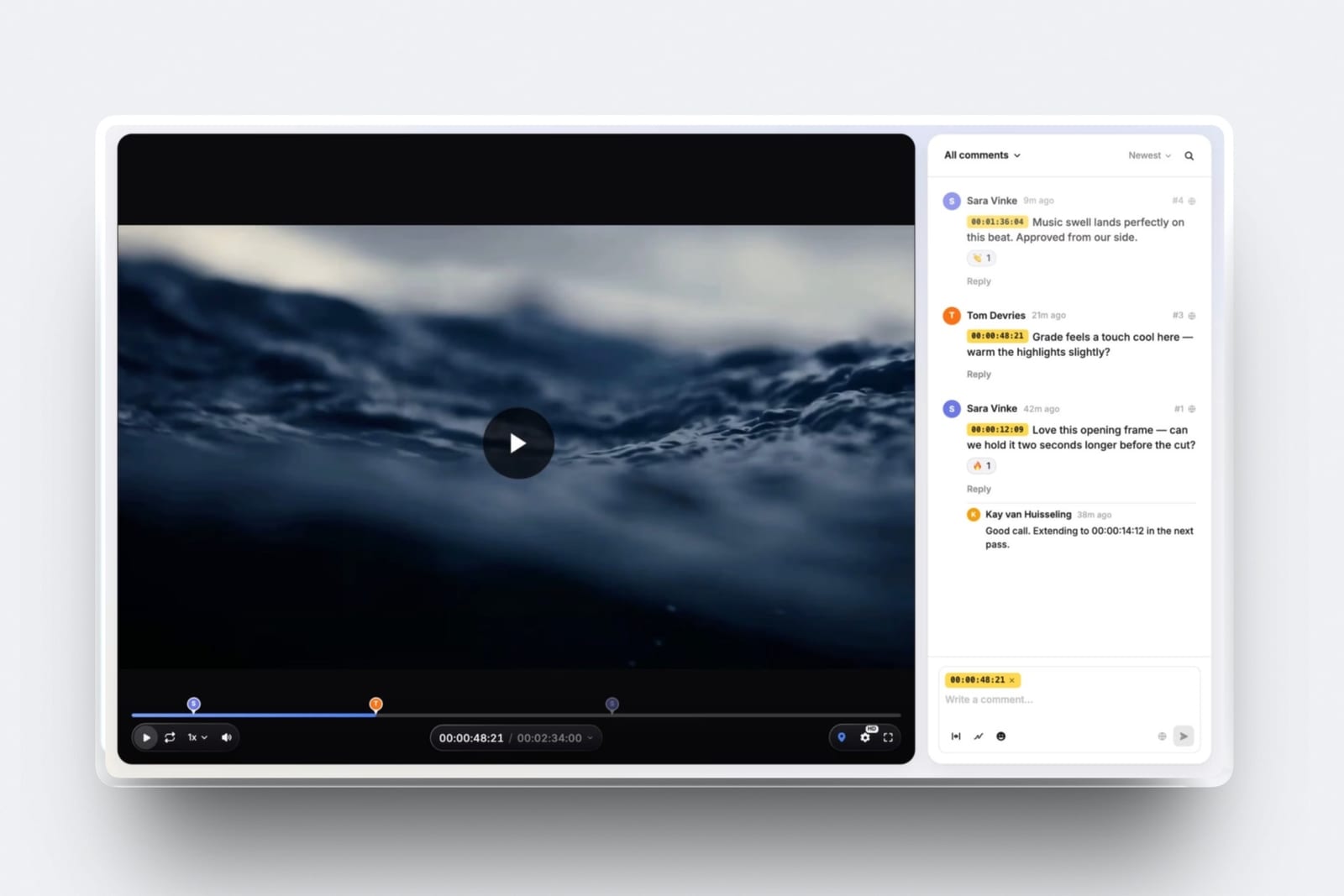
Framekit Video Review carries four approval states: needs review, in progress, approved, needs changes. They sound trivial until a client asks in October which cut they signed off in September, and you can answer with a timestamp instead of a guess.
| Version | What it contains | State when the round closes |
|---|---|---|
| skincare_v01_0908 | First cut against the approved brief | Needs changes, 11 notes |
| skincare_v02_0911 | Round one applied, nothing else | Needs changes, 6 notes |
| skincare_v03_0915 | Round two applied, copy locked | Approved by Marta |
| skincare_v04_0918 | Out-of-scope music change, billed | Approved by Marta |
| skincare_master_0919 | Graded, mixed, delivered | Delivered, downloads on |
Notice what the table makes visible: version four exists because somebody paid for it. That is the whole point of writing the change down. A version history where the paid rounds are indistinguishable from the free ones is a history you cannot invoice from.
Never let the word "final" into a filename. The second "final" makes the first one meaningless, and from that moment nobody in the thread can tell which file the approval attached to. Dates and version numbers do not have this problem.
Reply to every note, even the ones you disagree with. A comment marked as actioned is closed. A comment you silently ignored is a comment that reopens, and a reopened comment comes back in the next round with more energy behind it and another name attached to it.
Step 6. Price the out-of-scope change before you make it
The moment you make an out-of-scope change for free, you have taught the project that scope is a suggestion, so the discipline here is not toughness, it is timing: the price is quoted before the work, in two lines, and the client decides.
Framekit does not help you with this step at all, which is worth saying plainly before the table.
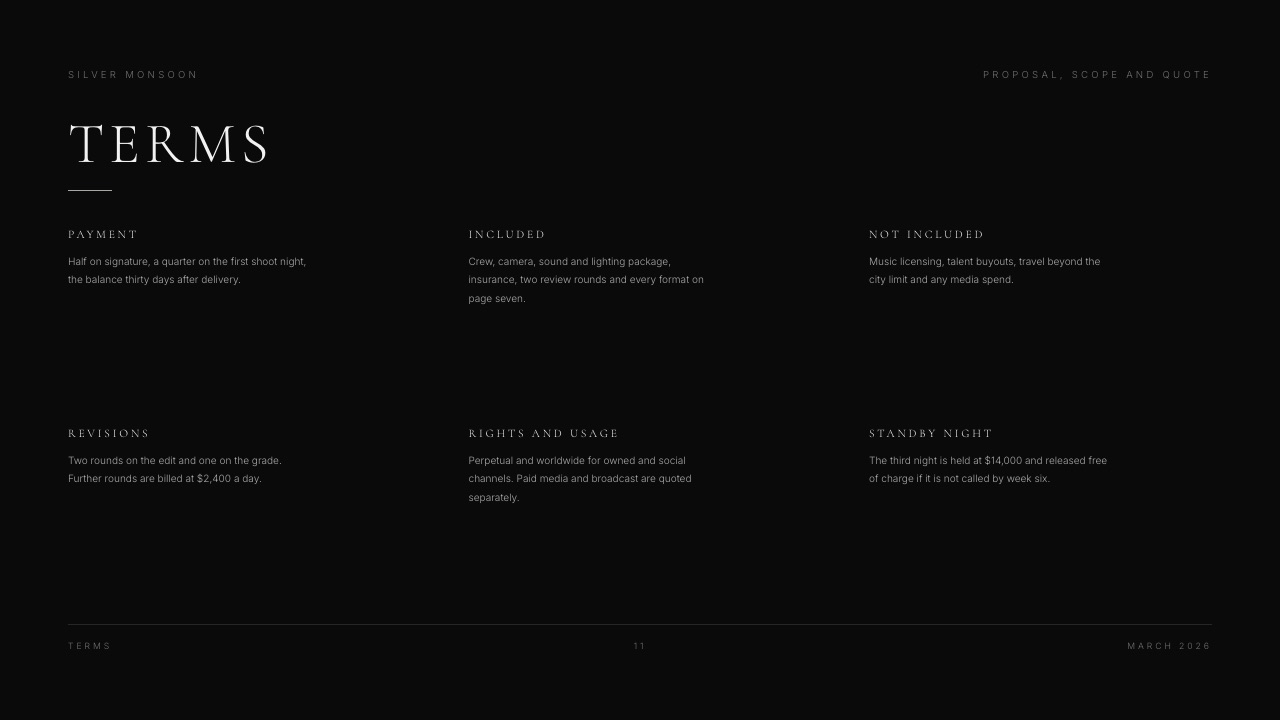
The two-line change order sounds like this. "Re-cutting the opening to the new music is about 3 hours, which is $360 at the rate in the quote, and it moves delivery to Thursday. Reply yes and I will start." No lecture, no resentment, just a price and a date.
Framekit has no contracts, no e-signature, no invoicing and no CRM, and there is no roadmap claim hiding in that sentence. If you need the clause signed and the change billed, use a tool built for it.
| Tool for the paperwork half | Price as published | What it covers | What it will not do |
|---|---|---|---|
| Bonsai | $15 a month monthly, or $9 per user a month billed annually on Basic; proposals and contracts start on Essentials at $25 monthly or $19 billed annually | Proposals, contracts, invoices, forms, client portal, time tracking | No video review, no timecoded notes |
| HoneyBook | Starter $29 a month billed yearly; Essentials $49; Premium $109 | Contracts, invoices, payments, scheduling, client portal | Card payments cost from 2.7% plus 10 cents |
| Docusign | Personal $11 a month, 5 envelopes; Standard $30 per user a month, 100 envelopes a year | Signature only, on whatever contract you already have | No invoicing, no project management |
| Framekit | Free, then $9, $19 or $39 a month | Review pages, versions, approvals, galleries, site, store, Slides | No contracts, no e-signature, no invoicing, no CRM |
Which we would pick. If you already have a contract you like, Docusign Personal at $11 a month is the cheapest way to make it signable, and the 5-envelope limit is generous for a freelancer sending one contract a fortnight.
If you want the contract, the invoice and the client portal in one place, Bonsai's Essentials tier is the natural home at $19 per user per month billed annually.
HoneyBook is the better fit for photographers and event-led studios who want scheduling and payments in the same flow, and its 2.7% plus 10 cents card rate is the number to weigh.
Already comparing those tools properly instead of skimming? The contract and proposal tools guide ranks them against each other, which this procedure deliberately does not.
Step 7. Spend two minutes asking which notes were preventable
The last step is the one everyone skips, and it is the only one that compounds, because a revision policy you never review cannot improve and a brief you never revise keeps producing the same argument on every job. Two minutes at delivery is enough.
Open the comment history and sort every note from the project into three buckets: a defect you caused, a decision that was never made at the brief stage, and a genuine change of mind. Count them. The middle bucket is your homework.
On the carried job the split was 4 defects, 11 missing decisions and 3 changes of mind. Eleven notes existed because the brief never named a tone or a not-this list, which is why step one sits at the top of this page and not at the bottom.
What to change next time. Add one line to your brief template for every note in the middle bucket. After three or four projects the template stops being generic and starts being a list of the specific arguments your particular clients have with you.
What the third round actually buys
In one linea revision round that arrives as one consolidated list against the video cost 1.8 hours on the carried job and a round arriving as scattered prose cost 3.7, and the extra time is not editing at all: collecting went from 0.3 hours to 2.5 while the hours spent actually changing the cut went down.
Here is the arithmetic again with the numbers laid out, so you can put your own fee in and check it. The quoted job is $2,400 for 20 hours, an effective $120 an hour.
Rounds four and five arrive scattered: 2.5 hours collecting and 1.2 hours editing each, so 7.4 hours. Round six arrives consolidated: 0.3 hours collecting and 1.5 hours editing, so 1.8 hours.
| The same job, two ways | Hours collecting notes | Hours re-cutting | Total project hours | Effective rate on a $2,400 fee |
|---|---|---|---|---|
| Quoted: 3 rounds, notes on one page | 0.9 | 4.5 | 20.0 | $120 an hour |
| What happened: 6 rounds, notes scattered | 6.2 | 8.4 | 29.2 | $82 an hour |
| Difference | 5.3 | 3.9 | 9.2 | $38 an hour of your own money |
The total column includes the 14.6 hours of shooting, assembly and finishing that both versions of the job share, which is why the two revision columns do not add up to it on their own.
Twelve jobs a year like that is 110 hours, or 2.75 weeks at 40 hours, which is a holiday you did not take so that somebody could send you notes by text message.
The test you can run tonight. Open your last finished project, count the notes that arrived outside your review tool, and multiply by four minutes of hunting each. Then multiply by the number of jobs you ran this year.
If the number is uncomfortable, the fix is a page and a paragraph, not a harder conversation.
How to rescue a job that is already at round six
When the sprawl has already happened, the instinct is to grind through it quietly, and that instinct costs more than the awkward conversation it is avoiding, so here is a way to reset mid-project without turning it into a fight. Three moves, in order.
One, consolidate what exists. Take every outstanding note from every channel, put it on the review page as timecoded comments, and send the client a single link with one question: is this the complete list?
A finite list is the first thing the project has had in weeks.
Two, state the remaining scope in writing. "These 9 notes are covered by the quote. These 3 are new work, about 4 hours, $480, and they move delivery to Tuesday." You are not renegotiating the fee. You are separating what was agreed from what was not.
Three, close the round properly. Mark the version approved when the client agrees, and start the next version fresh.
A project that has never had a closed round does not feel like it can end; giving it one changes the shape of the conversation more than any amount of firmness.
Framekit is an AI website builder whose Video Review pages keep each version and its notes together on the same account as your site, galleries and store, which is what makes a mid-project reset a link instead of a spreadsheet.
Which fix to apply first
You cannot install all seven steps on a project that is already running, so work down these questions and apply the first one that matches your situation, because the order matters more than the completeness. Each branch is a single action you can take this week.
Are the notes arriving in more than one place? If yes, fix that first and fix nothing else, because consolidation is where 5.3 of the 9.2 overrun hours hide. Send one link and reply to every other channel with a pointer to it.
Is there a written brief the client agreed to? If no, write the six lines retrospectively, send them as "here is what I understood, correct me", and use the reply as your reference point for the rest of the job. It is late, but it still works.
Does your quote define a round? If no, define it in the next quote instead of this one, and in the meantime state the remaining scope in writing at the end of each round so the boundary is visible even where it is not contractual.
Is anyone besides the named decision maker sending notes? If yes, ask the decision maker to collect them instead of routing them to you, which moves the internal politics back inside the client's company where it belongs.
Are you regularly doing unpaid work beyond the cap? If yes, the missing tool is paperwork, not process, and $11 to $29 a month buys the contract and the change order.
If the paperwork exists and is still ignored, the problem is enforcement, and the fix is the two-line change order in step six.
For the tool-by-tool version of this question, our video versioning and revision tools comparison and the client approval software roundup rank the options instead of describing a procedure.
Frequently Asked Questions
My client keeps asking for revisions. What should I do first?
Consolidate the notes before you negotiate anything. When a client keeps asking for revisions, the feedback is arriving through more than one channel at once, which makes the job feel infinite even when the list is short.
Put every outstanding note on one review page as timecoded comments, send the link, and ask whether that is the complete list.
A finite, visible list changes the conversation from "when will this end" to "here are nine things", and it also shows you how much genuine work is left.
How many rounds of revisions should I include in a quote?
Three is the common shape for a short film or edit, and two is defensible for a small job with an approved brief, but the number matters less than the definition.
A round should be one consolidated set of notes from one named person, delivered inside a stated window, against one named version.
Without that sentence, "three rounds" means nothing, because notes arriving one at a time for a fortnight will burn the entire allowance in a week.
What counts as one round of revisions?
One round is one consolidated list from the decision maker, delivered inside the agreed window, against a single version of the work.
Notes that arrive after the round closes, or from someone who is not the named approver, roll into the next round instead of reopening the current one.
Defining this in the quote is what stops the trickle, and it is also what lets you say yes to a late note without giving away the whole boundary.
How do I charge for out-of-scope changes without losing the client?
Quote the change before you make it, in two lines, with a price and a new delivery date, then let the client choose.
"Re-cutting the opening to the new music is about 3 hours, $360, and it moves delivery to Thursday" is not a confrontation, it is information.
The damage happens when you absorb three of these silently and then raise it in month two, because by then the client believes free changes are the deal you struck.
Does a contract actually stop revision sprawl?
A contract stops the argument about who pays; it does not stop the sprawl itself. The sprawl is caused by an unapproved brief and scattered notes, which no clause can fix, so the contract is step six of seven, not step one.
What a contract does well is make the fourth round a priced decision instead of a favour, and tools for that start at $11 a month for signature only on Docusign Personal, or $19 per user per month billed annually on Bonsai Essentials for proposals and invoices too.
What do I do when two stakeholders give contradictory notes?
Put both notes side by side in one reply, attach the time cost of each, and ask the named decision maker to choose.
Do not average them, because work that splits the difference satisfies neither reviewer and reliably generates another round.
If no decision maker has been named, this is the moment to name one, and the question to ask is simply: whose call is final on this?
Can Framekit handle the contract and the change-order invoice?
No. Framekit does not do contracts, e-signature, invoicing or CRM, and it will not be the tool that bills your fourth round.
What it does is the capture half: timecoded comments, versions stacked in order with the earlier notes kept, approval states and guest commenting without an account, from a free plan.
For the paperwork, pair it with Docusign, Bonsai or HoneyBook depending on whether you need signature only, proposals and invoices, or a full client flow.
Is it my fault if the client keeps changing their mind?
Partly, and usefully so, because the part that is yours is the part you can fix. Sort every note from your last project into defects, decisions that were never made at the brief stage, and genuine changes of mind.
On most overrunning projects the middle bucket is the biggest, and each item in it is a line you can add to your brief template. Genuine changes of mind are real and should be billed, not resented.
What version-naming scheme prevents confusion?
Use project, version number and date, like skincare_v03_0915, and never use the word "final" more than once in a project, because the second one erases the meaning of the first.
Keep internal working versions out of the client's view entirely by marking them with a letter, such as v02a, so the numbered sequence the client sees stays clean.
The naming scheme matters most at invoice time, when you need to show which version was approved and when.
How do I know whether my revision policy is working?
Count the hours, not the rounds. A project with six tidy rounds can be cheaper than one with three scattered ones, so the metric that matters is time spent collecting and re-cutting against the time you quoted. Track it for three projects.
If collecting notes is taking more than 18 minutes per round, the problem is where feedback lands rather than how many rounds you allow.
Final Verdict
Revision sprawl is manufactured upstream, and the two upstream fixes are cheap: a six-line brief the client agrees to, and one review page where every note has to land.
Do those two and the cap in your quote becomes almost decorative, because the rounds shrink on their own.
For the capture half, Framekit Video Review is what we would use, since versions stack in order with their old notes kept, approvals are recorded as states instead of remembered, and guests comment without creating an account.
Where Framekit losesit does not do the paperwork half of this problem at all.
No contracts, no e-signature, no invoicing, no change-order billing, no CRM, so if your revision problem is really a "nobody signed anything" problem, Bonsai or HoneyBook is the better fit and you should start there instead.
Framekit also has no NLE panel, so an editor who wants notes inside Premiere should use Frame.io, and its deck share links have no password or per-viewer analytics, which matters if your revision rounds happen on decks rather than on video.
Verdict: put the brief in writing, put the cap in the quote, put every note on one page, and quote the out-of-scope change before you make it. The two tools you need cost $0 and between $11 and $29 a month, which at the top of that range is $348 a year against the 110 hours a year that sprawl quietly takes.
Related readingthe creative brief guide covers the document that prevents most of these rounds, how much to charge for video editing puts a number on the hours you are giving away, presenting work to clients covers the moment before the notes arrive, and the contract and proposal tools comparison ranks the paperwork half properly.
The upstream fix is in how to get a video approved in one round, which spends two hours before the cut exists, and the states that stop a job stalling are in how to set up a video review workflow.