Framekit templates
Start from a designer-made template
 Use template
 Use template
 Use template
 Use template
 Use template
 Use template
 Use template
 Use template
A producer messages you. They like what they have seen, and they ask the simple question that ends most filmmakers' confidence: "Where can I see your work?" You send a Vimeo link. Or a Google Drive folder.
Or a reel with no context attached to it. And somewhere in that moment you realize the truth: you have footage, you have a reel, but you do not have a portfolio.
That gap is the most common one in filmmaking. The craft is strong, the reel is cut, and the thing that actually converts a producer into a client, a real portfolio, was never built. A reel proves you can shoot.
It does not prove you are the right hire for a specific job, and a specific job is the only kind anyone is hiring for.
This guide answers what a filmmaker portfolio should include in 2026: the 8 things a film and video portfolio needs to turn a curious producer into a booked client. Not 8 nice-to-haves. The 8 that do the work.
Framekit is an AI website builder that generates a reel-led filmmaker site with the project pages already structured, so most of the checklist below arrives built rather than waiting to be assembled, and the treatments and client review links you send after the booking live in the same account.
A filmmaker portfolio should include a strong hero reel, individual project pages, clear genre organization, real context for every project, an about page with a specialty, an obvious way to hire you, credibility proof like laurels or client names, and fast embedded video.
A reel alone is not a portfolio. The structure around it is what books work.
A filmmaker portfolio is a website that presents your film and video work in a way a paying client can navigate, judge, and act on. It is more than a reel and more than a Vimeo profile. A reel proves you can shoot.
A portfolio proves you are the right hire for a specific kind of job, and gives the client a way to act on that. This guide is the 8-part checklist for building one.
Why a Reel Alone Is Not a Portfolio
A reel is a trailer: a fast, curated burst designed to impress in 90 seconds. That is a real and necessary asset, but it answers only one question, "can this person shoot?" A hiring client has three more. Do they do my kind of project?
What exactly did they do on these films? How do I reach them? A reel cannot answer those, and a client who cannot get those answers moves on. A portfolio is the structure that answers all four, with the reel as one part of it.
For the platforms to build that structure on, see our roundup of the best website builders for filmmakers.
The 8 Things a Filmmaker Portfolio Must Include
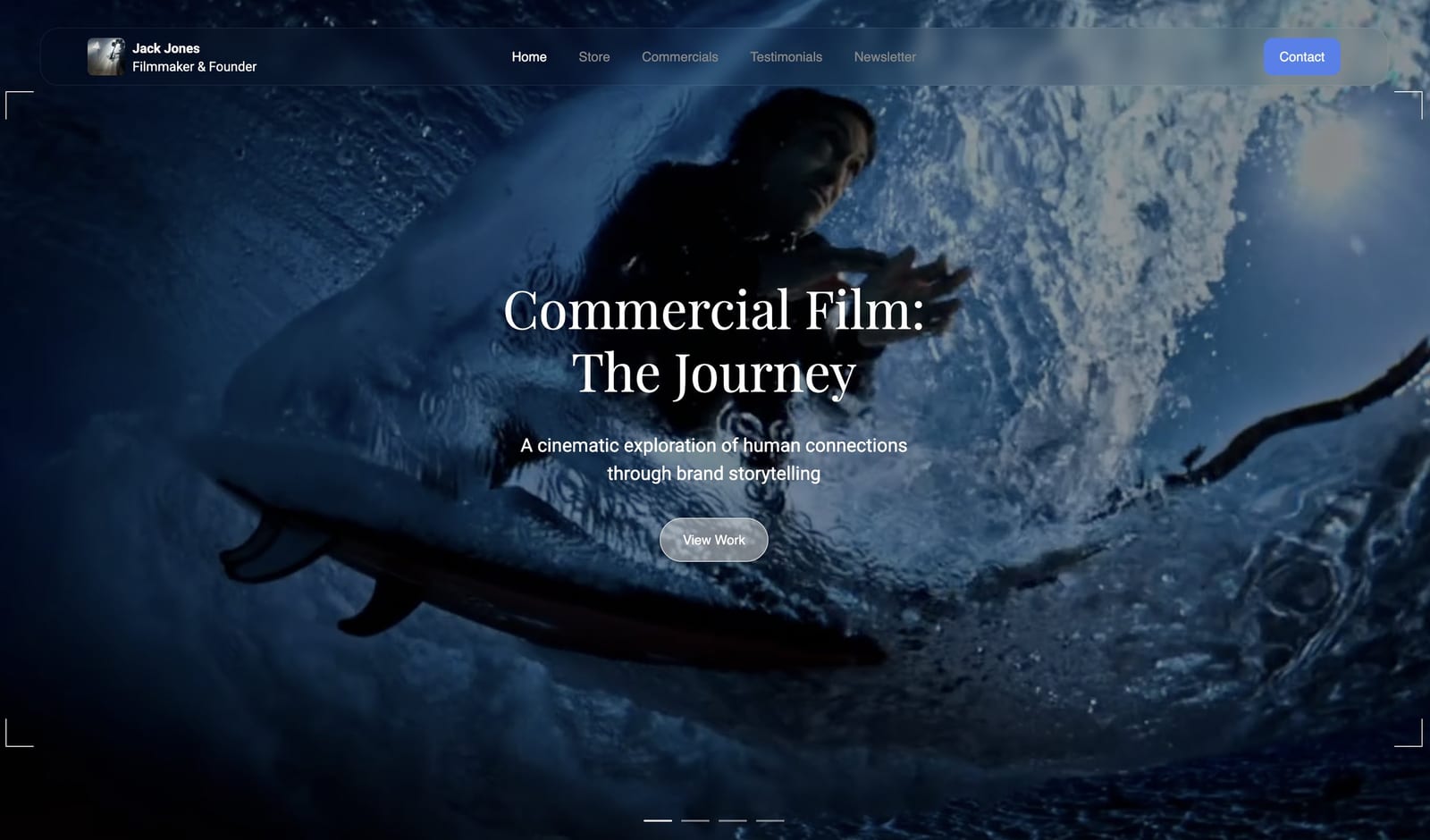
1. A hero reel that earns its first ten seconds
Your reel is the first thing a client watches, and often the only thing, so it has to win immediately. Lead with your single strongest shot, not a slow logo build or a title card.
Keep the whole thing tight, usually 60 to 120 seconds, cut down to the kind of work you actually want more of. A reel that opens weak is a reel a busy producer closes before it gets good.
Place it at the top of the homepage, ready to play, with sound off until the viewer chooses it.
2. Individual project pages, not just one reel
A reel proves range. It does not let a client see the one thing they came for. A wedding client wants weddings. A brand wants commercials.
If your whole site is a single montage, every visitor has to hope their kind of work is buried somewhere in it.
Individual project pages fix this: each significant project gets its own page with its own video, so a client can go straight to work that matches their job. The reel is the trailer. The project pages are the films.
3. Clear organization by genre or type
Filmmakers rarely do only one thing, and an unsorted pile of narrative, commercial, music video, and documentary work makes the client do the sorting. Organize the work by type, with a filter or clearly labelled sections.
A client looking for a music video director should reach your music videos in a single click, without scrolling past corporate jobs. Clear organization is not tidiness for its own sake.
It is how you tell each visitor, instantly, that you do exactly their kind of project.
4. Real context for every project
A video with no information is a clip. A video with context is evidence. Each project needs a few lines: your role on it, the client or production, and what the project actually was.
Filmmaking is collaborative, so a client genuinely needs to know what you did, not just what the team did. Vague or missing credits read as either false modesty or padding, and both cost you trust.
Specific context turns a good-looking clip into proof you can do their job.
5. An about page with a clear specialty
Producers hire filmmakers for a point of view, not a list of gear. The about page is where you give them one.
State your specialty plainly, the kind of films you do best and want more of, and let your approach come through in how you write about the work.
A filmmaker who reads as a clear documentary specialist will win documentary jobs over a vague generalist every time. A blank or generic about page makes the client guess, and guessing clients hire someone else.
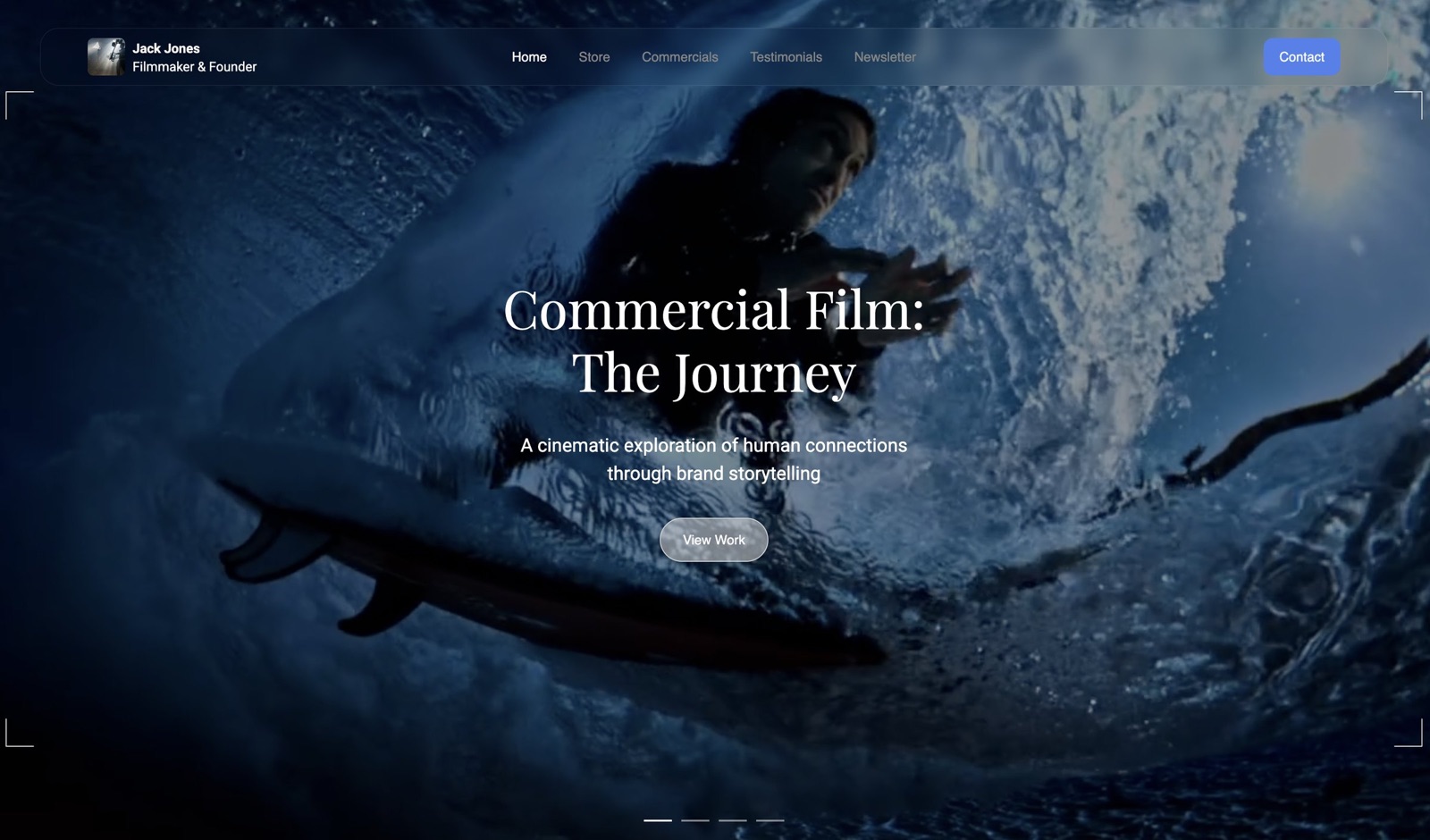
6. An obvious way to hire you
A producer with a job and a deadline should never have to hunt for how to reach you. The contact step has to be unmissable: in the navigation, after the reel, and on the about page.
Make it specific to how film work actually starts, an inquiry about a project, a request for a quote, a line to check availability. Many filmmaker sites pour everything into the reel and then end on a dead page.
The booking happens at the contact step, or it does not happen at all.
7. Credibility proof: laurels, clients, and press
A client choosing between two filmmakers looks for signs that other people have already trusted you. Show them.
Festival laurels, recognizable client or brand names, press mentions, and awards all belong on the site, placed where a visitor will actually see them rather than buried on a sub-page.
Proof does not need to be loud, and you must never invent it, but real credentials shorten the distance between "this looks good" and "I can safely hire this person."
8. Fast, properly embedded video
Video is heavy, and a filmmaker portfolio that stutters or takes an age to load on a phone undermines the exact thing it is selling.
Host the actual video files on a platform built for it, usually Vimeo or YouTube, and embed those players into your site rather than uploading raw files onto the page.
Make sure nothing autoplays with sound, since a producer often has five tabs open at once.
Framekit builds the portfolio around your work and embeds those players cleanly, so the site loads fast and the client judges the film, not a spinner.
If you are weighing where to host, our guide to the best Vimeo alternatives compares the options.
The 8 Must-Haves at a Glance
| # | Must-have | Why it books work |
|---|---|---|
| 1 | A strong hero reel | First impression, often the only one |
| 2 | Individual project pages | Clients see their kind of work directly |
| 3 | Genre or type organization | One click to relevant work |
| 4 | Real context per project | Shows your role, builds trust |
| 5 | A clear about page | Sells a point of view, not a feature list |
| 6 | An obvious contact step | The booking actually happens here |
| 7 | Credibility proof | Other people already trusted you |
| 8 | Fast embedded video | The work is judged, not the loading |
Common Filmmaker Portfolio Mistakes
Even strong filmmakers lose work to a few recurring mistakes. The biggest is treating the reel as the whole portfolio, with nothing structured around it.
Close behind: a reel that opens slow, projects with no role or client named, work that is impossible to filter by type, and contact details that are somehow harder to find than the gear list.
Autoplaying audio is another quiet one, since it makes a producer scrambling to mute a tab associate your name with annoyance.
We cover the wider pattern in our guide to the portfolio mistakes that cost creatives clients.
Frequently Asked Questions
What should a filmmaker portfolio include in 2026?
A filmmaker portfolio should include a strong hero reel, individual project pages, clear organization by genre, real context naming your role and the client, an about page with a defined specialty, an obvious way to get hired, credibility proof such as laurels or client names, and fast, properly embedded video.
Together those turn a reel into a site that actually books work.
Is a reel enough, or do I need a full portfolio website?
A reel is not enough on its own. It proves you can shoot but does not show whether you do a client's specific kind of project, what your exact role was, or how to hire you. A full portfolio website answers all of those around the reel.
The reel is one essential part of a filmmaker portfolio, not a replacement for one.
Where should I host the videos for my filmmaker portfolio?
Host the actual video files on a platform built for video, typically Vimeo or YouTube, then embed those players into your portfolio site. That keeps playback smooth and your pages fast.
Uploading raw video files directly onto site pages tends to be slow and unreliable. Your website's job is to frame, organize, and provide context for the embedded work.
How long should a filmmaker reel be?
For most filmmakers, a hero reel of roughly 60 to 120 seconds works best. It is long enough to show range and short enough to hold a busy producer's attention.
Cut it down to the work you genuinely want more of, and lead with your strongest shot. Longer, full-length project videos belong on individual project pages, not in the reel.
How many projects should a filmmaker portfolio show?
Quality beats volume. Most filmmaker portfolios are strongest with somewhere between 6 and 12 individual projects, each chosen because it represents the work you want to be hired for.
A handful of strong, well-documented projects reads as more professional than a long, unsorted list. Organize them by type so a client reaches the relevant ones quickly.
Should I list my exact role on each project?
Yes. Filmmaking is collaborative, and a client needs to know whether you directed, shot, edited, or did several of those on a given project.
Listing your specific role on each piece is not boasting, it is the basic information a producer uses to decide if you fit their job. Vague or missing credits create doubt and cost you the booking.
Do I need a website if I have a Vimeo or Behance profile?
A Vimeo or Behance profile is useful for hosting and discovery, but it is not a portfolio you control. It sits your work inside their brand, beside competitors, and limits how you organize, contextualize, and convert visitors.
A dedicated filmmaker portfolio website does all of that and ranks on Google. Keep the profiles, but make your own site the home base.
The Bottom Line
What should a filmmaker portfolio include? A strong reel, yes, but a reel is only the trailer.
The eight elements above are the structure that turns it into a site that books work: project pages, genre organization, real context, a clear specialty, an obvious contact step, honest proof, and fast video.
Most filmmakers already have the hardest part, the films. Building the structure around them is a weekend, not a career.
For a full walkthrough, see our guide on how to build a filmmaker website that books clients.
If a festival run is part of the plan, the best film festival submission platforms prices a thirty-festival campaign before you commit to one.
_Re-verified July 2026: the portfolio checklist and any pricing referenced re-checked at source._
Competitor pricing referenced here was checked against Squarespace's published plans.